Why Farmed Salmon Is Dyed Pink
The colour on your plate is chosen from a fan chart. That's less sinister than it sounds — and more interesting.
Contents
Somewhere in a feed-supply office there is a laminated card that looks like something you would pick up from a paint counter. It fans open into a row of numbered swatches, each a slightly deeper shade than the last, running from a pale rose through to a red so saturated it looks almost tinned. The card is called the SalmoFan, it is made by a Swiss chemicals company, and a fish farmer uses it the way a decorator uses a Dulux chart: to decide, before a single fish is harvested, exactly what colour the flesh on your plate is going to be. The photograph of that card has been circulating online for years, usually under a caption along the lines of they literally choose the colour of your salmon from a menu. The caption is true. Almost everything people conclude from it is not.
The thing that is actually true
Start with the part the outrage gets right, because it gets a surprising amount right, and conceding it is the only honest place to begin.
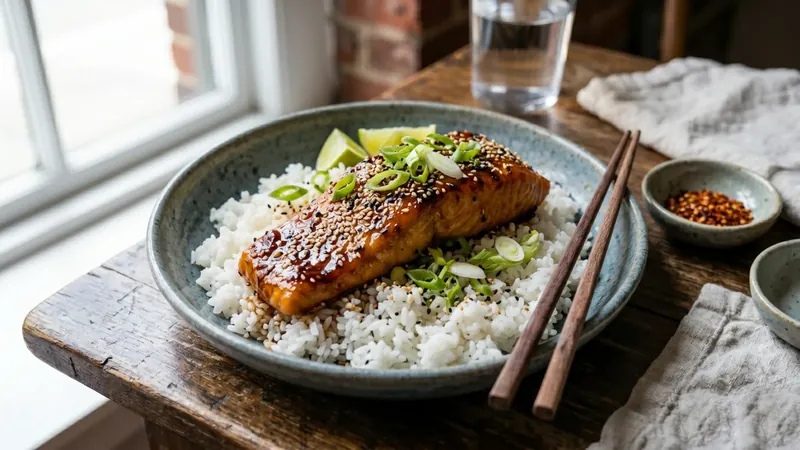
Farmed Atlantic salmon, left to its own devices on a standard aquaculture diet, has flesh that is pale — a wan, greyish beige, closer to cooked cod or a chicken breast than to anything you would call salmon-coloured. If a supermarket put that fillet in the chiller next to the deep coral one shoppers expect, it would sit there unsold. So salmon farmers add a pigment to the feed. The fish eat it, absorb it, and deposit it in the muscle, and over the months before harvest the flesh deepens to the familiar orange-pink. The pigment is a compound called astaxanthin, and for a long stretch of the industry’s history a related compound, canthaxanthin, was used alongside it.
The SalmoFan is the instrument that makes this a deliberate act. It was developed by Hoffmann-La Roche — the same Roche of the pharmaceutical world — whose vitamins-and-fine-chemicals division supplied much of the astaxanthin the industry ran on; that arm was later spun off and absorbed into the Dutch company DSM. The fan runs, in its standard form, from roughly swatch 20 at the pale end to swatch 34 at the deep, near-scarlet end. A producer picks a target number, calculates how much pigment the feed needs to hit it, and feeds accordingly. Retailers have preferences; a chain might specify that its salmon arrive at a 27 or a 29 because that is what its customers reach for. The colour is a product specification, agreed in advance, like the sugar content of a fizzy drink.
None of that is a rumour. It is how the industry openly works, described in feed-company literature and trade journals. If your instinct on first hearing it is a small recoil — the colour is fake, it’s been set by a marketing department — that instinct is responding to something real. The recoil is the interesting part. Follow it and it leads somewhere the outrage never goes.
What the word “dyed” quietly smuggles in
Here is the fork, and it turns on a single verb. To say salmon is dyed summons an image: a pale fillet going into a bath of red liquid, or a syringe of colouring pushed into the meat, the way a cheap kipper is painted or a maraschino cherry is soaked. That picture is what makes the fact feel sinister. It is also completely wrong, and the wrongness is not a technicality.
The fish is coloured from the inside, through what it eats, over the course of its life. Nothing is applied to the flesh. Astaxanthin is a carotenoid — the same broad family of fat-soluble pigments that makes carrots orange, tomatoes red and flamingos pink — and it colours the salmon by being metabolised and laid down in the muscle tissue, molecule by molecule, exactly as beta-carotene from carrots ends up in the fat of a well-fed chicken. Calling that “dyeing” is like saying a flamingo has been dyed, or that you dye yourself when you eat enough carrots to tint your skin. The mechanism is dietary all the way down, the same as in any body that colours itself from within.
And now the fact that dissolves the whole scandal, the one detail that turns the story inside out: wild salmon get their colour the same way. A wild Pacific sockeye is not born red either. It becomes red by eating krill, shrimp and other small crustaceans whose shells are loaded with astaxanthin, which the crustaceans in turn got from the microalgae at the bottom of the food chain — chiefly a green alga called Haematococcus pluvialis, which produces astaxanthin in staggering quantities when stressed, turning entire ponds blood-red. Salmon, wild or farmed, cannot manufacture astaxanthin themselves. Not one species of salmon can. Every pink salmon that has ever lived, in a river or in a pen, is pink because it ate the pigment. The wild fish eats it from krill; the farmed fish eats it from a pellet. The molecule deposited in the muscle is, in both cases, astaxanthin doing exactly the same job.
So the farmer adding pigment to feed is not faking a colour the fish would never have. He is supplying, through a manufactured pellet, the identical compound the animal would have got from a wild diet it no longer eats. The pale flesh of an un-supplemented farmed salmon is the unnatural state — a fish denied its normal food. The SalmoFan, for all that it looks like corporate cynicism, is the tool for putting back what the pen took away.
Nature-identical, and the fight over that phrase
There is a legitimate argument folded into all this, and it deserves to be stated fairly rather than waved away, because the people raising it are not cranks.
Most of the astaxanthin fed to farmed salmon is synthetic — manufactured industrially, historically from petrochemical feedstocks, which is why you will sometimes see the loaded claim that salmon is coloured with something “made from petroleum”. The chemistry here matters. Synthetic astaxanthin is described as nature-identical, meaning the molecule that comes out of the factory is the same molecule the alga makes; a carbon skeleton is a carbon skeleton whatever its origin. On that point the chemistry is genuinely settled. But there is a real subtlety underneath: astaxanthin exists in several three-dimensional mirror-image forms, called stereoisomers, and the mix a factory produces is not quite the mix Haematococcus produces. Wild salmon flesh is dominated by one particular form; synthetic astaxanthin is a roughly even blend of three. Whether that difference matters to human health is not well established either way, and honest sources say so.
That uncertainty has created a market. Some producers now feed astaxanthin from natural sources — from cultivated Haematococcus algae, or from a red yeast called Phaffia rhodozyma (Xanthophyllomyces dendrorhous) — and sell the result at a premium as more natural. The premium is real because algal astaxanthin is expensive to produce and the synthetic version is cheap. A sceptic can reasonably ask whether the premium buys a genuine benefit or just a better story. That is a fair question about sourcing and price. It is a completely different question from is my salmon painted with dye, and the viral version collapses the two, letting a real debate about stereoisomers and cost masquerade as a scandal about deception.
The one that was a genuine problem
The kernel-of-truth pieces on this desk earn their trust by conceding the real thing, and there is a real thing here that the food-fear posts almost never mention, probably because it is less dramatic than they would like.
For years the industry also used canthaxanthin, astaxanthin’s chemical cousin, as a cheaper way to push flesh colour toward the red end of the fan. Canthaxanthin is a permitted additive — it has been used to colour egg yolks and processed foods too — but in the 1990s it was linked, at high doses, to the formation of crystalline deposits in the human retina, a condition called canthaxanthin retinopathy, documented mainly in people who had taken large amounts of it in “tanning pills”. European regulators took the concern seriously. Around 2003 the European Union sharply cut the maximum level of canthaxanthin permitted in salmon and trout feed, on the advice of its scientific committee, precisely to keep dietary exposure well below any level of concern. Britain’s Food Standards Agency and the wider EU framework treat carotenoid feed additives as regulated substances with defined limits, reviewed periodically.
That episode is worth holding onto, because it is the shape of a real answer. A specific compound, used at the discretion of producers, raised a specific, evidenced safety question; a regulator looked at the toxicology and tightened the rules. That is the system working, and it is a world away from “they’re poisoning us with dye”. Astaxanthin itself has never carried the same flag — it is a permitted feed additive, it is also sold directly to humans as an antioxidant supplement, and it does the fish genuine good, protecting the eggs and tissues from oxidative damage in a way that matters to the animal’s health well beyond its appearance. The colour is a side effect of feeding the salmon something it biologically wants.
Why the fan chart feels like a confession
So why does the SalmoFan photograph keep going viral, when the underlying practice is this defensible? Because the image does something the facts cannot undo: it makes visible the moment a human being chooses the colour of a natural food, and choice reads as artifice.
We carry an unspoken assumption that the appearance of food is a truthful signal — that a red tomato is red because it is ripe, that a golden yolk means a well-fed hen, that the coral of a salmon fillet is the fish telling us it is good. When we discover a person with a swatch card standing between the animal and that signal, it feels like being lied to, even when the colour is chemically the colour the fish “should” be. The unease is really about the disenchantment of finding a decision, and a supplier, and a target number, in a place we imagined was just nature. The same jolt runs under a whole genre of food revelations: the discovery that the orange in a box of Kraft macaroni cheese came from a dye bottle, or the queasy internet-favourite claim about where a certain “natural” vanilla flavouring supposedly comes from. In each case the shock is out of proportion to the hazard, and in each case the shock is really about control — the sudden sight of the hand on the dial.
That is also why the salmon story rhymes so closely with the panic over genetically modified salmon. Both are stories about people intervening in a fish, and both get their charge from the feeling that the intervention is hidden. But a colour chosen from a fan is not a secret; it is a spec sheet, printed by the same regulatory apparatus that sets the limits on the pigment. The thing that felt like a cover-up turns out to be documented in a trade catalogue.
There is a version of the sceptic who is worth taking seriously through all of this, and it is the one who says: I would simply like to know. That person is right to want to know, and the food industry has often been slow to tell them, which is how a laminated colour card comes to feel like contraband when it is really just a tool. Consumer-preference studies, the ones the industry itself commissioned, found what everyone already suspected — put a pale fillet and a coral one side by side and shoppers overwhelmingly reach for the coral, and rate it as fresher and better-tasting before a bite is taken. The colour is added because we demand it. The fan chart is a portrait of our own eye, sold back to us at the fish counter.
None of which obliges anyone to prefer farmed salmon, or to stop asking where their astaxanthin was grown, or to shrug at an industry that took years to be candid about any of this. But it does rearrange the feeling. The correct response to the SalmoFan is a slightly vertiginous recognition that the redness we trusted as nature’s honest signal was always, in every salmon that ever swam, a message written in something the fish had eaten — and that the only real difference between the river and the pen is whether the krill came with a shell or a serial number.
Related Content