Ubåtsjakten: The Submarines Sweden Hunted and Never Caught
One Soviet submarine ran aground on the rocks. The hundreds Sweden chased for the next decade were harder to hold in the hand.
Contents
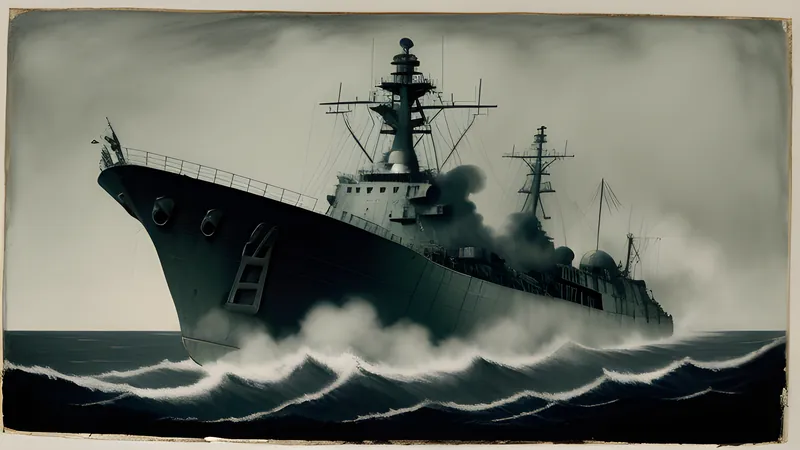
On the morning of 28 October 1981, fishermen in the archipelago outside Karlskrona, home to Sweden’s most important naval base, found something impossible sitting in the shallows of Gåsefjärden. A Soviet submarine, a Whiskey-class boat numbered 137, was aground on the rocks well inside Swedish territorial waters, in a restricted military zone she had no conceivable innocent reason to be near. She had run herself onto the stones in the dark and could not get off. For the Swedish press it was almost a gift, a headline that wrote itself in English as neatly as in Swedish: Whiskey on the rocks. For everyone else it was the moment a long-running national anxiety turned solid. Sweden had suspected for years that foreign submarines were slipping through its waters. Now one of them was stuck fast in daylight, flying the wrong flag, and there was no arguing with a hull on the rocks. The trouble was what came next — because after the one Sweden could touch, there came a decade of the ones it could not.
The boat on the rocks
The grounding of U 137, as the Swedes designated her, is the solid floor of this whole story, the piece of it that no amount of later revision can dissolve, and it is worth standing on firmly before anything wobblier is discussed.
The submarine was real, Soviet and exactly where she should not have been. Her commander, Anatoly Gushchin, offered the standard explanation of a navigational error, a failure of instruments that had carried the boat dozens of kilometres off course and deep into a defended zone by accident. Few in Stockholm believed it, and the Swedish military’s suspicion sharpened into something graver when technicians took gamma-ray measurements of the stranded hull from outside and detected the signature of uranium-238. The reading strongly indicated that U 137 was carrying nuclear weapons — most likely nuclear-tipped torpedoes — sitting on the rocks a short distance from a Swedish naval base. A Warsaw Pact submarine, probably nuclear-armed, aground in a restricted Swedish military area was not a rumour or an inference. It was a fact the whole world could photograph.
The standoff lasted about ten days. Swedish naval officers boarded to question the commander; Soviet warships gathered menacingly at the edge of Swedish waters; the prime minister’s government held its nerve. In early November the Swedes let the submarine be towed off the rocks and escorted out to sea, having extracted their diplomatic humiliation of Moscow and learned as much as a stranded boat could teach them. The incident was genuine, documented from every angle, and it settled one thing beyond dispute: at least one foreign submarine really had been in Swedish waters where it had no right to be. That single certainty would do an enormous amount of work over the years that followed — more, in the end, than it could honestly bear.
The hunt that followed
If one submarine had been caught, how many had not? That question, entirely reasonable in the autumn of 1981, set the tone for the whole decade, and it turned the Swedish navy into a service organised around a hunt.
The following year the hunt reached its peak. In October 1982, in the waters of Hårsfjärden near the Muskö naval base south of Stockholm, Swedish forces became convinced they had trapped one or more intruding submarines in a confined bay. For weeks they hunted. Depth charges and anti-submarine mines were detonated; helicopters and surface ships crisscrossed the fjord; the nation followed every muffled explosion on the evening news. And at the end of it, nothing surfaced. No submarine was forced up, no wreck was found, no crew was captured. The hunters were certain their quarry had been there and had somehow slipped away, but the sea that had handed over U 137 whole gave up nothing at Hårsfjärden at all.
The political response was to appoint a commission. The Submarine Defence Commission, chaired by the former defence minister Sven Andersson, reported in 1983, and its conclusions hardened suspicion into official truth. The commission held that Warsaw Pact submarines — Soviet submarines, in plain terms — had systematically violated Swedish territorial waters, and it went further, describing evidence of small submarines and even bottom-crawling tracked vehicles moving across the seabed of Swedish fjords. It was a grave finding delivered to a grave audience. The prime minister, Olof Palme, lodged a formal protest with Moscow. Sweden’s careful Cold War neutrality had been treated by the Soviet Union with contempt, the report implied, its coastline used as a training ground by an enemy that denied everything. For most Swedes, and for most of the Western press, the matter was closed. The Russians were under the water, in numbers, and only the luckless crew of U 137 had ever been dragged into the light.
The fork: when the evidence was weighed again
Here the solid floor gives way, and it is important to describe the collapse carefully, because it is not a matter of anyone having lied. It is a matter of how a hunt, once begun, teaches its hunters to hear.
The certainty of the 1980s rested largely on sound. Foreign submarines were rarely seen; they were heard, or rather their presence was inferred from hydrophone recordings and sonar contacts, from a characteristic acoustic signature that Swedish analysts had come to associate with an intruding boat. Over the following years, as the political heat cooled and independent researchers were allowed to re-examine the raw material, that association began to come apart. In the 1990s a fresh government inquiry took the recordings back to first principles, and bioacousticians, among them the Danish-Swedish researcher Magnus Wahlberg, tested what could actually produce the signature sounds. The unsettling answer was that the classic “typical” noise attributed to a hostile submarine could be reproduced by ordinary things in the water — the movement of civilian vessels, air escaping from the seabed, and, most famously and most awkwardly, mink swimming at the surface. The very sound that had been treated as a fingerprint of Soviet intrusion turned out to have innocent authors.
In 2001 the independent investigator Rolf Ekéus delivered the reckoning. His inquiry concluded that the great mass of acoustic evidence for foreign submarines was far weaker than the 1983 commission had believed, that many contacts had innocent explanations, and that the confident attribution of hundreds of violations to the Soviet Union could not be sustained on the evidence that actually existed. The seabed “tracks” that had so alarmed the earlier commission looked, on re-examination, like ordinary features of the bottom rather than the trails of crawling machines. This did not prove that no foreign submarine had ever entered Swedish waters after 1981 — U 137 was permanent proof that at least one had, and it remains entirely plausible that others did. What dissolved was the scale and the certainty, the sense of a coastline swarming with intruders that the nation had lived with for twenty years. A single real grounding had been extrapolated into a phantom fleet, and much of the fleet, when weighed again, turned out to be mink and misread noise and the amplifying pressure of a country that had already made up its mind.
What the hunt was really about
To leave it there — Swedish sonar operators mistook wildlife for warships — would be to miss the whole human truth of the thing, and to fall into exactly the sneer this desk exists to avoid. The submarine hunt was not a foolish error. It was a small, exposed, neutral nation making its dread audible.
Sweden in the early 1980s sat on the seam of the Cold War, unaligned by long tradition, sharing the Baltic with a superpower whose intentions it could not know and whose navy it could not match. Neutrality is a comfortable posture only when the great powers respect it, and U 137 was living proof that they might not. Once a Soviet submarine, probably carrying nuclear weapons, had been photographed on the rocks near Karlskrona, every subsequent shadow in the water inherited that image’s weight. A country does not misplace a stranded nuclear-armed submarine. Having seen one, how could its sailors not hear more of them in every ambiguous echo? The hunt was the physical form of a real and rational fear: that the neutrality on which Swedish security depended was being quietly violated by a neighbour who would deny it to the end.
That is the human need underneath the phantom fleet — the need to make an invisible threat visible, to convert an unbearable uncertainty into a target that could at least be depth-charged. It is the same machinery that turns any genuine adversarial secrecy into a suspicion that outruns its own evidence. Sweden’s error was of the same species as the one that hardened a real corridor of intelligence deception into total conviction after the Gulf of Tonkin engagement that only half happened, and the same reflex by which real, documented clandestine programmes seed sprawling belief far beyond what the files support, as with MKUltra and the mythology it left behind. A true kernel — one boat, one grounding, one gamma-ray reading — gave every later ambiguity permission to become a certainty.
There is a wilder branch of this story worth naming plainly, because it exists and because honesty requires it. The Norwegian scholar Ola Tunander argued in The Secret War Against Sweden that some of the intrusions were Western rather than Soviet — deniable American and British operations designed to frighten Sweden and pull its sympathies towards NATO. The claim is contested and unproven, and most historians treat it with heavy caution; it is included here as a documented hypothesis that has never been substantiated. But it points at the deepest irony of the whole affair. In a hunt where almost nothing was ever caught, the identity of the quarry was as uncertain as its existence, and a nation sure it was being menaced by the East could not fully rule out that some of the ghosts wore the colours of the West.
The one that stayed on the rocks
Everything in the Swedish submarine story resolves back to the difference between the boat that grounded and the boats that did not. U 137 was real, Soviet, probably nuclear-armed, and stuck fast where the whole world could see her, and no revision will ever move her off those rocks. She is the reason the fear was legitimate and the hunt was not absurd. The hundreds of intrusions that followed her were another kind of thing entirely — a mixture, we can now say, of some genuine violations that will never be counted, a great deal of honestly misread sound, and the swimming of mink through cold water at night, all of it fused by a small country’s rational terror into the shape of an enemy fleet.
The lesson is not that the Swedes were credulous, because they were not; they had photographed the reason for their fear. The lesson is subtler and harder to live with. A single undeniable fact can license a decade of certainty that the fact itself never justified, and the more real the kernel, the more convincing the extrapolation feels from the inside. Sweden hunted its ghosts because one of them had once been solid. That it never caught another does not mean it was foolish to look. It means only that dread, once given a real object, will keep finding that object in the water long after the water has gone quiet.
Related Content