The Wow! Signal: Six Minutes That Never Repeated
A red-inked exclamation on a computer printout became humanity's favourite ghost
Contents
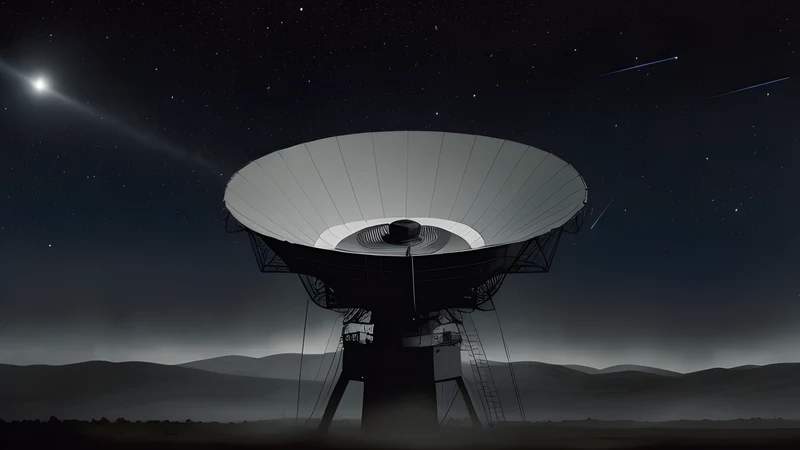
On 15 August 1977, a radio telescope in Ohio spent seventy-two seconds listening to a patch of sky in the constellation Sagittarius and heard something it was built to hope for. Nobody was in the room. The telescope, a Big Ear array run by Ohio State University, recorded to a line printer, and the printout sat in a stack for a few days until a volunteer astronomer named Jerry Ehman ran his eye down the columns of numbers. Most of the page was the low murmur of empty sky, rendered as ones and twos and the occasional low letter. Then a single vertical run leapt out: 6EQUJ5, a sequence encoding a signal that rose smoothly to more than thirty times the background noise and fell away again. Ehman circled it in red pen and wrote one word in the margin: Wow!
That margin note gave the signal its name and, arguably, its immortality. Because in the forty-odd years since, the Big Ear telescope has been dismantled and the site turned into a golf course, and the Wow! signal has never come again. Every serious attempt to re-detect it — and there have been many, some with vastly more sensitive instruments — has heard nothing. It remains the single most tantalising candidate signal in the history of the search for extraterrestrial intelligence, and it remains exactly one data point. This piece is about why one data point, and the silence after it, turned into a legend that outlived the telescope that caught it.
The signal, told straight
The Big Ear worked by lying still and letting the Earth’s rotation sweep the sky past its field of view. Any fixed cosmic source would therefore drift through the beam and produce a signal that rose and fell in a very particular shape over about seventy-two seconds — up for the first half as the source entered the beam, down for the second half as it left. The Wow! signal has exactly that shape. Whatever produced it behaved like something out in space, turning with the sky, and not like an aircraft, a passing satellite, or interference from the ground, all of which leave different fingerprints.
It was narrowband, concentrated in a single sliver of frequency near 1420 megahertz. That number matters more than any other in the story. It is the frequency at which neutral hydrogen, the most abundant substance in the universe, naturally radiates — the “hydrogen line,” a landmark every technological civilisation with a radio telescope would know. SETI theorists had argued for years that if anyone wanted to broadcast a beacon and be found, this quiet, universal frequency was the obvious dial to set it to. The Wow! signal sat almost exactly there. It looked, in other words, like the message people had told themselves to expect.
And then it did not repeat. Big Ear actually observed the same patch of sky a second time during the same pass, through a second feed horn a few minutes behind the first — and heard nothing. Ehman himself, ever the careful scientist, spent years resisting the excitement his own margin note had caused, and repeatedly warned that a single unrepeated event proves very little.
The fork
Here is where the story branches away from the modest thing the data can bear. What Big Ear recorded is a narrowband signal from the direction of Sagittarius that appeared once, lasted seventy-two seconds, matched the expected profile of a celestial source, and never returned. That is the entire evidentiary content. Every larger claim is an interpretation laid on top of it, and the interpretations have grown far heavier than the foundation.
The most famous reading — this was a deliberate transmission from another civilisation — is not supported by the data, and it is not refuted by it either, and that combination is the engine of the whole legend. A real message would presumably be sent more than once; a beacon that fires for seventy-two seconds and never again is a strange sort of beacon. But the silence has a dozen innocent explanations. A one-off natural burst. A momentary, never-repeated piece of interference of terrestrial origin that happened to mimic a sky source. A signal that was real and celestial but transient, the astronomical equivalent of a single lightning flash.
There is even a lingering ambiguity about where, exactly, to look. Big Ear had two feed horns, and because of how the recording worked it was never fully certain which one caught the signal — leaving two candidate patches of sky a few minutes apart, both in Sagittarius, both plausible. In 2020 the amateur astronomer Alberto Caballero trawled the European Space Agency’s Gaia star catalogue across that region and singled out one sun-like star, catalogued as 2MASS 19281982-2640123, as a candidate origin worth a closer look. It was a careful, modest piece of work, and it changed nothing about the underlying problem: a promising direction is not a detection, and pointing a telescope there since has turned up only ordinary silence.
Scientists have chased each of these. The most substantial recent attempt came in 2017, when astronomer Antonio Paris proposed that a passing comet’s hydrogen cloud could have produced the signal, and got a wave of headlines; the SETI community examined the claim and largely rejected it, since comets do not radiate that way at that intensity and the geometry did not fit. In 2024 Paris and others revisited the original data with modern reprocessing and suggested the source might have been a sudden brightening of interstellar hydrogen itself, stimulated by a distant flare — a natural astrophysical event rather than a message. That work is ongoing and contested. What none of it does is deliver the clean confirmation, in either direction, that would let the story end.
Who carried it, and why it grew
The Wow! signal became folklore for reasons that have very little to do with radio astronomy and everything to do with the shape of the thing. It has a name — a good one, human and spontaneous, a scientist’s involuntary gasp preserved in red ink. It has an image, that circled 6EQUJ5, which is genuinely striking to look at even if you cannot read it. It has a location you can point to, a constellation with a myth-heavy name. And, above all, it has a permanent open ending: it cannot be confirmed because it never repeated, and it cannot be dismissed because the one detection was clean. A mystery that can be neither solved nor closed is a mystery with an unlimited shelf life.
The signal even earned the rarest tribute a piece of folklore can receive: an attempt to answer it. In 2012, marking the detection’s thirty-fifth anniversary, the Arecibo Observatory beamed a reply toward the original coordinates — a transmission carrying some ten thousand messages crowdsourced from the public, encoded and aimed at the patch of Sagittarius where the printout said something had once been. It was a gesture more than an experiment, and everyone involved knew it, but the impulse behind it is the whole story in miniature: a signal we cannot verify, answered anyway, on the off chance that someone is still there.
It travelled the way modern legends travel. It surfaced in popular-science books, then documentaries, then the endless recirculation of the internet, where the circled printout became one of those images that carries its whole story in a glance. Along the way the careful hedges fell off. Ehman’s own repeated insistence that it might well be terrestrial rarely survives the retelling; what survives is the astronaut-movie version, a signal from Sagittarius that they sent and never sent again. The signal became a kind of secular ghost story, and like the best ghost stories it improves with each telling and resists every attempt to lay it to rest.
The pattern is familiar to anyone who has watched an unexplained event refuse to die. It is the same appetite that keeps insisting the empty forest of the Tunguska event must have hidden a spacecraft, and the same intolerance of an unmeant accident that keeps re-solving the Dyatlov Pass deaths with new villains each decade. A gap in the record is a vacuum, and human attention rushes to fill it.
The search itself deserves its due here, because the discipline that caught the signal is the same one that has refused to inflate it. SETI grew out of a modest, almost austere idea, laid down by Giuseppe Cocconi and Philip Morrison in a 1959 paper in Nature: if anyone is signalling, the hydrogen line is the rational place to try, and the honest thing to do is listen and report. Big Ear ran on a shoestring, staffed largely by volunteers like Ehman, for the plain reason that the question was worth asking even at long odds. When the signal came, the same austerity governed the response — repeat observations, quiet checks, decades of restraint. The people best placed to trumpet the Wow! signal as first contact are precisely the ones who have spent forty years refusing to, and their restraint is a quiet act of respect for the thing they are hunting.
What it is really about
The Wow! signal endures because it sits on the exact fault line of the thing we most want to know and most fear the answer to: are we alone? For seventy-two seconds in 1977 the answer appeared to be no, printed out in a language of letters and numbers, at precisely the frequency we had reasoned an unknown mind might choose. And then, for every second since, the answer has been silence — not a “no,” just an absence, which is somehow worse, because absence can always be hoped against.
That is the true content of the legend. It is really a portrait of us: a species that built an ear the size of three football fields, pointed it at the sky, and caught one ambiguous whisper that it has been unable to either verify or forget for two generations. The signal is a Rorschach blot at 1420 megahertz. The optimists see contact; the sceptics see interference; the honest see a single, beautiful, unrepeatable event that the universe has declined to explain.
The most human detail in the whole affair is the red pen. Jerry Ehman did not write “candidate signal, requires verification.” He wrote Wow! — the reflex of a person who, for one unguarded moment, believed. He spent the rest of his life being scrupulously cautious about what he had found, and the caution is admirable, and it never had a chance against that margin note. We remember the gasp and forget the disclaimer. The Wow! signal is what it feels like to hope, caught in the act and circled in red, still unanswered on a page from a printer that no longer exists.
Related Content