The Wendigo: How a Sacred Warning Became a Monster
A famine-country teaching about greed, stripped of its meaning and reissued as an antlered forest cryptid.
Contents
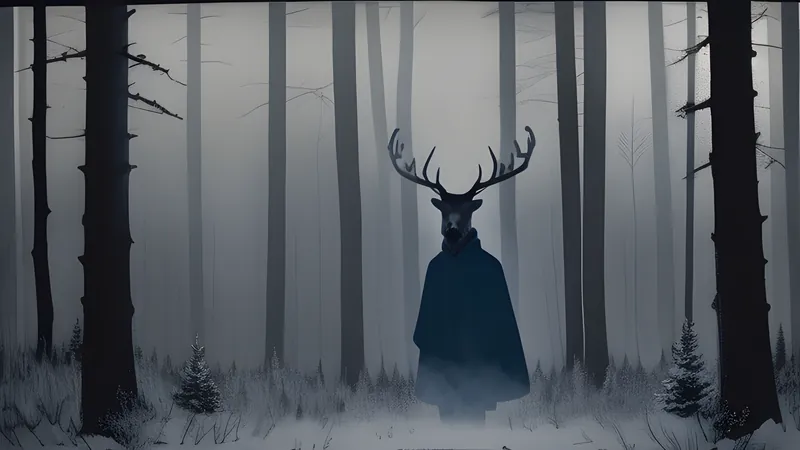
Open a horror game, a cryptid podcast or a certain kind of found-footage film made in the last fifteen years and there is a decent chance you will meet a version of the same creature: tall, gaunt, deer- or elk-skulled, stalking through snow-heavy pine forest with an appetite for human flesh, its presence signalled by a cold that has nothing to do with the weather. It is usually called a wendigo. It is usually described as an ancient Native American legend, spoken of the way one might mention Bigfoot or the chupacabra — a regional monster to be catalogued alongside the others. What almost none of these tellings acknowledge is that the wendigo is not folklore in the sense that a campfire story is folklore. It began, and for many Anishinaabe, Cree, Ojibwe and other Algonquian-speaking communities continues, as a living moral and spiritual concept — one that horror fiction spent the twentieth century quietly hollowing out and refilling with something else entirely.
What the windigo actually is
In the oral traditions of the Algonquian-speaking peoples of the northern United States and Canada — a language and cultural family stretching from the Great Lakes into the boreal forests of Ontario, Quebec and Manitoba — the windigo (the spelling varies by community and language: windigo, wiindigoo, weendigo, wetiko) is bound up with the hardest fact of life in that country: winter famine. The northern forest offers little in deep winter, and communities that depended on hunting could and did face stretches of genuine, life-threatening starvation. Out of that reality grew a figure that embodied its worst possible outcome — a person so consumed by hunger, or by greed more broadly, that they crossed into cannibalism, and in doing so transformed into something monstrous: a gaunt, ice-hearted, endlessly hungry being that could never be satisfied, growing larger with every person it consumed rather than being sated by them.
The spelling variance is itself worth pausing on, because it is a small marker of how many distinct communities and languages actually hold a version of this figure. Windigo traditions are documented among the Ojibwe, Cree, Naskapi, Innu and Saulteaux, among others, spread across a territory that runs from the Great Lakes north and east into subarctic Canada — related peoples, related languages, but not one single monoculture with one fixed story. A popular retelling that flattens all of this into a single “Native American legend,” as though “Native American” named one culture rather than hundreds, is already committing a smaller version of the same erasure it goes on to commit with the creature’s meaning.
Crucially, the windigo in its original context is as much a moral category as a literal monster. Anthropologists and Indigenous scholars who have documented windigo traditions across different Algonquian communities describe a figure that represents the corrosive endpoint of selfishness in a society organised around communal sharing of scarce resources — a warning less about a creature in the woods than about what winter scarcity can do to a person’s character, and a taboo so absolute that the mere accusation of “windigo-like” behaviour, hoarding food while others starved, refusing to share, showing the wrong kind of hunger, carried real social weight. The being is not simply evil the way a slasher-movie killer is evil. It is a specific, culturally coherent answer to the question of what happens to a person who lets greed win against the ethic that kept small, isolated communities alive through the worst months of the year.
Windigo psychosis and the limits of the record
The concept had a documented, and controversial, afterlife in Western psychiatry. In the nineteenth and twentieth centuries, missionaries, fur traders and later anthropologists working in Algonquian territory recorded cases of what came to be called “windigo psychosis” — a supposed culture-bound syndrome in which an individual developed an overwhelming, terrifying compulsion to eat human flesh, sometimes accompanied by a delusion that they were transforming into a windigo themselves. A number of documented legal cases from the eighteenth through early twentieth centuries record Algonquian communities executing a member believed to have windigo psychosis, reasoning that the transformation, once begun, was irreversible and the danger to the group too great to risk.
The best-documented individual case is that of Swift Runner, a Cree hunter and sometime guide for the North-West Mounted Police, who in the winter of 1878 killed and ate six members of his own family near Fort Saskatchewan in what is now Alberta while camped only a day’s travel from a Hudson’s Bay Company post stocked with food. Swift Runner confessed at trial and was hanged at Fort Saskatchewan in December 1879, the first judicial execution in what would become Alberta, and his case is still cited in the psychiatric and anthropological literature as the clearest instance of the syndrome on record. His proximity to a stocked trading post is exactly what makes the case resist a simple reading of starvation-driven desperation alone; something beyond plain hunger appears to have been at work, and the specific, culturally shaped horror of windigo transformation remains part of how historians have tried to account for it.
The anthropological status of windigo psychosis as a genuine, distinct psychiatric syndrome has been seriously questioned since at least the 1980s, when researchers including Lou Marano argued that the diagnosis had been substantially overstated and in some cases fabricated or misunderstood by outside observers who arrived already expecting to find a “primitive” pathology to catalogue. Marano’s position is that extreme scarcity and social crisis around a genuine famine explains most documented cases better than any distinct mental illness does. The debate matters less for its clinical verdict than for what it shows: even the “scientific” version of the windigo story was shaped by outsiders bringing their own expectations to a culture they were studying, listening for confirmation of what they already believed rather than to the community itself — a pattern that would recur, at much greater scale and with much less scholarly care, in what happened to the windigo next.
The fork: from spiritual teaching to franchise monster
The wendigo’s journey into mainstream popular culture runs through a fairly traceable set of gates, and each one strips away another layer of the original meaning. Algernon Blackwood’s 1910 short story “The Wendigo” is usually credited as the creature’s literary debut in English, and it already shows the transformation under way: Blackwood, an English writer with no Algonquian background, borrowed the name and a vague sense of a forest terror while inventing most of the specifics — supernatural flight, a burning smell, a voice calling a man’s name in the wilderness — that owe more to Blackwood’s own taste for cosmic horror than to any documented tradition. From there the wendigo entered pulp horror and comics; Marvel introduced its own “Wendigo” as a hulking, furred monster-of-the-week in 1973, thoroughly divorced from any moral content, and by the 2000s the antlered-skull silhouette now treated as definitive had crystallised largely through video games, horror films and internet cryptid culture rather than through any Algonquian source.
That antlered or elk-skulled appearance is, on the specific evidence, an almost entirely modern invention. Traditional oral descriptions of the windigo vary by community and are often deliberately non-visual or genuinely terrifying in ways that resist a simple monster-design summary; the sleek, deer-skulled, quasi-elegant creature now ubiquitous in games and films appears to owe far more to modern horror-design conventions, and possibly to conflation with unrelated animal imagery, than to any documented indigenous account. A largely invented visual signature has been backfilled onto the name and then presented, again and again, as ancient tradition — the fork where a spiritual concept became a commercial monster design with the serial numbers left conveniently vague.
Why this particular erasure matters
Algonquian communities and Indigenous scholars have been vocal, particularly since the 2010s, about the wendigo’s use in mainstream horror as a clear case of cultural appropriation rather than harmless creative borrowing. The critique is specific rather than a blanket objection to outsiders ever writing about Indigenous culture: the windigo is not a neutral monster available for any studio or novelist to reskin, because for many communities the concept retains active spiritual and cultural weight, tied to real teachings about famine, community obligation and the danger of unchecked greed, and its casual commercial use — divorced from context, often alongside genuinely offensive stereotyping of Native characters and settings in the same properties — causes real harm to communities already contending with the more general erasure and misrepresentation of Indigenous culture in North American popular media. Author Chadwick Allen and other Indigenous studies scholars have pointed out that the pattern is a familiar one: a living tradition treated as though it were public-domain folklore simply because it originates outside the dominant culture, stripped of the community context that gave it meaning, then sold back as generic “Native American legend” packaging.
It is worth being precise about what the critique is and is not. It is not a claim that non-Native writers can never engage with Indigenous stories, and it is not a demand that the windigo vanish from fiction altogether — some Indigenous writers, including Ojibwe author Louise Erdrich, have themselves drawn on windigo imagery in their own work, from inside the tradition, with the context intact. The distinction that keeps recurring in Indigenous critique is between engagement that acknowledges the tradition’s origin, weight and living community, and extraction that treats a name as free raw material for a monster design, discards the moral content that made the figure meaningful in the first place, and calls the result ancient folklore.
What the flattening actually erases
Compare the windigo’s journey with something like Slender Man, a figure invented from nothing in 2009 on an internet forum with no prior tradition to misrepresent — its entire meaning is contained in its short, well-documented history, and nobody can accuse its creators of erasing anything because there was nothing there before them. The windigo is the opposite case: a monster that already had a coherent, well-documented meaning, attached to a specific set of living communities, before commercial horror culture arrived and quietly swapped that meaning for a more marketable one. The mechanics resemble how Mothman went from a specific, dated 1966 sighting to a generalised cryptid brand — a real, particular thing flattened by repetition into a genre convention — except the windigo’s flattening erases an active spiritual teaching rather than a regional news story, which is a meaningfully higher cost.
What gets lost in the antlered-skull version is the entire point of the original concept. A windigo, properly understood, is a warning about what a person from inside the community might become if they let hunger curdle into greed and let greed override the obligation to share — a threat generated from within, not a monster that arrives from outside to menace innocent travellers. That is a genuinely sophisticated piece of moral thinking, forged specifically for the conditions of northern winter scarcity, and it survives today as a living teaching in the communities that produced it. The forest monster with the elk skull that shows up in a horror game knows none of that history and needs none of it to sell tickets, which is precisely the problem: a teaching built to keep people honest with each other during famine has been repackaged as a jump scare, and the repackaging works exactly as well without anyone involved having to learn what it used to mean.
Related Content