The Wendigo and the Colonial Retelling
How an Algonquian teaching about famine and greed became a skull-faced horror monster
Contents
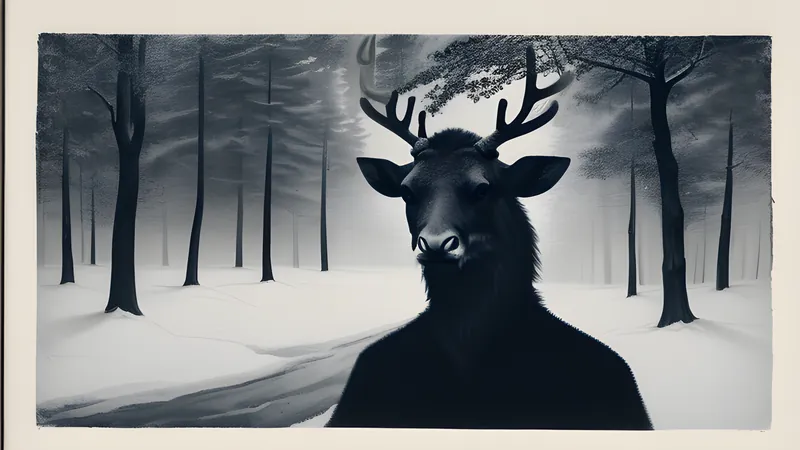
In the version most people now carry, the Wendigo is a towering thing that stalks snowbound forests: a gaunt, decaying body crowned with the antlers and long skull of a deer, hollow-eyed, driven by an endless hunger for human flesh. It appears in video games, in horror films, in television and countless online retellings, and its image, half-starved corpse and half-stag, is instantly recognisable. It is genuinely frightening, and its popularity is easy to understand. But this creature, the antlered monster of modern horror, is a young invention, and behind it lies something older, more coherent and far more interesting: a moral teaching from the Algonquian-speaking peoples of the northern woodlands, quietly scooped hollow and refilled with Hollywood.
The task here is a folklorist’s, which means tracing how a story travelled and what happened to it along the way. It is worth saying plainly at the outset that the original belief belongs to living peoples, the Ojibwe, Cree, Innu and other Algonquian-language nations of the Great Lakes and the subarctic, and is not a piece of dead mythology to be picked over. The point of following its journey is to understand both why the traditional teaching was so powerful and why its stripped-down descendant became such a durable monster.
The teaching, told straight
Among the Algonquian peoples of the cold northern forests, the windigo, a name spelled many ways, including wiindigoo and wetiko, is a being bound up with winter, starvation, greed and the deepest of taboos: cannibalism. Descriptions vary across nations and storytellers, but the traditional windigo is broadly a giant, emaciated to the point of skeletal, its skin drawn tight and grey over its bones, sometimes described as made of or encased in ice, reeking of death and decay. It is defined above all by insatiable hunger. However much it eats, it starves; the more it consumes, the larger it grows, so that it can never be filled.
That image is a precise piece of moral engineering for a people who lived through long, lethal northern winters. A community snowed in for months, its food stores finite, depended for survival on sharing, restraint and the absolute refusal of the one act that would tear the group apart: eating another human being. The windigo is the embodiment of everything that threatens such a community. A person who gave in to selfishness, who hoarded while others starved, or who in the extremity of famine turned to cannibalism, was said to risk becoming windigo, or being possessed by its spirit, their humanity consumed by an appetite that could never be satisfied. The Ojibwe scholar Basil Johnston, who wrote about the windigo from within the tradition, framed it as a warning against greed and excess, a monster that grows more ravenous the more it devours. It is, in effect, a story a culture tells itself to make hoarding and selfishness unthinkable, and to keep the group alive through the dark of the year.
The kernel of real terror
The windigo was more than a metaphor; it grew out of genuine, documented dangers, and this is the kernel that gives it weight. Famine was real. Northern winters did kill, and there are historical records from the fur-trade era and after of Algonquian communities facing starvation, and of rare, terrible cases in which isolated, starving individuals did resort to cannibalism. Within the culture, such a person might be understood to have become windigo, and there are recorded instances of individuals who, fearing they were turning, asked to be killed, or who were killed by their own communities as a protective act when they were believed to have crossed the line and become a danger to everyone around them.
One of the most cited episodes is that of Swift Runner, a Plains Cree man executed in Alberta in 1879 after killing and eating members of his family during a winter of hardship, a case complicated by the fact that he was not, in the event, far from food. Cases like his sat at the intersection of real famine, real violence and a cultural framework that had a name and a meaning for what had happened. The windigo, in other words, described something that genuinely occurred at the edge of survival, and gave a community the means to recognise the threat, mourn it, and act against it. This is a belief that did real work in the world.
The fork: where the retelling breaks off
The departure from this coherent tradition can be dated with some confidence, and it runs through outsider literature into modern mass media. A pivotal moment was the 1910 short story “The Wendigo” by the English writer Algernon Blackwood, a masterpiece of atmospheric horror set in the Canadian bush, which reframed the being as a nature-spirit of terror and wild flight for a Western reading public. Later horror writers, including August Derleth in the Lovecraftian tradition, absorbed the creature into the pulp bestiary. From there it passed into comics, role-playing games, films, and the vast folklore engine of the internet.
Along that journey the windigo lost its moral centre and gained a set of antlers. The traditional creature is overwhelmingly described as a gaunt giant or ice-being of roughly human shape; the now-ubiquitous image of a deer skull and antlers atop a skeletal body has no secure basis in the older Algonquian descriptions and appears to be a modern accretion, plausibly a conflation with other creatures and with generic horned-beast horror imagery, cemented by video games and online art in the twenty-first century. More importantly, the ethical heart drained away. The pop-culture Wendigo is a generic flesh-eating monster, a thing to be shot or outrun. The teaching about greed, restraint and the survival of the community, the entire reason the windigo existed, simply fell out of the retelling, leaving a scary costume with nothing inside it.
Western anthropology added its own distortion. In the mid-twentieth century, scholars proposed “windigo psychosis” as a culture-bound mental illness in which Algonquian individuals developed a compulsion to eat human flesh. The category was later dismantled by the anthropologist Lou Marano, whose influential 1982 study argued that it was largely an artefact of the anthropologists’ own assumptions, built from second-hand reports and the framework of the observers, describing a disorder that the evidence did not support as a widespread clinical syndrome. The academic “wendigo psychosis” turned out to be its own kind of colonial retelling, a monster assembled out of outside expectations rather than lived experience.
How the antlers arrived
It is worth following the modern chain link by link, because the mutation is unusually traceable. After Blackwood gave the creature literary respectability in 1910 and the pulp writers absorbed it, the twentieth century handed the windigo to mass entertainment. Marvel Comics introduced a hulking white-furred Wendigo in the 1970s, a curse-monster with no deer skull and little of the tradition beyond the name. Stephen King wove the windigo’s cannibal hunger into the dread of Pet Sematary in 1983, keeping the association with the dead and with appetite. Television series such as Supernatural built episodes around a fast, forest-dwelling Wendigo, and the 2015 video game Until Dawn offered a generation its most vivid image yet: pale, emaciated, screeching Wendigos climbing through a snowbound mountain lodge.
The antlered, deer-skulled silhouette that now dominates online art seems to have crystallised largely in this internet-and-gaming era, spread through concept art, creepypasta and social media until it felt ancient. It fuses the windigo’s starvation with the visual language of horned nature-demons and of other misappropriated figures, producing a striking hybrid with a very short pedigree. The speed of that spread is a lesson in how modern folklore forms: an image repeated often enough across enough screens acquires a false antiquity, and people begin to insist it is the “real”, traditional Wendigo, precisely because they have seen it everywhere. The internet does in a decade what oral tradition once did over generations, and it does it without any of the cultural guardianship that once kept a teaching intact.
What gets lost in that acceleration is the difference between a story a people tells about themselves and a story told about them by others. The Algonquian windigo was answerable to the community that held it; each retelling passed through people who understood what it was for. The pop-culture Wendigo answers only to the market for horror, and the market has no reason to preserve a moral about restraint when a screaming skeleton sells better. The image thrives; the meaning starves, which is a fate the windigo itself might have recognised.
What each version is really about
The two Wendigos endure for different reasons, and both are worth taking seriously. The traditional windigo persists because it is a genuinely sophisticated ethical technology, a way of encoding the values that keep people alive through scarcity into a figure vivid enough to be unforgettable. Some Indigenous thinkers have extended it as a diagnosis of the wider world: the scholar Jack D. Forbes, in Columbus and Other Cannibals, used the wetiko concept to describe a sickness of endless consumption and exploitation, reading colonial and corporate greed itself as a kind of windigo, a hunger that devours land and people and only grows. Understood this way, the windigo becomes a critique, and a strikingly modern one, of the appetite that consumes without ever being satisfied.
The horror-movie Wendigo endures for reasons that are also real, if shallower. Hunger and the fear of being eaten are among the oldest terrors we have, and a starving thing in a frozen forest touches the primal dread of the wilderness in winter, of being lost and cold and hunted. The antlered skull-monster is a superb piece of visual horror, and the people who love it are inheriting a version that reached them already stripped and reshaped; there is nothing foolish in being frightened by a well-made monster. The distortion belongs to a long process of retelling by outsiders who kept the fear and discarded the meaning, with no individual fan to blame.
That process is itself the real story here, and it is a common one. Sacred and serious traditions of Indigenous peoples have repeatedly been mined for their surface imagery and sold back as entertainment with their substance removed, as has happened with the appropriation surrounding the Skinwalker Ranch industry and its borrowing of Navajo belief. A folklore that once carried a community’s survival wisdom becomes a costume, a jump-scare, a piece of content. The windigo shows the mechanism with unusual clarity, because we can still see both ends of the chain: the coherent teaching at the source, and the hollowed monster at the far end.
So the Wendigo walks the frozen woods of a thousand screens, antlered and starving, and it is worth pausing before it to remember what it once meant. The image is compelling because it sits on top of something profound: a people’s hard-won knowledge that unchecked hunger, for food or for wealth, destroys the person who feels it and everyone who depends on them. The modern monster keeps the shiver and forgets the wisdom. Recovering that wisdom, and honouring the living peoples who carry it, is the more rewarding kind of fear the story still has to offer. For other legends that changed meaning as they travelled across cultures and centuries, see how La Llorona, the weeping woman, crossed centuries, and how the Nain Rouge became Detroit’s red dwarf of doom.
Related Content