The War of the Worlds Panic: What the Broadcast Actually Caused
A nation of millions did not run screaming into the night — so who decided that it had?
Contents
At eight o’clock on the evening of Sunday 30 October 1938, a twenty-three-year-old Orson Welles sat in a Columbia Broadcasting System studio in New York and told the United States that Martians had landed in New Jersey. The programme was The Mercury Theatre on the Air, an hour-long adaptation of H. G. Wells’s 1898 novel, restaged as a sequence of increasingly frantic news bulletins interrupting an evening of dance music. Cylinders fell near a farm at Grover’s Mill. A reporter described a tentacled thing emerging. A heat-ray incinerated the crowd. By the time Welles broke character to wish everyone a happy Halloween, the legend holds, a continent had already gone mad with fear — people fleeing cities, clutching rosaries, loading rifles, phoning police, some reportedly close to suicide.
It is one of the most retold stories in the history of mass media, cited for eighty-odd years as proof that broadcasting could hijack the collective mind. The trouble is that the panic, in the shape everyone remembers it, does not survive contact with the evidence. What did survive, and thrived, was the story about the panic — and the reasons that story was told, and repeated, and never quite allowed to die, turn out to be more revealing than any stampede.
The evening the Martians landed
The broadcast itself is real and worth taking on its own terms, because Welles and his writer Howard Koch genuinely built something clever. They moved H. G. Wells’s Victorian England to contemporary New Jersey and, more importantly, adopted the exact grammar of live radio news. Listeners of 1938 had spent the preceding month glued to their sets during the Munich crisis, when regular programming was repeatedly broken into by grave bulletins from Europe as Hitler pressed his claim on Czechoslovakia. That interruption format — the dance band cut short, the announcer’s clipped urgency, the on-the-spot correspondent — was fresh in the ear. Koch borrowed it wholesale.
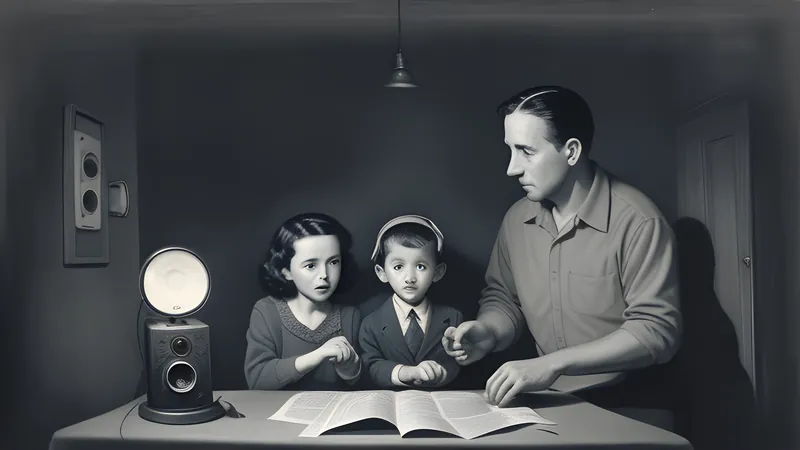
The show did carry disclaimers. It was announced as a Mercury Theatre drama at the top of the hour, identified again partway through, and again at the end. But anyone twisting the dial and arriving late — and many did, because the far more popular Chase and Sanborn Hour with the ventriloquist Edgar Bergen ran opposite on NBC and paused for a musical number around ten past eight — could land in the middle of a bulletin about poison gas advancing on New York with no framing at all. Some of those listeners were briefly, genuinely alarmed. That much is true and human, and any of us who has caught a fragment of frightening news out of context can feel it.
The clever cruelty of the format was that it front-loaded the realism and back-loaded the absurdity. The first half of the hour unfolds slowly, in the plausible register of a real news night — an astronomer interviewed, explosions on Mars reported, a correspondent dispatched to a New Jersey farm. Only later does the invasion accelerate into obvious science fiction, with the narrator surveying a depopulated Manhattan days after the landing, a leap in time no genuine bulletin could make. A listener who tuned in for the tense opening minutes and switched off in fright, before the story revealed its own impossibility, would have carried away only the frightening part. That is almost certainly what happened to the small number who were scared: they left early, missing both the disclaimers and the moment the fiction gave itself away.
What the newspapers did with the morning
The scale is where the story leaves the ground. Open a newspaper the next morning and the headlines are apocalyptic. The New York Times front page read “Radio Listeners in Panic, Taking War Drama as Fact.” The New York Daily News went with “Fake Radio ‘War’ Stirs Terror Through U.S.” Papers across the country ran wire stories of mass flight, of highways clogged with fleeing families, of miscarriages and heart attacks and a woman who supposedly reached for poison. Editorials thundered about the reckless power of the airwaves.
Almost none of it was verified, and much of it appears to have been invented outright or inflated from a single anecdote into a national phenomenon. Reporters, working overnight to a deadline, had no way to measure how many of the tens of millions of American households had even been tuned to CBS, let alone how they had reacted. So they reached for the vivid image and printed it. The handful of real incidents — a jammed switchboard here, a frightened caller there — became, in the retelling, a country in flight.
The media historians Jefferson Pooley and Michael Socolow laid this out in a much-discussed 2013 piece for Slate under the flat title “The Myth of the War of the Worlds Panic.” Their point was blunt: the ratings simply do not support a mass audience. The C. E. Hooper telephone survey conducted that very night found only about two per cent of respondents listening to a “play” or “the Orson Welles programme”; the overwhelming majority were elsewhere on the dial or not listening at all. A programme that few people heard could not have terrified a nation.
Why the press wanted the story to be true
Here is where a folklorist starts paying attention, because a rumour that spreads this fast and holds this long is usually doing a job for the people who spread it. In 1938 the newspaper industry was frightened, and its fear had a specific object: radio. Through the Depression, advertising money had been draining out of print and into the airwaves. Broadcasting delivered news faster, free, and with a voice in the living room that no column of type could match. The papers had spent years trying to hobble their new rival, at one point pressuring the wire services to restrict what radio could report.
A story in which radio’s irresponsibility drove a gullible public to hysteria was, for a threatened print industry, almost too useful to check. It cast the new medium as a dangerous toy in the hands of showmen, and the old medium as the sober adult in the room. The panic narrative armed editorial writers with exactly the argument they wanted to make about regulation and trust. The incentive to exaggerate ran straight through the newsroom, and it did its work on the morning of 31 October.
The scholar who accidentally set the legend in stone
The myth might have faded as a two-day sensation had it not been given an academic backbone. In 1940 the Princeton psychologist Hadley Cantril published The Invasion from Mars: A Study in the Psychology of Panic, a serious and genuinely pioneering piece of social science. Cantril and his team interviewed listeners and tried to understand who had been frightened and why. His book is careful, and he acknowledged the limits of his data. But he also estimated that of some six million people who heard the broadcast, over a million had been “frightened” or “disturbed” — a figure built on thin survey ground and generous interpretation.
That number, stripped of its caveats, escaped into the culture and never came back. A million terrified Americans was a concrete, citable, scientific-sounding fact, and it was repeated in textbooks, documentaries and undergraduate lectures for generations. The panic had graduated from newspaper sensation to established knowledge. Cantril did not set out to build a myth; he built a rigorous study whose most quotable figure outlived its own footnotes, which is a distinctly modern way for a legend to survive. The same laundering of an uncertain estimate into a hard fact recurs across the belief landscape, from the moon-landing hoax to the wilder readings of Kubrick’s films.
What the story is really about
Strip away the phantom stampede and a real question remains, and it is the interesting one. Why has a culture clung so tightly to the image of itself panicking? Every retelling of the War of the Worlds legend carries a quiet flattery aimed at the teller: those people, back then, were credulous enough to mistake a play for an invasion. We, the modern audience, would never. The story lets each generation feel sophisticated at the expense of its grandparents.
That is precisely why it keeps being wheeled out at each new technological anxiety. When television arrived, the 1938 panic was the cautionary tale. When the internet arrived, it returned. Every time a fresh medium seems to threaten the public’s grip on reality — cable news, social feeds, deepfakes, generative video — someone reaches back to Grover’s Mill to prove that ordinary people cannot be trusted with a powerful new channel, and that the channel therefore needs a firm adult hand. The panic myth is less a memory than a reusable argument about who gets to be believed. It sits alongside other durable anxieties about hidden persuasion, from subliminal advertising to the fear that the words on a record were secretly reprogramming us through backmasking.
There is a further irony worth sitting with. The real credulous audience in this story was not the radio listeners of New Jersey. It was everyone who read the panic into the record afterwards and passed it on unexamined — the reporters, the professors, the documentary narrators, and, for eight decades, the rest of us. The mass suggestibility the legend warns against is the mechanism by which the legend itself propagated. A tidy story about people believing something false spread precisely because people found it easy to believe.
The panic that mattered
None of this means the broadcast was nothing. A genuine number of people were momentarily scared, and their fear was reasonable given how convincingly the fake bulletins mimicked the real ones they had been hearing all month from Europe. Welles had, without quite meaning to, demonstrated that the form of authoritative news could be detached from its substance — that the cadence of a trusted announcer could carry falsehood as easily as fact. That was a real and unsettling discovery, and it is the part of the evening genuinely worth remembering.
But it is a subtler lesson than the one the myth teaches. The danger the broadcast exposed was not that the public is a herd waiting to bolt. It was that trust attaches to the sound and shape of authority as much as to what authority actually says — a vulnerability that belongs at least as much to the newspapers who fabricated a stampede as to the listeners who briefly believed in Martians. Orson Welles spent the rest of his life alternately apologising for the panic and, when it suited him, taking credit for it, well aware that the story had become larger and more useful than anything that happened that night. The Martians never reached New York. The story that they nearly frightened a nation to death reached everywhere, and it is still travelling.
Related Content