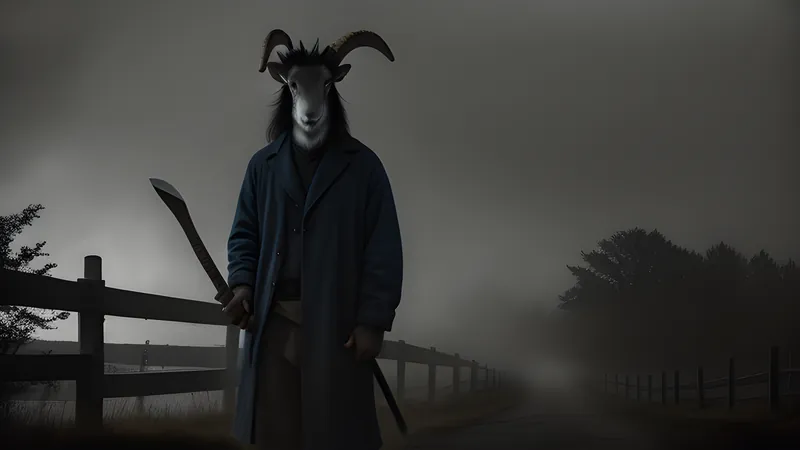
The Wampus Cat: Appalachia's Shape-Shifting Panther
A Cherokee story about spying and punishment became a mountain monster, then a school mascot

Contents
Hunters and farmers across the Appalachian range, from Tennessee through the Carolinas and up into Kentucky, have described a version of the same creature for generations: a large cat, panther-sized or bigger, sometimes said to walk upright on its hind legs, with glowing eyes and a scream that carries for miles down a hollow at night. Livestock go missing near its reported range, dogs refuse to track it past a certain point in the woods, and the people who claim to have seen it up close describe something with an unsettling, almost deliberate intelligence behind its eyes, more purposeful than a simple predator hunting for a meal.
The story attached to the creature is more specific than most cryptid lore, and it comes from a real, named source: a Cherokee legend about a woman called Ewah, who disguised herself in a mountain lion’s hide to spy on a sacred, men-only hunting ritual she had no right to witness. When the tribe’s medicine man discovered the deception, he cursed her, and the punishment fused her permanently into the disguise she’d chosen, trapping her between human and cat, doomed to prowl the ridgelines in a form that was neither one thing nor the other. That is the kernel most retellings trace back to, and unlike a great many “ancient Native legend” framings tacked onto American folklore after the fact, this one has a specific narrative shape, consistent across multiple Cherokee oral history sources, rather than a vague gesture toward “old Indian legend” invented wholesale by later settlers.
A real animal underneath the curse
The Wampus Cat legend did not need to invent its predator from nothing. The eastern cougar, a subspecies of mountain lion that once ranged across the entire Appalachian corridor, was a genuine, well-documented apex predator in these mountains for centuries, large enough and elusive enough that even confirmed sightings were rare and unsettling events for the rural communities living alongside it. Settlers arriving in Appalachia through the eighteenth and nineteenth centuries hunted the eastern cougar aggressively, both out of fear for livestock and in the general pattern of large-predator eradication that swept most of the settled United States, and the population collapsed accordingly, growing rarer and more mysterious with every generation, exactly the conditions under which a genuinely present but genuinely uncommon animal tends to accumulate legend rather than lose it.
The eastern cougar’s decline followed a pattern familiar from most large-predator eradication campaigns in early America: bounty systems that paid hunters per animal killed, systematic trapping organised by local governments responding to genuine livestock losses, and the steady clearing of the deep forest habitat the cats needed to maintain a viable range and prey base. By the early twentieth century, confirmed breeding populations east of the Mississippi had effectively vanished, though scattered, credible individual sightings continued for decades afterward, kept alive by wildlife officials taking reports seriously enough to investigate rather than dismiss outright. That combination, a genuinely rare but not impossible animal, investigated seriously by the same authorities who might otherwise be expected to debunk it, is exactly the environment in which a supernatural gloss tends to attach itself most durably to a real creature.
The U.S. Fish and Wildlife Service made the eastern cougar’s disappearance official rather than folkloric in 2018, formally declaring the subspecies extinct after a review process that had been building for years, closing out a documented decline that had been underway since well before the Wampus Cat stories were first written down by folklorists in the early twentieth century. That declaration matters for how the legend should be read: this isn’t a case of settlers fabricating a predator that never existed, but of them living for generations alongside a real, retreating, and genuinely dangerous big cat whose increasing rarity made every encounter with it feel more significant, more freighted with meaning, than a sighting of a common animal would.
Where the legend forks from the record
Where the story departs from straightforward wildlife history is in the specific claim of a curse-driven transformation, the upright walk, and the eerie, almost sentient behaviour attributed to the creature. A retreating cougar population, hunted hard enough to become genuinely rare, would produce exactly the pattern of increasingly infrequent, increasingly startling encounters that feeds a growing sense that the animal being seen is smarter and stranger than an ordinary cat, precisely because each sighting now carries the full weight of scarcity and surprise rather than routine recognition. Add a specific, memorable, and already-circulating Cherokee narrative about a woman cursed into a cougar’s shape, and settler communities had a ready-made frame through which to interpret every unnerving glimpse of a big cat moving through the tree line at dusk.
The transformation from named Cherokee story to generic “shape-shifting mountain monster” tracks a broader and less comfortable pattern in American folklore, in which settler communities absorbed Indigenous narratives, stripped them of their specific cultural context and moral weight, and redeployed them as generic backwoods spook stories detached from the people who originated them. The Wendigo, an Algonquian story about starvation, greed, and the consequences of consuming more than one’s share, underwent a nearly identical flattening once it was picked up by non-Native horror writers and filmmakers looking for a ready-made monster rather than the specific cultural warning the story was built to carry. The Wampus Cat’s journey from a named figure in a specific Cherokee narrative tradition to a generic “spooky mountain cat” available for any campfire retelling follows the same basic mechanism, even though the Ewah story has, unusually, managed to survive in recognisable form alongside its flattened popular version.
How the story travelled into modern Appalachia
Folklorists collecting Appalachian oral history in the early twentieth century, working for regional archives and university folklore departments, recorded multiple independent versions of the Ewah story with enough shared structural detail, the disguise, the sacred ritual, the medicine man’s discovery, the permanent transformation, to treat it as a genuinely rooted narrative tradition rather than a single storyteller’s invention later copied by everyone else. That consistency across multiple tellers and multiple communities is one of the clearer markers folklorists use to distinguish an inherited tradition from a story that got fixed into a single canonical form by one influential written source, the way many “ancient legends” attached to American roadside attractions later turn out to trace to a single twentieth-century newspaper article rather than genuine oral history.
By the twentieth century the Wampus Cat had become common enough regional shorthand that it started showing up as a mascot rather than a warning, a transition that tends to happen once a creature has been circulating long enough to feel more like shared regional colour than an active threat. High schools and universities across Tennessee and neighbouring states adopted “Wampus Cats” as team names, treating the creature the way countless American sports programmes treat any locally distinctive predator, as a symbol of ferocity rather than a specific narrative about a curse and a broken taboo. That mascot use, ironically, has probably done more to keep the name circulating in the twenty-first century than any hunter’s fireside account, in much the way the Beast of Bray Road turned an unnerving stretch of Wisconsin road into a recognisable regional brand almost by accident once the story had enough momentum to travel beyond the people who first reported it.
The mascot adoption also did something the original story never intended: it stripped out the moral entirely and kept only the ferocity. A school choosing “Wampus Cats” as a team name in the 1920s or 1930s was reaching for the same generic register of local toughness that produced Wildcats, Bobcats, and Mountain Lions at rival schools across the same decades, with little interest in Ewah, the taboo she broke, or the medicine man who cursed her. The name survived; the specific story that gave the name meaning became optional trivia, known mostly to folklorists and to the occasional local historian rather than to the students wearing the logo on game day.
Contemporary Wampus Cat reports, when they surface, tend to cluster in exactly the terrain where the eastern cougar’s last confirmed populations held on longest — steep, forested, sparsely populated ridges where a big cat, or a large dog, or a bobcat looking unusually large in poor light, could plausibly go unidentified for a stretch of road or a hollow’s length before vanishing back into cover. Wildlife officials in several Appalachian states still periodically investigate reported cougar sightings, occasionally confirming individual transient animals, likely dispersing westward populations rather than a surviving eastern subspecies, which keeps the underlying biological question genuinely open even as the supernatural curse narrative sits comfortably alongside it rather than depending on it.
What the curse was really protecting
Read straight, the Ewah story is not really about a monster at all. It’s a narrative about the consequences of violating a specific, gendered taboo around a sacred hunting ritual, using transformation into a liminal creature, neither fully woman nor fully cat, as the price for that violation. Stories built around transformation-as-punishment are common across many oral traditions precisely because they let a community talk about the seriousness of a taboo without needing to specify an earthly punishment that any real authority would have to carry out; the curse does the enforcing so the people don’t have to. Stripped of that context by later retellings, the story lost its function as a lesson about sacred boundaries and gained a new one as generic backwoods atmosphere, which is a smaller and less interesting thing than what it started as.
Some contemporary tellers have started deliberately restoring that missing context, prompted partly by renewed public interest in Cherokee history and partly by folklorists pushing back against decades of flattened, decontextualised retellings across American regional monster lore generally. Restoring Ewah’s name and her specific transgression to the story doesn’t make the creature any less unsettling on a dark ridge at night; if anything, it makes the tale considerably richer, giving the reader an actual person, an actual broken rule, and an actual consequence to sit with, rather than a nameless cat-shaped void standing in for generic backwoods dread.
What the Wampus Cat still carries, for anyone willing to trace it back past the mascot logos and the campfire retellings, is a genuinely rare, genuinely magnificent predator that Appalachian communities lived alongside for centuries before hunting it into extinction, wrapped around a specific, meaningful Cherokee story about the cost of watching something you were never meant to see. The mountains that produced both the animal and the story are still there, quieter now than they were when a big cat’s scream down a hollow meant something was actually close, and the legend that outlasted the cougar is, in its own way, a record of exactly what those mountains used to hold.
That record survives in an unusually literal sense. Every school gymnasium banner reading “Wampus Cats,” every roadside sign in the Tennessee hills claiming a sighting, every retelling around a campfire is, whether the teller realises it or not, keeping alive the memory of an animal the region hunted into oblivion and a story the region borrowed and reshaped rather than let disappear alongside it. Few pieces of regional folklore carry quite that double weight, a vanished predator and a repurposed sacred narrative, folded into a single, still-recognisable name.
Related Content