The Vanishing Hitchhiker: The Ghost Who Rides Home
A folklore motif so consistent that two researchers charted it across three continents in 1942, decades before Chicago gave it a name
Contents
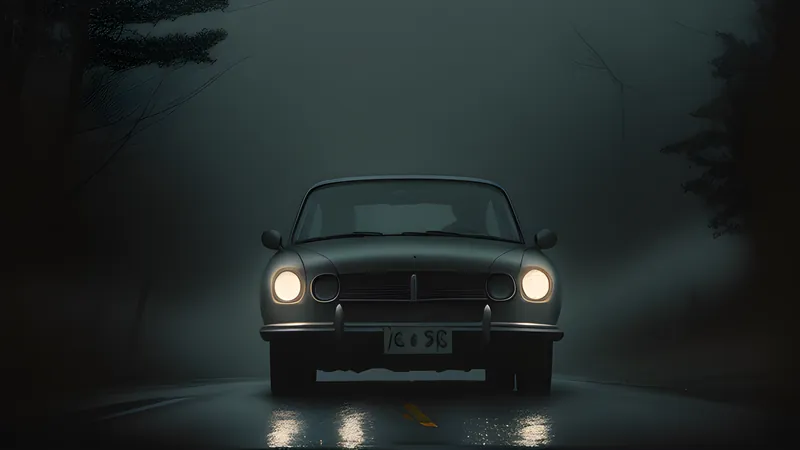
A man is driving alone at night, on a road he knows well, when his headlights find a young woman standing at the verge in a light dress, thumb out, no coat against the cold. He stops. She gets in, gives him an address a few miles on, and says almost nothing else the whole way — polite, a little distant, watching the road. He turns to make conversation as he pulls up outside the house she named, and the back seat is empty. The door has not opened. When he knocks at the house, shaking, an older resident answers and hears him out without much surprise, then explains, gently, that his daughter died in a car accident on that same stretch of road years before, on a night very like this one, and that she has done this before — climbed into a stranger’s car, ridden partway home, and disappeared before she arrived.
That story, in some close variant of it, has been told in nearly every part of the world with paved roads and cars to drive on them. It is the single most documented ghost story in modern folklore, and its documentation is the interesting part: two American researchers wrote it up formally in an academic journal in 1942, more than a decade before Chicago produced the version — Resurrection Mary — that would become the story’s most famous American face.
A ghost with a paper trail
Folklore rarely gets studied with this much rigour this early. In 1942, the California Folklore Quarterly published “A History of the Vanishing Hitchhiker” by Richard K. Beardsley and Rosalie Hankey, a survey that collected and compared roughly eighty reported tellings of the story from across the United States, plus older parallels from Europe. Beardsley and Hankey were not debunking a hoax or chasing a single sighting; they were doing something rarer, treating an oral story as a specimen and asking how it varied and where it stayed fixed. What they found was a narrative with remarkably stable bones: a driver, alone or with one companion, picks up a hitchhiker who is unremarkable to look at, rides some distance in near-silence, gives an address, and vanishes from a moving vehicle before arrival — sometimes leaving behind a coat lent against the cold, which the driver later finds folded neatly on a grave.
The folklorist Jan Harold Brunvand picked up where Beardsley and Hankey left off, and it was Brunvand’s 1981 book The Vanishing Hitchhiker: American Urban Legends and Their Meanings that gave the whole genre of modern, orally transmitted, believed-true stories its lasting academic name — the urban legend. Brunvand used the hitchhiker as his title case precisely because it demonstrated everything the genre does: a plot loose enough to be relocated to any town’s own dangerous curve, and specific enough that tellers swear it happened to a friend’s cousin, not to them directly, which is itself one of the story’s most consistent fingerprints. Folklorists call this FOAF transmission — friend of a friend — and the vanishing hitchhiker is close to its textbook example.
The shape underneath the story
Stith Thompson’s Motif-Index of Folk-Literature, the standard reference folklorists use to catalogue recurring narrative elements across cultures, assigns the vanishing hitchhiker’s core action its own entry: E332.3.3.1, a ghost that rides in a vehicle and disappears from it. That a university classification system needed a specific slot for “ghost gets out of a moving car without opening the door” says something about how often collectors were running into the same story in unrelated places, decades before anyone had proposed the internet or mass media as an explanation for how a tale might spread so evenly.
The variants collected by Beardsley and Hankey, and by Brunvand after them, differ mostly in surface detail — the ghost is sometimes a young woman in a party dress, sometimes a soldier hitching home from war, sometimes an elderly man in old-fashioned clothes — while the mechanics barely move. The hitchhiker is picked up near a bridge, a crossroads, or a bend with a known accident history. The ride is quiet. The address given turns out, when checked, to belong to the family home of someone who died on that road on the anniversary of the encounter, or close to it. A physical object — a coat, a scarf, a hat — sometimes crosses from the living world into the story’s proof, turning up folded on a headstone the next morning, which gives the tale a testable-feeling detail even though nobody telling it produces the coat itself.
Archer Avenue and the name Chicago gave her
Of all the local variants, Chicago’s Resurrection Mary is the one that got a name, a home cemetery, and a press clipping file. The story, current since at least the 1930s, describes a young blonde woman in a white party dress picked up by drivers along Archer Avenue on Chicago’s southwest side, usually near the Willowbrook Ballroom (long known as Oh Henry Park in the era the legend is set), who asks for a ride toward Resurrection Cemetery and disappears from the car near its gates — occasionally passing straight through the cemetery fence, according to more than one cab driver’s account collected over the decades. A specific real death is sometimes attached to her: a young woman killed in a car accident after a night dancing at the ballroom in the early 1930s, buried at Resurrection Cemetery, though no single documented case matches every detail well enough to satisfy a genealogist. What has never been in short supply is testimony. Cab and bus drivers along that stretch of Archer Avenue have been filing near-identical accounts to Chicago papers since at least the 1970s, and in 1976 a police officer reported spotting a woman matching the description gripping the cemetery’s iron bars from the outside, hard enough to leave what looked like scorched handprints in the metal — a detail cemetery staff addressed by replacing the bars, which did nothing to slow the sightings.
Resurrection Mary owes her staying power to something the more generic version of the story lacks: a fixed, visitable location. Believers and sceptics alike can drive Archer Avenue past the cemetery gates, which turns an abstract motif into a place with a name on a map, the same way a specific bridge or crossroads anchors most local hitchhiker legends elsewhere. It is a pattern that shows up across the Bermuda Triangle as well — a diffuse worry given a fixed patch of geography to live in, which makes it feel more provable than it is.
A much older kind of stranger
The vanishing hitchhiker is not, by any honest reading, a car-age invention retrofitted onto older bones. Beardsley and Hankey traced European precursors well before automobiles existed — ghost stories about a stranger who joins a traveller on foot or on horseback, converses politely, and disappears partway to a destination that turns out to be a graveyard. Rudyard Kipling’s 1885 story “The Phantom Rickshaw” uses the same shape with a rickshaw standing in for the car, decades before Ford’s assembly line made the automobile the story’s default vehicle. Older still, and outside the folklore-collector tradition entirely, the Gospel of Luke’s account of the road to Emmaus describes two travellers joined on their walk by a stranger who talks with them at length and then vanishes the moment they recognise him. Its authors were writing theology, and the mechanism is nonetheless the identical narrative hinge: a companion accepted in good faith, present for a stretch of a journey, gone the instant the truth of who they were becomes clear.
What holds this lineage together, car or rickshaw or open road, is the idea of hospitality extended to someone who turns out to have died — the living doing a small, ordinary kindness (a ride, a seat, a coat against the cold) for someone who, it emerges, no longer needs transport in any conventional sense. Folklorists reading the story this way treat the vehicle as incidental. What travels between cultures and centuries is the moment of unknowing kindness and the small chill of finding out, afterward, exactly who you helped.
Same skeleton, a new address every time
Part of what convinced Beardsley and Hankey they were looking at a genuine folklore motif, rather than one American legend copied town to town, was how readily the same skeleton turned up wearing entirely local clothes. Hawaii has its own long-running version tied to the Pali Highway on Oahu, where drivers have reported a woman in white flagging them down near the old pass for generations, said by some tellers to be linked to the volcano goddess Pele testing travellers’ courtesy, and by others simply to an unnamed accident victim; either way, taxi and bus drivers on that road have historically avoided carrying pork over the pass out of respect for exactly this kind of roadside spirit. Malaysia and Indonesia have their own hitchhiking female ghosts, often folded into the older Pontianak tradition of a woman who died in childbirth and haunts roadsides and banana groves, picked up by drivers who realise too late what they have let into the car. Postwar Japan produced its own automobile-age ghost stories built on the same hinge — a passenger, picked up in good faith, who is not what she seems by the time the taxi reaches its destination.
None of these traditions needed to borrow from Chicago, or from each other, to arrive at the same shape. What they share is a common set of ingredients any culture with roads, night driving, and grief over sudden death already has on hand: a vehicle small enough to trap two strangers together for a fixed stretch of time, a driver whose politeness is genuinely tested, and a resolution built on the slow-dawning realisation of who was really in the car. Where the story differs — a scarf left on a headstone in Ohio, scorch marks on cemetery bars in Chicago, an aversion to carrying pork on Oahu — is exactly where local memory and local ritual have grafted themselves onto an old international scaffold.
Why the road keeps producing her
Roads make unusually good habitats for ghost stories because they are already liminal in every sense folklore cares about — a stretch of ground between one fixed place and another, travelled mostly in the dark, populated by strangers you will typically never see again regardless of whether they turn out to be alive. A fatal crash on a specific curve leaves a community with a genuine, dated tragedy and no ritual built for revisiting it the way a graveyard invites revisiting. The vanishing hitchhiker gives that stretch of asphalt a way to be haunted on schedule, usually around the anniversary of the death, which turns a bare accident site into something the community can keep returning to on its own terms.
There is also a quieter transaction happening in the story’s insistence that the driver behaved well. Every version rewards ordinary generosity — stopping for a stranger on a bad night — with a story worth telling for the rest of one’s life, and rarely punishes it. Compare that to the darker strain of hitchhiker folklore, the murderous-stranger stories that peaked alongside real anxieties about roadside crime in the 1970s and ’80s: the vanishing hitchhiker is the gentler mirror image, a legend that lets the driver be generous without cost, because the passenger was never dangerous, only sad and lost and briefly, movingly, in need of a ride home. It shares that gentleness with Bloody Mary, another figure conjured by ordinary behaviour — saying a name, offering a lift — who turns out to be grief wearing a familiar shape rather than a threat.
The ride that never quite ends
What makes the vanishing hitchhiker worth taking seriously as folklore, rather than dismissing as a stock campfire trick, is how precisely it maps onto a real, universal experience: driving a road at night where someone died, and feeling the specific unease of sharing that space with an absence. Beardsley and Hankey’s 1942 catalogue, and every collector since, shows a species of story that endures because it gives a community a repeatable, low-stakes ritual for acknowledging a loss that has no other outlet — no memorial service scheduled every year, no headstone most passing strangers will ever visit. The ghost gets in the car, rides a while in the company of someone who never knew her, and gets out again before the truth becomes unbearable to either of them. Every driver who tells the story afterward is, in the smallest way, keeping her company for one more mile.
Related Content