The Van Meter Visitor: Iowa's Winged Thing of 1903
For five nights in 1903 a small Iowa town shot at a glowing winged creature — and then never spoke of it again
Contents
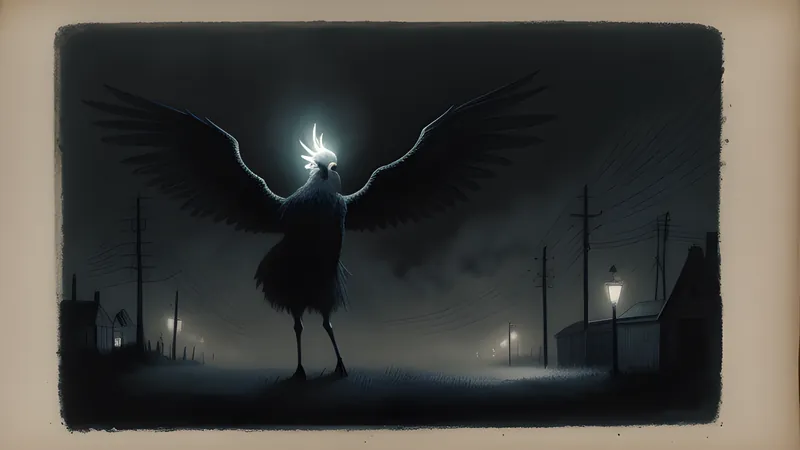
For roughly five nights at the end of September and start of October 1903, the small railroad town of Van Meter, Iowa — a few hundred people about twenty miles west of Des Moines — reported that something was flying over their streets after dark. It had wings, it was very large, and, most memorably, it carried a blinding light on its head that shone like an electric lamp and could not be explained by any lamp the town possessed. Grown men, several of them named and locally respectable, fired shotguns at it at close range and swore it was unharmed. Then it was gone, and Van Meter, by and large, stopped talking about it for a hundred years.
The Van Meter Visitor is an unusually clean specimen of a certain kind of American legend: a genuinely strange few days, documented at the time in the local press, involving witnesses with names and reputations, that then sits almost untouched in the archive until the modern age digs it up and gives it a second, larger life. There is no confession here, no carved wooden feet, no admitted hoaxer. What there is instead is a case study in how newspapers, respectability, and a century of silence combine to turn a week of small-town fright into folklore.
Five nights of witnesses
The events as recorded run roughly like this. Late on the night of 29 September 1903, a travelling salesman staying at a Van Meter hotel was woken by a bright light moving on the wall of the building opposite. Looking out, he saw a light on top of what he took to be an enormous animal, and fled back inside. Over the following nights the sightings multiplied and the cast of witnesses grew, and — crucially — they were the town’s own solid citizens: the local physician, a hardware-store owner, a banker, an implement dealer, the town marshal. Their names went into the paper.
The creature they described accumulated features as the nights went on. It was gigantic, moving on great leathery wings. It gave off a foul smell. It was said to leave marks, and to emit its extraordinary light from a blunt horn or projection on its head. On one of the later nights a group of men reportedly tracked it to an old abandoned coal mine on the edge of town and saw two of them — a larger and a smaller, as if the thing had a mate or a young — disappearing down into the shaft. After that the visitations stopped. The men had fired on it repeatedly across those nights, at ranges they described as point-blank, and reported that the shots had no effect at all.
What the newspapers actually did
The single most important fact about the Van Meter Visitor is that our knowledge of it comes almost entirely from newspaper reports written in 1903, principally in the Des Moines and central-Iowa press, and that 1903 was near the height of a particular journalistic culture. This was the era of sensational local reporting, of the tall tale printed with a straight face, of papers competing for readers with exactly the kind of colourful, half-winking marvel that a winged monster over Van Meter provided. The reporters named their witnesses, which lends the story its air of documentary solidity, but the naming of respectable men was also precisely the technique that made such stories sell: a monster seen by the town doctor is news, a monster seen by nobody in particular is not.
This is the fork in the record, and it is a subtle one, because it does not resolve into a clean hoax. We genuinely cannot now separate what the men of Van Meter actually experienced from what the newspapers shaped that experience into for print. The accreting details — the smell, the two creatures, the abandoned mine, the invulnerability to shot — are exactly the features a good storyteller adds, and a good reporter of 1903 was a good storyteller. The witnesses may have been sincere; the paper may still have embroidered them. Both can be true at once, and disentangling them at this distance is impossible. What survives is the report of the event rather than the event itself, and the report was a commercial product as much as a factual one.
The candidates, mundane and marvellous
If we take the sincere core of the sightings seriously — that several people saw a large flying thing with an unusually bright light — the candidate explanations sort into the mundane and the marvellous, and honesty requires laying out both. On the mundane side: 1903 was a moment of genuine novelty in artificial light and in the night sky. Bright arc lamps and early electrical lighting were spreading and could produce startling, unfamiliar glows. Large birds — herons, owls, migrating waterfowl — crossing in front of a light source can look enormous and misshapen against a dark sky. A misperceived owl, luminous with reflected light and silent on the wing, has fooled a great many sober people into reporting monsters, and Van Meter sits on a migratory flyway.
On the marvellous side sit the explanations the modern retellings prefer: a surviving pterosaur roosting in the old mine, an interdimensional entity, a genuine unknown animal. These are the versions that sell books and fill a festival, and they are unfalsifiable in the satisfying way marvels always are — the creature went down a mine and never came back, so there is nothing to test. The bioluminescent horn, in particular, is a detail no known animal on earth possesses, which is precisely why it is the most memorable feature and precisely why it should make a careful reader most suspicious that a storyteller’s hand is on it. The same over-reaching from an odd-but-explicable sighting to an impossible marvel is what animates the whole cryptid genre, from the Michigan Dogman to a hundred half-glimpsed things at dusk.
The hundred-year silence, and the revival
What genuinely distinguishes Van Meter from busier legends is the long quiet that followed. After 1903 the story largely went dormant. It was not franchised into decades of fresh sightings the way Nessie or Bigfoot were; it sat in the newspaper morgue and in a few dusty local memories, a peculiar week that the town neither denied nor promoted. That silence is itself evidence of a kind. A living hoax needs constant feeding, fresh sightings, someone with an interest in keeping it alive. Van Meter’s monster was fed by nobody for the better part of a century, which is at least consistent with the people involved having genuinely seen something they could not explain, been unnerved by it, and then simply gone on with their lives once it stopped.
The revival came in the modern era, most decisively with a 2013 book, The Van Meter Visitor, by Chad Lewis, Noah Voss and Kevin Lee Nelson, which gathered the 1903 press accounts and reintroduced the creature to a national cryptid audience. Van Meter, like Churubusco with its turtle, then did the sensible small-town thing and turned the legend into a party: the town has held a Van Meter Visitor Festival, embracing the winged thing as local heritage. A week of genuine fright in 1903 became, in the twenty-first century, a friendly annual occasion — the mystery domesticated, monetised gently, and made to earn its keep.
A sky already full of lights
Van Meter’s glowing visitor did not arrive over an empty sky. Only six years earlier, in 1896 and the spring of 1897, a genuine national sensation had swept the American Midwest: the great “mystery airship” wave. Across Iowa, Illinois, Kansas, Nebraska and beyond, thousands of ordinary people reported a cigar-shaped craft moving through the night sky, and — the detail that matters here — they described it carrying a brilliant, sweeping searchlight, a beam of artificial brightness gliding over farms and small towns after dark. The airship stories filled the same central-Iowa papers that would later carry the Van Meter Visitor, and they filled them with named witnesses and sober-sounding datelines in exactly the same way.
That earlier wave had already trained the region’s eyes and its newspapers. It had established that strange lights could cross the Iowa night, that respectable citizens would report them, and that the press would run the reports. When the men of Van Meter looked up in 1903 and saw a moving brightness they could not place, they were seeing it through an imagination that had been rehearsing for it since 1897. The searchlight on the airship and the glowing horn on the Visitor are the same anxious image — the intrusion of a hard, artificial light into a sky that had held only stars — attached in one case to a machine and in the other to a monster.
This is the broader lineage the Van Meter creature belongs to, and it is worth naming because it dissolves the temptation to treat 1903 as an isolated miracle. From the 1897 airships through the Van Meter Visitor to the flying humanoids of a later century, the American night has repeatedly produced luminous winged intruders at exactly the moments when a new technology was changing what could plausibly be up there. The Visitor was the shape a wired, mechanising age took when it flew, uninvited, over a small railroad town that had not asked for it.
What the visitor was really for
The most honest thing to say about the Van Meter Visitor is that we will never know what those men saw, and that the not-knowing is durable precisely because the record is both real and unreliable at the same time. Real witnesses, real names, real newspaper columns — and a journalistic culture that we know inflated and adorned exactly this kind of story for exactly this kind of reader. The creature exists in the gap between a sincere fright and a good yarn, and that gap cannot now be closed.
But consider the shape of the fear. 1903 was a town on a railroad, wired for a new kind of light, on the edge of a century that would bring flight, electricity and machines into the sky above places that had known only stars. The thing the men of Van Meter shot at was enormous, luminous with a light they associated with the new electrical age, and it came out of an abandoned mine — a hole into the industrial underworld that had already been dug and used up beneath their town. It is hard not to see, in a glowing winged giant emerging from a spent coal shaft, the anxious shape of modernity itself arriving over a small farming community after dark: bright, mechanical, unkillable by the old means, and gone before you could make sense of it. The town could not name what was coming for its quiet way of life. So, for five nights, it gave the thing wings and a lamp and a smell, fired every shotgun it had, and told the newspaper. A century later, with the future safely arrived and survived, Van Meter throws it a festival.
Related Content