The USS Liberty Incident: An Attack Still Argued Over After Sixty Years
Israeli forces attacked an American spy ship in 1967, killing thirty-four sailors. Whether they knew what they were hitting has never stopped being disputed.
Contents
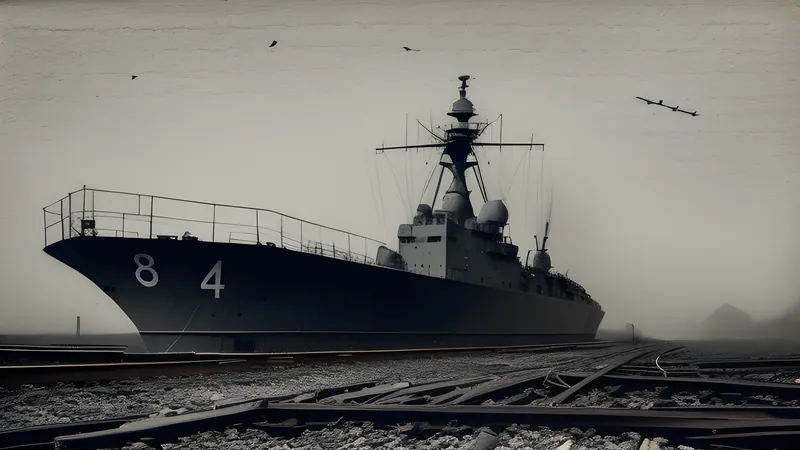
On the afternoon of 8 June 1967, in the fourth day of the Six-Day War, the USS Liberty was steaming slowly through international waters off the Sinai coast, some thirteen nautical miles north of the town of El Arish. She was a technical research ship — in plain terms, a floating listening station operated by the US Navy for the National Security Agency, bristling with antennas, monitoring the radio traffic of the war raging around her. She flew an American flag. At around two in the afternoon, Israeli fighter jets attacked her with cannon fire, rockets and napalm. Minutes later, Israeli torpedo boats followed, and one of their torpedoes tore a forty-foot hole in her starboard side. By the time it was over, 34 American servicemen were dead and 171 were wounded, out of a crew of fewer than 300. It remains one of the deadliest peacetime assaults on a US Navy vessel, and the fact that it was inflicted by an ally has never sat easily with anyone.
Israel apologised almost immediately, calling it a tragic case of mistaken identity — its forces, it said, had believed the Liberty to be an Egyptian vessel in a fast-moving combat zone. It paid compensation to the wounded, to the families of the dead, and to the United States government. Official inquiries on both sides accepted, in the main, that the attack was a terrible error. And yet, sixty years on, the argument has not closed. Many of the survivors have insisted for their entire lives that the attack was deliberate — that the Israelis knew exactly what ship they were hitting. Holding this case honestly means neither dismissing those men nor pretending the record answers a question it does not.
What is not in dispute
Begin, as always, with the solid ground. The attack happened, in international waters, against a clearly American vessel, and it was devastating. That much no serious party contests.
The Liberty was on an intelligence mission. Her presence off Sinai was part of the American effort to monitor a war that had erupted on 5 June, when Israel launched pre-emptive strikes against Egypt and swiftly routed the Egyptian, Jordanian and Syrian forces. She was a valuable and sensitive asset, and the Pentagon had in fact tried to move her further from the fighting: messages ordering the Liberty to withdraw to a safer distance were sent, but through a chain of communications failures — misrouting, mishandling, one message reportedly sent to the wrong place entirely — they did not reach the ship in time. This bureaucratic bungling is itself a documented scandal, and it meant that the Liberty was much closer to the coast than her own command intended when the Israeli aircraft found her.
The physical facts of the assault are also well established. The attack came in waves: first jets, strafing and dropping napalm, in passes that lasted several minutes; then the torpedo boats. The crew, under fire, managed to get off distress calls, and American carrier aircraft were launched to defend her and then recalled. The torpedo strike killed 25 men in the intelligence spaces below. The survivors kept the ship afloat through the night and brought her, listing and burning, to Malta. Their conduct earned the ship’s commander, Captain William McGonagle, the Medal of Honor.
There is a small, telling detail even in the honours. The Medal of Honor is normally awarded at the White House by the President, in a ceremony freighted with publicity. McGonagle received his at the Washington Navy Yard, from the Secretary of the Navy, in a distinctly muted setting. Survivors have long read that quiet handover as a sign of official discomfort — a nation reluctant to draw attention to how its highest award for valour had been earned, because the enemy that day had been a friend. Whether the low-key ceremony reflected diplomatic delicacy or something more deliberate is itself part of the argument, but the discomfort was real, and the men who lived through the attack felt it as a second wound.
The case the survivors make
The dispute is entirely about intent, and the survivors’ case deserves to be laid out with the seriousness they have earned by living it.
They point, first, to the length and deliberateness of the assault. This was not a single strafing run by a confused pilot; it was a sustained attack by aircraft and then torpedo boats over the better part of an hour, which they argue is hard to square with a fleeting misidentification. They point to the flag: the Liberty was flying the Stars and Stripes, and when it was shot away in the attack, the crew raised a larger holiday ensign. They point to the ship’s distinctive profile — a clearly marked American auxiliary, not resembling the Egyptian vessel, the horse-transport El Quseir, that the Israelis said they took her for. Some survivors allege the attackers strafed their life rafts in the water, which, if true, would be very difficult to reconcile with an innocent error. And they point to motive: the Liberty was listening to Israeli communications during a war in which Israel was doing things — the scale of its advance into Sinai, its intentions toward the Golan Heights, questions later raised about the treatment of prisoners at El Arish — that it might not have wanted overheard.
These are not the ravings of cranks. They are the testimony of men who were on the ship, who watched their shipmates die, and who have spent decades feeling that their own government preferred the comfort of the alliance to the full truth of what happened to them. Their sense of betrayal is a real and reasonable thing, and any account that waves it away has failed at the first duty of this desk.
Where the record grows genuinely uncertain
Set against that is the case for error, which is also substantial and which the official inquiries found more persuasive. The Israeli account holds that in the chaos of the war, its forces had received reports of a shelling of El Arish from the sea, wrongly attributed to an enemy ship; that the Liberty’s identification markings were hard to read at speed and distance, particularly in the haze and with the flag possibly hanging limp; and that the torpedo-boat crews, closing in, misjudged her size and identity. Israeli intercepts of the pilots’ radio chatter, portions of which have been released and studied, show confusion rather than a clean recognition of an American ship — though the interpretation of that chatter is itself contested, and the fullest tapes have never been made public. The muddle of intercepted radio traffic recalls the Gulf of Tonkin, where fragmentary signals from a confused night at sea were later read into whatever shape the moment demanded.
American investigations reached mixed and cautious conclusions. A Navy court of inquiry in 1967, convened under difficult wartime conditions, accepted the mistaken-identity explanation while noting failures on all sides. The NSA’s own internal history described the attack as, in its assessment, a case of mistaken identity, while acknowledging the enduring doubts. Later reviews, including one associated with the Central Intelligence Agency’s inspector, likewise leaned toward error without ever fully dispelling the questions. On the other side, senior figures have publicly rejected that conclusion. Admiral Thomas Moorer, who became Chairman of the Joint Chiefs of Staff, later chaired an unofficial commission that declared the attack deliberate and accused the US government of a cover-up. Secretary of State Dean Rusk wrote in his memoirs that he never believed it was an accident.
The honest position is that the intent cannot be established with the certainty either side claims. The documentary record is genuinely incomplete — key Israeli communications remain classified or unreleased, and some American records were slow to surface. A person can weigh the same set of facts and land in good faith on either side. That uncertainty is uncomfortable, and it is precisely what the two competing certainties are built to relieve.
The fork: from a contested attack to a settled grievance
Because the underlying question is unresolved, the Liberty has become something that harder cases rarely are — a genuinely open wound that different communities have each closed in their own direction. For many of the survivors and their advocates, “deliberate attack and cover-up” is settled fact, and any hedging reads as a continuation of the betrayal. For defenders of the alliance, “tragic error, fully investigated” is equally settled, and the survivors’ persistence reads as grievance hardening into obsession. Each side has resolved an ambiguity that the evidence does not resolve, because living inside the ambiguity is unbearable.
The distortion, where it appears, is in the certainty rather than in the substance. The substance — a deadly attack on an American ship by an ally, followed by an official preference for moving on quickly — is real, and it earns the distrust that has grown around it. What the record does not support is the confidence, on either side, that the intent has been proved. The Liberty is often invoked alongside cases like the Lavon Affair, where an Israeli covert operation is a matter of documented fact, as though the confirmed case settles the contested one. It does not. A state having conducted a proven deception in 1954 tells you it is capable of deception; it does not tell you what a specific pilot saw through his canopy in 1967. Treating the two as interchangeable is the move that turns a real, unresolved tragedy into a closed case it has never actually been.
What the incident is really about
The USS Liberty endures as a controversy for the same reason the deepest conspiracy cases do: because it sits on the seam between an ally’s account and the experience of the men who were attacked, and neither the surviving documents nor the passage of time has stitched that seam shut. The survivors are owed something the historical record has not been able to give them — a definitive answer, and the acknowledgement that their decades of doubt were never unreasonable. What they have instead is a case that remains, in the strict sense, argued over.
The temptation, in a story like this, is to reach for the resolution that comforts whichever side you already stand on. The harder and more honest thing is to hold the whole shape at once: an ally really did attack an American ship and kill thirty-four of her crew; the attack was real, the deaths were real, the communications failures that put the ship in harm’s way were real, and the official eagerness to close the file quickly was real too. Whether the men in the cockpits and on the torpedo boats knew what they were hitting is the one thing that has never been settled, and the deepest respect one can pay to the Liberty’s dead is to refuse to pretend otherwise.
Every year the dwindling band of survivors still gathers to read the names of the thirty-four. They do it partly to remember their shipmates and partly to keep alive a question that officialdom would prefer had been laid to rest with the men. There is a dignity in that refusal to let go, whatever one concludes about intent. A country that can look steadily at an unresolved wound, decline the easy answers offered by both its friends and its cynics, and simply keep the question open, is doing something more honest than either exoneration or accusation. The Liberty asks that of anyone who takes it seriously — to carry an uncertainty that will probably never be relieved, and to carry it with the same patience the survivors have shown for sixty years.
Related Content