The Tunguska Event and the Century of Guesses
Eighty million trees fell in Siberia, and it took nineteen years for anyone to look
Contents
At about seven in the morning on 30 June 1908, reindeer herders of the Evenki people camped near the Podkamennaya Tunguska river in central Siberia saw the sky split. A column of blue-white light, brighter than the sun, crossed the heavens; a few minutes later came a flash, a wall of heat that one man said felt as though his shirt were on fire, and then a shockwave that threw people and animals off their feet and knocked down the walls of a trading post forty miles away. Seismographs as far as western Europe registered the ground-tremor. The blast registered on a microbarograph in England, whose delicate pens traced the pressure wave twice as it circled the globe, and on seismographs from Irkutsk to Germany. Over the next two nights, across Russia and into Britain, the sky stayed strangely bright — Londoners read newspapers outdoors at midnight, and observers noted a silvery glow that has never been convincingly matched since.
Something had exploded over Siberia with the force of somewhere between ten and fifteen megatons of TNT, a thousand times the Hiroshima bomb, in a part of the world so remote that nobody with a scientific interest managed to reach the site for nineteen years. That gap — two decades between the largest impact event in recorded history and the first human being to walk into its centre — is the whole reason Tunguska became a mystery instead of a data point. Nature left an enormous, spectacular, unexplained hole in the record, and for a hundred years people have been filling it with whatever they most wanted to be true.
The event, told straight
The Evenki accounts, gathered later, are consistent and vivid: fire in the sky, a heat that scorched, a blast that flung reindeer into the air and flattened the taiga. Because the region was frozen swamp and trackless forest, and because Russia within a decade was plunged into war and revolution, no expedition set out. The event survived mainly as rumour and as a few lines in provincial newspapers, and it might have faded entirely if not for one stubborn mineralogist.
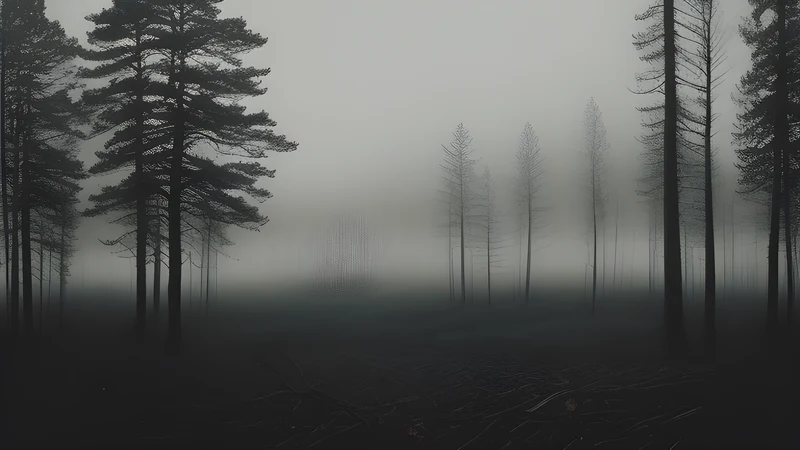
Leonid Kulik of the Soviet Academy of Sciences became convinced a giant meteorite had fallen — one he could recover, with valuable iron for the young Soviet state. He mounted his first proper expedition in 1927. What he found when he finally struggled through to the epicentre reset every expectation he carried in with him. The forest lay flattened across roughly 2,000 square kilometres, some eighty million trees knocked flat and pointing radially outward from a central zone. And at that centre, where he expected a crater and a buried mass of iron, the trees were still standing upright — stripped of branches and bark, scorched, dead, but vertical. There was no crater. There was no meteorite. There was a forest of blackened telegraph poles ringed by a hundred miles of devastation, and nothing to have caused it.
What was really there
Kulik’s empty epicentre is the single fact the whole legend hangs on, so it is worth being precise about it, because conceding exactly what he saw is what makes the ordinary explanation credible rather than dismissive.
The pattern of standing trees at the centre surrounded by radial blowdown is now a signature scientists recognise well: it is what an airburst does. An object entering the atmosphere at tens of kilometres per second heats and compresses the air ahead of it until, several kilometres up, the internal pressure tears it apart in a single detonation. The blast then radiates downward and outward. Directly beneath the burst, the shockwave arrives from straight overhead, so trees lose their branches but keep their footing; further out, the wave arrives at an angle and lays them flat, all pointing away from the point below the explosion. There is no crater because nothing solid reached the ground at speed. The forest itself recorded the geometry of an explosion in the air, and Kulik was standing under it without a framework to read it.
The energy estimates, reconstructed from the blast radius and the seismic and barometric records, put the event in the ten-to-fifteen-megaton range, later revised by some models downward toward three to five. The bright European nights were most likely sunlight scattering off dust and ice lofted high into the atmosphere by the burst. Later Soviet expeditions found microscopic spherules of nickel-rich and silicate material in the soil and peat, consistent with a vaporised cosmic body. Everything the site contains points the same way: an object from space, perhaps sixty metres across, that never touched the ground because it destroyed itself a few kilometres up.
The fork
The record and the mystery part company on one word: what kind of object. And this is where the honest scientific uncertainty — real, ongoing, respectable — gets stretched into something else entirely.
Two natural candidates fit. A stony asteroid around fifty to eighty metres across, entering at a shallow angle, would fragment and detonate at roughly the right altitude and leave exactly the spherules found. A comet fragment — mostly ice — would explode higher and more completely, leave even less residue, and could account for the shining nights through the water and dust it injected upward. The debate between these two has run for decades in the actual literature, and it is unresolved in the way real science is often unresolved: the evidence underdetermines the answer, and reasonable specialists disagree. In 2020 a group of Russian researchers even revived an older idea that no object struck at all, but that a large iron asteroid grazed through the atmosphere and skipped back out into space, its shockwave doing the damage in passing. That, too, is a serious hypothesis under discussion.
But “we know it was a space object and we’re still debating whether ice or rock” is not a satisfying sentence to a certain kind of imagination, because it contains no secret and no agent. So alongside the genuine debate grew a parallel one, and it is the parallel one that made Tunguska famous outside science.
Who carried it, and why it grew
The alternative Tunguskas arrived roughly in the order of the century’s anxieties, which is the tell. In 1946 the Soviet science-fiction writer Alexander Kazantsev published a story imagining the blast as a nuclear-powered Martian spacecraft exploding over Siberia — written, pointedly, the year after Hiroshima, when an airburst that flattened a forest suddenly resembled something humans had just learned to make. The idea escaped the fiction and took on a life of its own: the reported radial burn, the absence of a crater, the “high radiation” (never actually established), all reread as the wreck of an atomic engine.
From there the site accumulated the era’s other preoccupations. When black holes became fashionable, a 1973 paper in Nature — half-serious, quickly rebutted — proposed a tiny primordial black hole passing through the Earth. When antimatter was the frontier, someone proposed an antimatter meteorite annihilating in the air. Nikola Tesla’s admirers decided his Wardenclyffe tower had fired a death-ray across the pole and hit Siberia by mistake, a claim with no basis in Tesla’s actual capabilities or activities but a perfect fit for the myth of the suppressed genius. Each theory is a fossil of its moment’s fears and enthusiasms, pressed into the same blank space Kulik found at the centre of the forest.
This is the mechanism worth naming, because it recurs everywhere the record leaves room. An unexplained event does not stay empty; it becomes a mirror. People looked into Tunguska’s crater-that-wasn’t and saw, in turn, the atom bomb, the flying saucer, the black hole, the death-ray — a fairly complete inventory of twentieth-century dread. The same reflex that reads purpose into an empty desert, the one that turned the Nazca lines into an alien landing strip, reads intention into an empty forest. And the same intolerance of arbitrary catastrophe that keeps the Dyatlov Pass deaths unsolvable in the public mind keeps insisting that Tunguska must have meant something.
The search for physical remains has never quite stopped, and its history is a small lesson in how hard the empty epicentre is to accept. In 2007 a team from the University of Bologna proposed that a small lake eight kilometres from the blast centre, Lake Cheko, might be a crater gouged by a surviving fragment — its funnel shape and position looked suggestive. Other researchers pushed back hard, pointing out that trees older than 1908 appear to grow around the lake and that its sediments seem to predate the event, and the idea has not held up. Meanwhile, painstaking sifting of the peat bogs has turned up microscopic mineral spherules and traces consistent with a cosmic body, the quiet, unglamorous residue that fits an airburst and disappoints everyone hoping for wreckage. A century of expeditions has recovered exactly the kind of nothing an exploding stone or comet would leave.
What it is really about
The deepest pull of Tunguska, underneath the Martians and the death-rays, is the vertigo of realising how close it came. The object, whatever it was, arrived over swamp and reindeer. Shift its arrival by a few hours and the Earth’s rotation would have placed St Petersburg or London beneath it; a city would have been erased, and the twentieth century would have opened with a catastrophe it had no way to explain. That the largest cosmic impact in modern history landed on almost the emptiest inhabited ground on the planet is a coincidence so enormous it feels like it ought to carry a message.
It carries none. That is the hardest part to sit with, and it is why the exotic theories keep their appeal. A Martian ship or a Tesla ray, however absurd, at least implies a story with actors and stakes. A random rock on a random morning implies only that the sky is full of these things and one of them will, eventually, arrive over somewhere that matters — a thought that has, belatedly, produced the entirely real science of planetary defence and asteroid tracking. The people who scan the sky for the next Tunguska took the event more seriously than the ones who invented spacecraft for it, and they arrived at the genuinely frightening conclusion: no author, no warning, and a great many more where that came from.
A hundred years of guesses turned out to be a hundred years of trying to give an accident a purpose. The forest was only ever recording physics. What it recorded was that we live under an open sky, and that on one summer morning in 1908 the sky came very close to the ground.
Related Content