The Slender Man and Folklore Made in Public
A monster with a birth date, a byline, and a paper trail the old legends never left
Contents
Almost every monster we have inherited arrives without a return address. Nobody can name the first person to describe a werewolf, or point to the evening the weeping woman first walked a Mexican riverbank, or produce the manuscript in which a hitchhiking ghost first climbed into a stranger’s cart. The legends reach us already worn smooth, their authorship dissolved into centuries of retelling. The Slender Man is the rare monster that keeps its receipts. We know the forum, we know the thread, we know the date, and we can read the exact two sentences that gave a faceless figure in a dark suit his first outing into the world. He is a piece of folklore we watched being made, in public, over a weekend.
The thread
On the tenth of June 2009 a user of the comedy website Something Awful posted in a thread whose premise was a competition: alter ordinary photographs to make them look paranormal, convincingly enough to fool a hypothetical audience. A member posting under the name Victor Surge, later identified as Eric Knudsen, submitted two black-and-white images of children, into which he had inserted a tall, unnaturally thin figure in a suit, its face a blank. Beneath them he wrote short captions in the register of an archive: dry lines about a mass disappearance, a photographer who vanished, a figure the local authorities called the Slender Man.
That was the whole of it. Two doctored photographs and a few lines of invented provenance, offered as an entry in a game everybody in the thread knew was a game. What happened next is the interesting part. Other users went further than admiring the images; they answered them. They added their own photographs, their own fragments of fake testimony, their own rules about how the creature behaved, whom it took, and how it announced itself. Within days the Slender Man had acquired the things a folk monster needs: a habitat, the deep woods; a prey, children; a method, silent abduction; and a set of warning signs. He had been assembled by a crowd, each contributor building on the last, none of them in charge.
How a crowd writes a legend
Folklorists have a word for the way an audience turns a story into a shared performance, acting it out and adding to it until it feels real: ostension. The Slender Man is one of the clearest cases anyone has ever been able to document, because the whole process left a timestamped trail. The scholar Andrew Peck studied the phenomenon closely and described it as “digital folklore”, arguing that the internet had not replaced the old machinery of legend so much as sped it up and left the workings visible. What once took generations of firesides now took a fortnight of forum posts, and the anonymity of the medium meant no single author could claim the creature or freeze its shape.
The myth grew arms. In the same summer of 2009 a group of filmmakers launched Marble Hornets, a series of short videos presented as found footage from a student film project stalked by the Slender Man, released through YouTube and Twitter as though the events were unfolding in real time. It became one of the defining works of the form, and it demonstrated the second great feature of digital folklore: it is collaborative and cross-platform, jumping from written “creepypasta” to video to fan art to games, each medium adding texture the last could not carry. The figure acquired tendrils, a mythology of “proxies” who did his bidding, a symbol, a static-filled aesthetic. He was open source, and thousands of people were committing to the repository.
Crucially, almost everyone involved knew it was fiction. The pleasure was in the collective pretending, the way a group of children playing a haunted-house game know the house is not really haunted and are frightened all the same. This is the ordinary condition of a great deal of internet horror, and it is the reason the Slender Man belongs on the same shelf as the monster the internet made of him and the later Backrooms, a whole mythology grown from a single unsettling photograph. The knowing is part of the fun. It is also, occasionally, where the danger hides.
The ancestors he never had
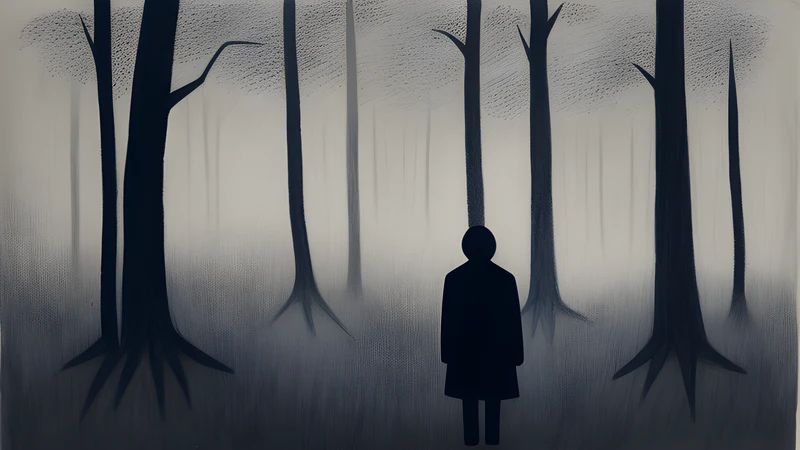
Part of what made the Slender Man feel instantly old was that he was assembled, without anyone planning it, out of parts that were genuinely ancient. The tall thin stranger who steals children is a figure European folklore had carried for centuries under a dozen names, and observers quickly noted the resemblance to Der Grossmann, a bogey from German tales invoked to keep children out of the forest. The blank suited watcher borrowed the uncanny anonymity of the Men in Black from mid-century UFO lore. The static and corruption that clung to him drew on a modern folk belief that electronics fail in the presence of the paranormal. None of these lineages were deliberate. The contributors reached for images that felt right, and the images that felt right were the ones the culture had already spent generations loading with dread.
This is why the argument over whether the Slender Man is “real folklore” or merely a manufactured one tends to miss its target. Every legend was manufactured by somebody, once; the werewolf and the weeping woman had first tellers too, whose names time happened to erase. The Slender Man differs only in that the erasure never took place, so we can see the seams. Watching a crowd reach instinctively for Der Grossmann and the Men in Black, without knowing they were doing it, is as close as we are ever likely to come to observing the raw grammar of legend at work, the deep templates that a culture keeps in reserve and hands out whenever it needs a new shape for an old fear.
Waukesha
On the last day of May in 2014, in Waukesha, Wisconsin, two twelve-year-old girls lured a classmate into a wooded park after a sleepover and stabbed her nineteen times. The victim, Payton Leutner, dragged herself to a path where a passing cyclist found her, and she survived. Her attackers, Morgan Geyser and Anissa Weier, told police they had done it to please the Slender Man, whom they believed to be real and to require a killing as proof of devotion before he would take them to live in his mansion in a nearby forest. The country recoiled. Here at last was the harm the story had seemed to promise, and the headlines named the creature as the culprit.
The truth uncovered in the years that followed was sadder and more complicated. Geyser was found to be experiencing early-onset schizophrenia, hearing voices and holding delusions that had nothing to do with any forum. Both girls were young, isolated and in the grip of a folie à deux, a shared delusion between two people, in which the myth had become the available vocabulary for a break with reality already underway. The 2016 HBO documentary Beware the Slenderman laid out the psychiatric picture with painful care. Both girls were committed to secure mental health institutions rather than prisons. The Slender Man had not reached out of a screen to command a murder; a terribly ill child had reached into the culture for a shape to give her illness, and the culture had this one lying ready to hand.
The author who lost his monster
There is a peculiar footnote to the Slender Man’s success, which is that his creator got almost none of it. Eric Knudsen had made something that behaved less like a story than like a living thing: it reproduced without him, mutated beyond his intentions, and belonged, in every sense that folklore recognises, to nobody. When a feature film and a stream of merchandise eventually arrived, Knudsen’s claim to the character he had drawn was tangled and contested, precisely because he had released it into a form of authorship the law was never built to handle. He had written the first two sentences of a myth, and the myth had done the rest, carried by thousands of hands that owed him nothing and knew, most of them, that this was how legends had always worked.
Some of those hands stopped treating it as a game. A strand of the community came to speak of the Slender Man as a tulpa, a being that belief itself could summon into a kind of reality, on the theory that enough concentrated attention might give a fiction weight in the world. Most who used the word were half playing, enjoying the frisson of pretending the pretence had teeth. But the idea marks the exact seam where digital folklore does its most interesting work, the point at which a story invites its audience to wonder whether telling it often enough might make it come true. That invitation is present in the oldest ghost stories too; the Slender Man simply issued it to a million people at once and left the results where anyone could read them.
The creature also travelled downward in age. Born on an adults’ comedy forum, he seeped through YouTube and gaming channels and schoolyard retelling until he reached children far too young to have seen the original thread or to grasp the wink it came wrapped in. By the time a nine-year-old heard about the tall man in the woods, the frame that marked him as fiction had fallen away in transmission, and what arrived was simply a monster that other children swore was real. This is the ancient life cycle of any playground legend, the loss of the knowing that the first tellers took for granted, and it is the mechanism that turns a shared joke into a genuine fear somewhere down the chain of mouths.
What the story is really about
The temptation, after Waukesha, was to treat the Slender Man as proof that the old fear had been right all along, that fiction bleeds into children and turns them dangerous. The evidence does not support that reading any more than it supported it in the decade parents feared a dice game. Millions of people participated in the myth; a vanishingly small number of deeply unwell children mistook it for instruction. What the case actually reveals is something gentler and more unsettling: that we build our monsters out of whatever material is nearest, and that a sick mind will furnish its delusions from the same cultural shelf a healthy one browses for a thrill.
The deeper fascination of the Slender Man is what he tells us about ourselves as myth-makers. Given a blank figure and a game, a crowd of strangers reached instinctively for the oldest patterns: the thing in the woods, the taker of children, the horror without a face onto which any fear can be projected. Nobody instructed them. The forms welled up because they are how human beings have always organised dread, and the internet simply handed us a mirror in which we could watch ourselves do it in real time. His blankness is the whole secret; a face would have fixed him, and a fixed monster cannot hold everyone’s private terror at once.
That is the quiet marvel underneath the alarming headlines. For the first time in the long history of monsters we possess a complete case file on the birth of one: the thread, the captions, the contributors, the mutations, the leap into video and the leap into a courtroom. Scholars will be studying the Slender Man for as long as they study the werewolf, and with a luxury they never had before, the ability to read the myth’s first draft. He was made by people who knew he was made, which is why he tells us so much about the ones who make the monsters that do not leave a paper trail. Somewhere in the shape of a faceless man in a suit is the plainest proof we have of how badly the species wants a shape for the thing waiting in the trees.
Related Content