The Roswell Balloon and Project Mogul
There really was a secret at the crash site, and it really was classified
Contents
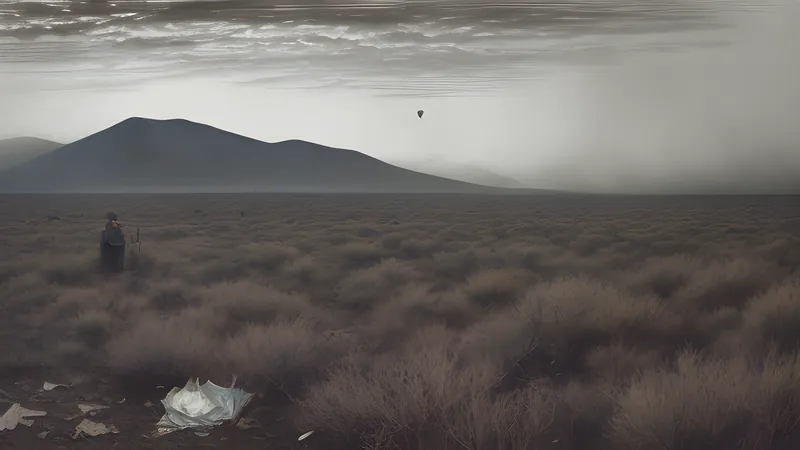
In the first week of July 1947, a ranch foreman named William Brazel rode out to check his sheep on the Foster ranch, in the high desert near Corona, New Mexico, and found a field strewn with wreckage. There was a great deal of it: sticks, greyish rubber, tough foil-like sheeting, tape with faint pinkish markings, and lengths of a material that some later said sprang back into shape when crumpled. Brazel gathered a few pieces, mentioned it to neighbours, and in time drove into the county seat and told the sheriff, who put him in touch with the Army air field at Roswell, some seventy-five miles away.
What happened next is the reason we still say the word Roswell. On 8 July 1947 the public information officer at Roswell Army Air Field, Lieutenant Walter Haut, issued a press release announcing that the base had recovered a “flying disc.” The Roswell Daily Record ran the story under a headline about the Army capturing a flying saucer, and it went around the world in hours. The next day the Army walked it all back: at Fort Worth, General Roger Ramey displayed torn foil and balsa before the press and said the object was a weather balloon, and a warrant officer duly identified it as such. The saucer became a balloon overnight, the papers moved on, and the whole affair went quiet for thirty years. The interesting part is that the second, deflating story was also a lie — just a smaller one than the myth that eventually grew.
The kernel: a real secret in the desert
To take Roswell seriously you have to start with what was genuinely there, because it was genuinely secret. The debris almost certainly came from Project Mogul, a classified programme run by the US Army Air Forces to detect Soviet atomic tests from a distance. The idea was elegant and, at the time, urgent. The Cold War had begun, the United States expected the Soviet Union to build a bomb, and there was no reliable way to know when it happened from the other side of the world. Mogul’s answer was to hang sensitive microphones in the stratosphere, in a layer of the atmosphere where sound travels for enormous distances, and listen for the low rumble of a nuclear blast carried around the globe.
Doing that required lofting long trains of balloons — strings of neoprene envelopes carrying instruments, radar reflectors and acoustic sensors, far more elaborate than the single weather balloon of the later cover story — launched from Alamogordo Army Air Field. One of these, catalogued as Flight 4, was launched in early June 1947 and its telemetry was lost as it drifted north-east across exactly the country where Brazel found his field of wreckage. The materials match what Brazel described in convincing detail. The tough foil-and-balsa sheeting was a radar reflector, a folding target made of foil-backed paper on light wooden struts. The “memory metal” was that same foil, which does spring back when crumpled. The “alien hieroglyphics” were the reinforcing tape used on the reflectors, printed by a novelty manufacturer with small geometric and flower-like figures. Everything Brazel gathered has a mundane origin, and every mundane origin was, in 1947, a state secret.
That is the crucial thing to hold onto. The Army did cover something up at Roswell. The weather-balloon story was a fabrication, deployed precisely because the truth — that the debris belonged to a classified programme for spying on Soviet bomb tests — could not be spoken aloud. There was a real secret, real classification, and a real official lie. The soil of the whole legend is a genuine government deception. The myth did not grow out of nothing; it grew out of the fact that people had correctly sensed they were being told a cover story, and were right.
The thirty-year silence, and who broke it
For three decades Roswell was a forgotten footnote. It came back to life in the late 1970s, when the nuclear physicist and UFO researcher Stanton Friedman happened to be introduced to Jesse Marcel, the major who had gone out to the Foster ranch in 1947 to recover the debris. Marcel, by then retired and interviewed long after the fact, said he had never believed the weather-balloon explanation and that the material he handled was unlike anything he knew. Friedman and others took that thread and pulled.
In 1980 Charles Berlitz and William Moore published The Roswell Incident, which assembled interviews conducted more than thirty years after the events into a narrative of a crashed craft and a cover-up. From there the story accreted, in the way such stories do, gathering new witnesses and new details across the 1980s and 1990s. Where the 1947 accounts described a field of foil and sticks, the later versions supplied a largely intact disc, then alien bodies, then a military autopsy, then a second crash site, then hushed deathbed testimonies. Each retelling added a layer, and memories recorded decades later are famously porous, prone to absorbing what the interviewer expects and what the culture has since supplied. By the 1990s Roswell had become the founding scripture of the belief that the United States government was hiding extraterrestrial hardware.
The fork: from balloon train to spaceship
This is the precise point where the myth leaves the record, and it is worth marking carefully, because the departure runs from one secret to a grander one, keeping the shape of the cover-up while enlarging its contents. The documented reality is a classified balloon programme and an official cover story. The mythic version keeps the cover-up, which is real, and swaps out its contents, replacing a Cold War listening device with an interstellar craft and its crew. The emotional logic is seamless: if the government lied once, as it demonstrably did, then perhaps it is lying still, and about something far bigger.
The alien bodies are the clearest case of a real thing migrating into the wrong story. In the 1990s the US Air Force, under pressure from a congressional inquiry, produced two lengthy reports, The Roswell Report: Fact vs. Fiction in the New Mexico Desert in 1995 and The Roswell Report: Case Closed in 1997. The first laid out the Project Mogul explanation in detail from surviving records and the recollections of the men who launched the balloons. The second addressed the bodies, and its answer was oddly poignant. Through the late 1940s and 1950s the Air Force had dropped anthropomorphic test dummies from high-altitude balloons over New Mexico in parachute research, life-sized figures with featureless faces and articulated limbs, recovered afterwards by military crews. The reports argued that decades-old memories had compressed and merged these dummy recoveries, along with real air-crash casualties, into a single tale of little bodies gathered from a saucer. Whether or not every detail of that reconstruction is right, its shape is instructive: once again a real, documented, half-hidden military activity had been folded into the alien narrative.
The documents that arrived too conveniently
As the legend matured it began to generate its own paperwork, and the paperwork tells its own story about how belief manufactures evidence. In 1984 a roll of film arrived unsolicited in the post to the researcher Jaime Shandera, containing what purported to be a briefing document for President-elect Eisenhower describing a secret committee, “Majestic 12” or MJ-12, of scientists and officers convened to manage recovered alien craft and bodies, Roswell’s included. The documents were seized on as proof of the cover-up. Careful examination undid them: the typography, the date formats and a signature apparently lifted from another letter all pointed to a modern fabrication, and the FBI eventually stamped its own copy “bogus.” No original has ever surfaced in any archive.
The bodies acquired their own fake footage too. In 1995 a London-based producer, Ray Santilli, released grainy black-and-white film purporting to show a military autopsy of a Roswell alien, and it was broadcast around the world to enormous audiences. More than a decade later Santilli conceded that the footage was a staged reconstruction, filmed in a flat in Camden with a dummy of latex, sheep brains and chicken entrails, which he defended as a re-creation of genuine film he claimed had degraded. What matters is the pattern: at each point where the story needed harder evidence than a field of foil could provide, evidence duly appeared, and each time it turned out to have been made to order. A myth that has outgrown its facts will grow its own, and the manufactured proofs are a symptom of the hunger rather than a cause of it.
There was also a real official reckoning, prompted from inside the system. In the early 1990s Congressman Steven Schiff of New Mexico, unable to get straight answers, asked the General Accounting Office to investigate what records existed. The GAO’s 1995 report found that many relevant administrative files from Roswell Army Air Field in 1947 had been destroyed years earlier without explanation, a finding believers read as a smoking gun and archivists read as the routine, careless attrition of mid-century paperwork. The inquiry is what pushed the Air Force to publish its two reports, and so the government’s fullest accounting of Roswell exists precisely because a congressman took the cover-up seriously enough to demand the files.
Why the correction never took
The Air Force reports are thorough, and to a documentary historian they close the case. They did almost nothing to dent the belief, and understanding why is more revealing than the debunking itself. A government that has admitted lying once has no clean way to be believed the second time. When the same institution that said “weather balloon” in 1947 says “actually it was a different secret balloon” in 1994, the admission of the first lie poisons the credibility of the second explanation. The very honesty of conceding Mogul reads, to a suspicious mind, as a more sophisticated cover story. The structure of a real cover-up makes every subsequent truth-telling look like another layer of the same operation.
There is also the matter of who was doing the remembering. Jesse Marcel was a real officer who really did recover the debris and really was made to pose with weather-balloon wreckage he did not believe in, for a photograph meant to end the story. His resentment was genuine and earned. When such a man says, thirty years later, that he was lied to, he is telling the truth, and the truth he tells is that the official account was false. That is entirely compatible with the debris being a balloon train — but it feels like corroboration of a cover-up, because it is corroboration of a cover-up. The witnesses to the deception were authentic, which lent their later, embellished testimony a credibility it could not otherwise have had.
What the desert was really hiding
Strip Roswell back to its bones and it is a story about a population correctly detecting that it was being deceived, and then filling the shape of the deception with the largest thing imaginable. The instinct was sound. Something was recovered, something was classified, and the public was fed a fabrication. In 1947, at the dawn of the atomic age and the security state, ordinary people had just been handed a vivid lesson that their government kept enormous secrets and would lie to their faces to protect them. Roswell arrived at the exact moment that lesson was sinking in, and it gave the new distrust a place to live.
The saucer, in that light, is a way of naming a true feeling with a false object. The feeling — that vast machinery operates out of sight, that we are told cover stories, that the desert holds secrets we are not cleared to know — was accurate, and the Cold War would prove it again and again in the decades that followed. Roswell endures because it began with a genuine secret and a genuine lie, and because no later disclosure can ever fully satisfy a suspicion that was, at its root, correct. The believers standing in that New Mexico field are guarding a real insight about power and secrecy, wrapped around a balloon.
For more on the machinery of official UFO secrecy and the myths it breeds, see Roswell’s balloon that became a spaceship, Area 51, the Betty and Barney Hill abduction, the foo fighters and the Phoenix Lights.
Related Content