The Phoenix Lights and the Flare Explanation
Two separate events over Arizona, folded into one enormous craft
Contents
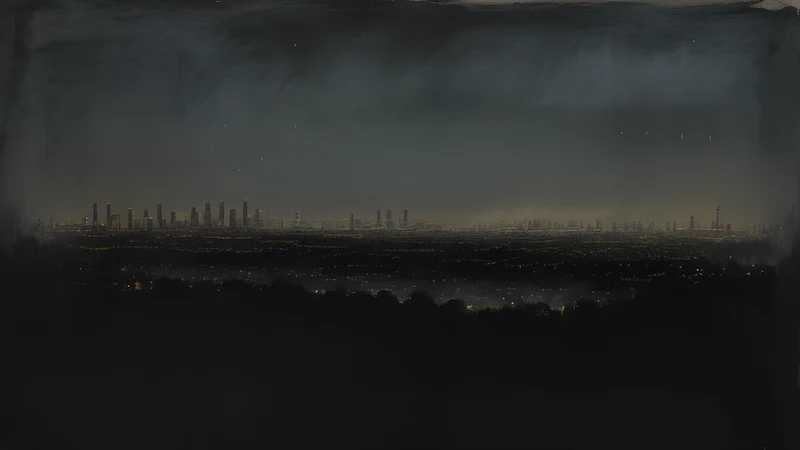
On the clear evening of 13 March 1997, thousands of people across Arizona looked up and saw lights in the sky they could not explain. The reports ran the length of the state, from Paulden and Prescott in the north down through Phoenix and on towards Tucson, and they came from ordinary, sober witnesses: families in gardens, drivers pulled over on the highway, a former pilot, a police officer. Many described an immense V or boomerang of lights gliding overhead in silence, so large it seemed to blot out the stars behind it, so low and so slow that it felt less like an aircraft than a passing landscape. It became one of the most witnessed unidentified aerial events in American history, and the phrase “the Phoenix Lights” entered the language as a byword for a genuine modern mystery.
The enduring power of the case comes from a sleight the story performs almost invisibly. There was not one event over Arizona that night. There were at least two, separated by roughly two hours and by tens of miles, with different appearances and, as it turns out, different explanations. The legend of the mile-wide craft survives by quietly merging them into a single object, and untangling them is the whole of the work. One of the two events, the one most people have actually seen on video, has an explanation that the military confirmed: it was flares.
The night, told straight
Set the two events side by side as they happened. The first came at around half past eight in the evening. A formation of lights, arranged in a broad V or chevron, was reported first far to the north, near Paulden, then tracked steadily south over Prescott, over the Phoenix metropolitan area, and away towards Tucson, covering the length of the state over the better part of an hour. Witnesses under it described a coherent shape moving in eerie silence, the lights holding a fixed pattern as though fastened to a single enormous body passing overhead.
The second event came at around ten o’clock, and it is the one preserved in most of the famous footage. A row of bright lights appeared in the sky to the south-west of Phoenix, over towards the Estrella mountains. They did not travel across the city; they hung more or less in place, appeared one after another, glowed for minutes, and then faded and dropped from view one by one. It is this second set of lights — stationary, slowly extinguishing, filmed by residents on camcorders — that most people picture when they think of the Phoenix Lights, even though the descriptions that give the case its grandeur, the silent craft blotting out the stars, belong to the earlier event.
The kernel: the flares were real
Start with the confirmed fact, because there is one, and it is solid. On the night of 13 March 1997 the airspace south-west of Phoenix included the Barry Goldwater Range, a vast military training area in the desert. A unit of the Maryland Air National Guard, flying A-10 attack aircraft, was conducting an exercise that involved dropping LUU-2 high-intensity illumination flares over the range. These are parachute flares designed to light a battlefield from above; each burns fiercely for minutes while drifting slowly down under its canopy.
Seen from the city, twenty or more miles away, a stick of such flares released in sequence would appear as a row of brilliant lights hanging in the sky to the south-west, holding position because the flares descend slowly and the distance flattens their motion, then winking out one by one as each burned to its end or sank behind the Estrella mountains. That is an exact description of the ten o’clock event. The identification was not a sceptic’s guess; the military eventually confirmed that the flare drop had taken place, the timing and location matched, and independent analysts reconstructed the geometry, showing how the line of lights and the order in which they faded fitted flares descending behind the mountain ridge. For the event captured in most of the footage, the explanation is documented and dull.
The fork: two events become one craft
Here is where the myth leaves the record, and the departure is a specific and understandable error. The most spectacular testimony — the silent V so vast it hid the stars — comes from the eight-thirty event, an hour and a half before the flares. The most striking video — the row of hanging lights fading in sequence — comes from the ten o’clock flare drop. In the retelling these two fused. Footage of the flares was played alongside descriptions of the giant craft, and audiences understandably assumed they were watching the object the witnesses described. A stationary line of lights over the mountains and a moving chevron over the city became, in the popular account, one enormous triangular ship that had first crossed the state and then paused above it.
The earlier event has its own more prosaic candidates, and while it is less cleanly settled than the flares, the leading explanation is a formation of high-flying aircraft. On the night, an amateur astronomer in the Phoenix suburbs named Mitch Stanley pointed his telescope at the moving V as it passed and reported that, magnified, it resolved into individual aircraft flying in formation, each a separate craft with its own lights, the “solid” shape between them being an illusion of the dark sky. A line of aircraft passing at altitude and steady speed can read, to the naked eye, as a single connected structure, especially when the mind is already reaching for something extraordinary. The chevron was very likely several objects the observer’s brain stitched into one.
The governor who laughed, then confessed
No figure captures the case’s strange trajectory better than Fife Symington, the governor of Arizona in 1997. In the weeks after the sightings, with the state’s phone lines lit up and the press demanding answers, Symington held a press conference at which an aide was marched out in an alien costume, a piece of theatre meant to defuse the panic with a joke. The governor played the sceptic-in-chief and told the public, in effect, to calm down.
A decade later, in 2007, Symington said something quite different. He revealed that he had himself gone outside on the night of 13 March 1997 and watched an enormous craft pass silently overhead, and that he considered it genuinely unexplained and probably not of this world. He had staged the mockery, he said, to prevent hysteria while privately being as unsettled as anyone. His reversal is often cited as proof that the case cannot be explained. It is better read as a demonstration of how the two events tangle even in the mind of a single careful witness: Symington described the moving craft of the earlier event, the one the aircraft-formation explanation addresses, while the public debate around him was fixated on the flare footage of the later one. A governor could hold both halves of the confusion at once.
Why the flare answer never satisfied
The flare explanation is confirmed, and it changed almost nobody’s mind, which is worth sitting with. Part of the reason is that it only ever addressed one of the two events, and the more emotionally powerful event — the silent behemoth over the city — was left to a less tidy answer involving aircraft that most witnesses never saw resolve into separate planes. When an official explanation accounts for the footage but not for the feeling, it lands as an evasion. People who had stood beneath the great chevron knew that flares behind a mountain were not what they had experienced, and they were right, because they had seen the other event.
There was also the texture of the witnessing itself. This involved thousands of people, many of them credible, describing something with real consistency over a wide area, well beyond a handful of excitable observers. The scale of the testimony gave the case a democratic weight that a single sighting never has. To be told that the row of lights was flares can feel, to someone who watched a silent shape cross the whole sky, like being corrected about a thing they were not even talking about. The official answer was true and partial, and partial truths from authorities are exactly the diet on which suspicion thrives.
The lights that kept coming back
One reason the flare account is more than a convenient theory is that Phoenix has produced the same effect again, under conditions that could be checked. The A-10 units that train in Arizona deploy to the desert each winter, and flare drops on the Barry Goldwater Range are a routine part of that work, so the ingredients that produced the ten o’clock lights of 1997 are present in the sky over Phoenix on many nights. In February 2007 and again on other occasions, residents reported and filmed hanging rows of lights of the same character, and the pattern of a line of slow, silent, fading lights to the south-west kept recurring in step with military activity on the range. A phenomenon that repeats whenever a known cause is present, and matches that cause in position and timing, is behaving exactly as an explanation predicts.
There was also at least one recurrence that was openly a prank, and it is instructive. In April 2008 lights appeared over Phoenix in a formation that briefly reignited the whole excitement, and within days a local resident admitted he had tied road flares to helium balloons and released them from his yard to see what would happen. The answer was that a handful of flares on balloons, drifting in the dark, could once again convince a city that something uncanny was overhead. That a backyard hoaxer could reproduce the essential impression with hardware bought from a shop proves nothing about the 1997 events on its own, though it vividly demonstrates how little it takes, in a dark desert sky, to manufacture a mystery from a few burning lights.
The 1997 case also had a tireless documentarian in Lynne Kitei, a Phoenix physician who photographed lights from her home and spent years assembling witness accounts into a book and a 2005 film that kept the story in front of the public. Her sincerity is not in doubt, and her archive is part of why the case never faded. It also illustrates how a single dedicated chronicler can hold a legend together across decades, curating the most dramatic testimony, foregrounding the great silent craft over the mundane flare footage, and giving the whole a coherence and momentum that the scattered events of one night never had on their own. Legends need keepers, and the Phoenix Lights found a devoted one.
What the desert sky was really for
Underneath the Phoenix Lights is something gentler than a cover-up and more interesting than a mistake. Two ordinary things happened in the Arizona sky that night — a formation of aircraft passed over, and a military unit dropped flares on a range — and thousands of people, watching a clear desert sky where the horizon runs for a hundred miles and the stars are close, assembled those things into a single wondrous object. The desert is a landscape built for this. Its darkness and distances flatten depth and scale, its clarity makes lights vivid, and its emptiness gives the mind room to reach.
The reaching is the real subject. A great silent craft passing over a modern American city answers a wish that the sky is still capable of astonishing us, that something vast and deliberate might yet cross overhead and change what we know. Thousands of Arizonans wanted, at some level, to have seen exactly that, and the sky gave them enough raw material to build it. The flares are confirmed and the aircraft are likely, and the wonder people felt was completely real, which is why the case keeps its hold. Understanding the Phoenix Lights means understanding how much a wide dark sky and a hopeful crowd can make of a few ordinary lights, and how reluctant any of us are to give the wonder back once we have felt it.
For more on lights in the sky and the explanations that trail them, see the Belgian UFO wave, the Hessdalen lights, the Marfa lights, the Brown Mountain lights and, for a harder case, the Cash-Landrum incident.
Related Content