The Ozark Howler: A Cryptid Built by a Prank
A student's 1998 bet, a planted paper trail, and the machinery that turns an email into a monster with a history
Contents
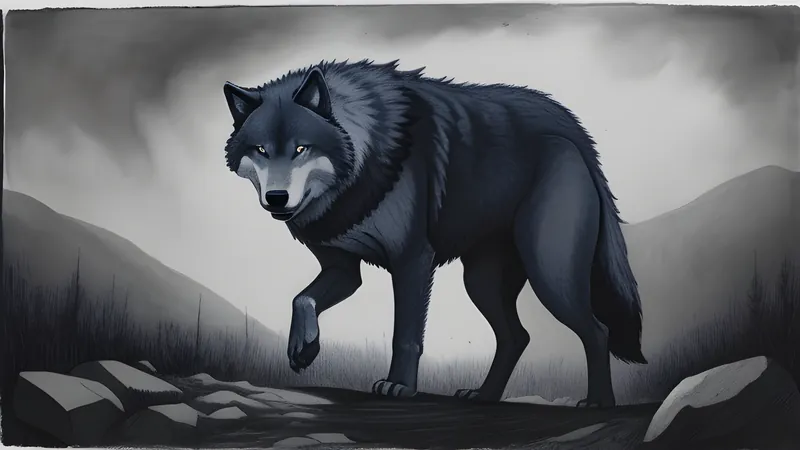
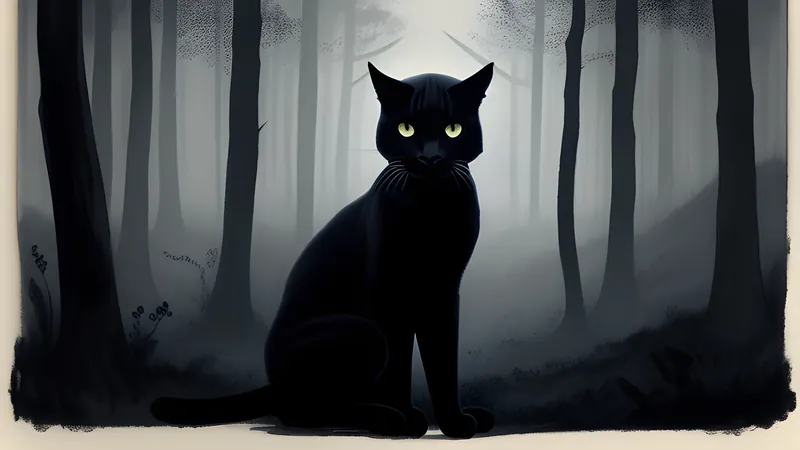
Sometime in the late 1990s, a University of Arkansas student watched the chupacabra spread across the young internet — from a first sighting in Puerto Rico in 1995 to a continent-wide panic in a couple of years, carried on email chains and early message boards — and made a bet. He was convinced the cryptozoology community would swallow anything if it arrived dressed the right way, and he set out to prove it by building a monster from scratch. The animal he invented was the Ozark Howler: a creature the size of a bear, black and shaggy, with thick stocky legs, glowing red eyes, and a pair of prominent horns, whose cry was said to be a wolf’s howl crossed with an elk’s bugle rolling out of the hollows of the Arkansas and Missouri hills. Within a few years the Howler had websites, sightings, a physical description precise enough to draw, and a foothold in the reference literature. The student had won his bet. What he had also done, without quite meaning to, was leave behind a clean laboratory record of how a modern legend actually gets assembled.
The bet, and the man who caught it
The story of the hoax survives because the student aimed too high. Part of the plan was to get the Howler into print in a book being written by Loren Coleman, one of the best-known figures in American cryptozoology, who was then compiling Cryptozoology A to Z with his co-author Jerome Clark. A fabricated creature that made it into a respected encyclopaedia would acquire the one thing a hoax cannot manufacture for itself: an authoritative citation, a place other writers could footnote. So the emails came in — sighting reports, historical references, inquiries — pushing the Howler toward Coleman’s desk.
The hoaxer made one careless move. To lend one of his email inquiries authority, he signed it with the real name of a prominent Memphis physician. Coleman, doing the unglamorous work that separates a researcher from a stenographer, phoned the doctor’s office to check, and the physician confirmed he had never heard of the Ozark Howler and had sent no such message. From that thread Coleman traced the correspondence back to a University of Arkansas student — referred to in the retelling under the alias “Cook” — and confronted him. Cook agreed to confess in full on one condition: that Coleman not publish the real doctor’s name he had misappropriated. Late in May 1998, Cook explained exactly what he had done and why. He had wanted to see whether a determined amateur could bend the belief-machine to his will, and he had very nearly got a phantom into a hardback.
The three tricks that make a monster feel old
What makes the Ozark Howler such a useful specimen is that Cook, in trying to be convincing, reverse-engineered the exact features a legend needs to feel real. The first is a coherent physical description. A vague “something in the woods” travels poorly; a bear-sized black beast with horns and red eyes and a very specific, unusual, two-animal cry gives every would-be witness a template to match their half-second glimpse against. Give people a precise enough picture and some of them will start seeing it, because perception in poor light is mostly the brain reaching for the nearest available pattern.
The second trick is manufactured antiquity. Cook reportedly built multiple websites, the point of which was to seed the impression that the Howler had a long history — that sightings ran back well before his emails, that the thing had been part of Ozark lore for generations. This is the single most important move in the whole operation, because a legend with a pedigree is nearly unkillable. If the Howler is only as old as one student’s prank, exposing the prank ends it. If the Howler has “always been in these hills,” then the prank is just a footnote and the creature sails on. Antiquity is armour, and Cook knew to forge it.
The third trick is the authority-laundering he tried on Coleman: get the invention cited by a trusted source, and let everyone downstream inherit the citation without checking where it came from. This is how a great deal of dubious material becomes “well documented”: each writer trusts that the previous writer already verified it, and nobody actually does. Cook understood the plumbing of belief well enough to try to inject his creature at the source.
The confession that couldn’t catch up
Here is the part that turns the Ozark Howler from a simple hoax into a genuine lesson in how belief outruns correction. Coleman got his full confession in 1998 and intended to tell the true story in Cryptozoology A to Z. But when the book was finalised, its Simon & Schuster editors cut the hoax-related entries to trim length, and the account of the Howler’s fraudulent origins was among the material dropped. So the book came out without the debunking — and the correction that would have travelled with real authority simply never got printed. Cook’s fabrication had a head start of several years and a set of purpose-built websites; the truth had one researcher and a deleted manuscript entry.
The result is exactly what you would predict. Search for the Ozark Howler today and you will find it treated across countless pages as a straightforward regional cryptid, described in loving physical detail, often with confident assertions that its sightings “stretch back to the early 1800s” and that it once crossed paths with Daniel Boone in Missouri. Those older pedigrees are precisely the manufactured antiquity the hoax was designed to create, now recirculated by writers who never encountered the confession because the confession never made it into the book that would have carried it. The mechanism worked. The lie was structured to survive its own exposure, and it did.
Why a debunked creature won’t die
There is a genuine complication that the pure-hoax account has to be honest about, and it is the same complication that lets the Howler persist. The Ozark Mountains really did have, long before 1998, a folk tradition of eerie nocturnal howls and elusive dark predators — settlers in nineteenth-century Arkansas and Missouri told of unidentified beasts and strange cries in the hollows, and the region has a durable “black panther” legend of a large melanistic cat that biologists insist has never lived there. Cook did not invent the Ozarks’ unease about their own dark woods. What he did was give that pre-existing, formless unease a brand name, a face, and a fake paper trail — and because there was real folkloric soil for it to root in, the invented creature grew where a wholly baseless one might have withered. This is why “it’s just a hoax” is an incomplete answer. The hoax succeeded partly because it was planted in ground that was already primed.
That is the uncomfortable, interesting truth underneath the Ozark Howler, and it is the same truth that surfaces whenever a fabricated monster refuses to die: the fabrication and the folklore are not opposites. A good hoaxer does not build in a vacuum. He finds an existing anxiety — a region’s sense that its woods are not fully known, its nights not fully accounted for — and he gives that anxiety a shape specific enough to repeat. Compare the Michigan Dogman, which began as a radio DJ’s 1987 April Fools’ song and hardened into a creature people now report seeing in earnest. In both cases a known, dated, admitted invention became a “real” cryptid because it dropped into a landscape that wanted one, the way the Skunk Ape grew from a genuine Seminole tradition rather than from nothing.
The folklorist who documented the real soil
The “real folkloric soil” is not a vague gesture — it has a name attached. Vance Randolph, the Ozark folklorist who spent decades in the 1920s through the 1950s collecting the region’s oral traditions door to door, published Ozark Superstitions in 1947 and Ozark Magic and Folklore in 1964, both still standard references for what hill communities in Arkansas and Missouri actually believed before radio and television homogenised rural culture. Randolph recorded genuine local traditions of strange nocturnal cries, unaccountable animal tracks, and a black panther that biologists have never confirmed in the region, all gathered directly from Ozark residents decades before Cook ever opened a web browser. Cook did not need to invent an Ozark tradition of things that howl in the dark. Randolph had already documented, and carefully sourced, that the tradition existed.
That distinction matters for judging exactly what Cook accomplished. He did not fabricate an anxiety from nothing — the Ozarks’ unease about their own back hollows was real, collected, and published a half-century before his prank. What he fabricated was a single, specific answer to that anxiety: a named animal, a physical description, a manufactured citation trail. The forgery sits on top of genuine folklore the way a counterfeit banknote sits on top of a real economy — it only works because the underlying system it is imitating is itself trustworthy and well established.
From Usenet to the group chat
Cook’s method also belongs to a specific, dateable moment in internet history. The mid-to-late 1990s were the tail end of the Usenet era, when newsgroups like alt.folklore.urban had spent years training a small community of enthusiasts to trade, test, and occasionally deliberately plant unverifiable stories just to see how far they would travel before someone called them out. Cook’s use of email chains, freshly built websites, and a planted citation to a named professional reads like a graduate-level application of exactly those Usenet-era tricks, aimed for the first time at a target — a hardcover reference book — durable enough to outlive the conversation that produced it.
What has changed since 1998 is speed, not method. A modern equivalent of Cook’s project does not need years to build websites and wait for an encyclopaedia deadline; a single convincing video or a well-timed post can reach millions of people and harden into “common knowledge” within days, sometimes hours, long before any Loren Coleman figure has time to place a verifying phone call. The Ozark Howler moved at the pace of 1998’s internet — dial-up modems, static web pages, a manuscript with a print run — which is exactly why its whole life cycle, hoax to confession to editorial cut to durable legend, is slow enough to watch happen. A twenty-first-century version would compress the same arc into a single news cycle.
What the Howler teaches
The Ozark Howler is the closest thing the field of belief has to a controlled experiment, and its findings are unflattering to all of us. A single motivated person, armed with nothing but email and a few websites, can manufacture a creature complete with description, history, and the beginnings of a scholarly citation, in a couple of years, for the price of a bet. The correction can be true, sourced, and confessed, and still lose the race simply because an editor cut it for length and it never got the distribution the lie enjoyed. And the whole thing works best when it is planted in the soil of a real, older unease, so that the invention feels less like something new than like something finally named.
None of that requires anyone to be stupid. The people who repeat the Howler today are doing the ordinary, reasonable thing of trusting sources that seemed trustworthy, in a landscape where the debunking was quietly removed before it could reach them. That is the machinery worth understanding, because it did not switch off in 1998. It runs every day now, faster and at greater scale, on every platform we have. The Ozark Howler is valuable precisely because we happen to know, for certain, where it came from — and can therefore watch, in slow motion, how thoroughly that certainty failed to stop it. The next manufactured creature will not come with a signed confession attached. This one did, and it barely mattered.
Related Content