The Owlman of Mawnan: Cornwall's Answer to Mothman
A winged shape over a Cornish church tower, a handful of young witnesses, and a showman-artist who knew exactly how to raise a monster
Contents
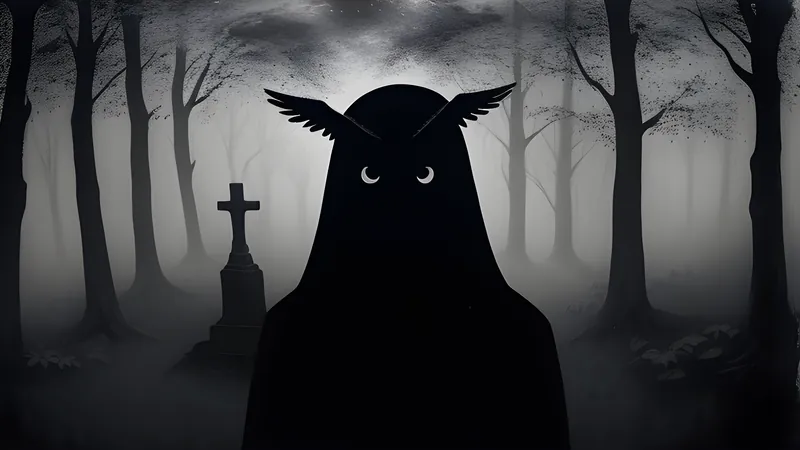
In April 1976, two sisters on a family holiday in Cornwall — June and Vicky Melling, aged nine and twelve — came running back to their father to say they had seen a great feathered creature, like a man with wings, hovering above the tower of the old church at Mawnan, a village tucked into the wooded creekside near Falmouth. Their father, an antiques dealer named Don Melling, was so unsettled by the state of them that he cut the holiday short and drove the family home, and he refused to let the story be photographed or pursued. That should have been the end of it: a fright, a spoiled holiday, a tale two children would tell for years.
Three months later, in July, two teenage girls camping in the woods near the same church, Sally Chapman and Barbara Perry, both fourteen, said they saw something too — a figure the size of a man, covered in grey feathers, with pointed ears, glowing red eyes, and black claws like pincers. It rose into the air, they said, and they heard a hissing sound as it went. From those two encounters, a few months apart, around one small churchyard on the Helford River, grew the legend of the Owlman of Mawnan, which the Fortean press would soon be calling Cornwall’s answer to Mothman. The interesting question is less what flew over the church than how a couple of children’s frights became a durable British cryptid — and who made sure it did.
A church, a wood and a name
Mawnan Old Church is a genuinely atmospheric place, and any honest account of the Owlman should start by conceding it. St Mawnan’s sits low among trees above the Helford estuary, reached by a sunken lane, hemmed by dense woodland that runs down to the water; it is old, quiet and easy to feel watched in. Cornwall carries a heavy freight of folklore — piskies, spectral hounds, the drowned bells of lost churches — and a wooded churchyard at dusk is precisely the setting in which that inheritance switches on. The children who reported the Owlman were not lying about being frightened, and the place gives their fear a plausible home.
There is a mundane candidate for the creature itself, and it is a good one. The Eurasian eagle-owl, Bubo bubo, is among the largest owls in the world: it stands close to two-thirds of a metre tall, spans more than a metre and a half at the wing, wears prominent ear tufts, and has large forward-facing eyes that flare bright orange in a low light. Eagle-owls rarely breed in the wild across most of Britain, yet escaped and released captive birds have long been present, and one loose in Cornish woodland — perched on a tower, then launching low over a child’s head with a hiss — matches the reported Owlman closely enough that the naturalist’s explanation barely has to strain. A large, unfamiliar owl seen at twilight by a frightened child could carry every feature in the original accounts.
Escaped eagle-owls are a real feature of the British countryside rather than a hypothetical one. The birds are kept by falconers and private collectors, they are powerful fliers that regularly go missing, and free-living individuals have turned up and even bred in parts of Britain in the decades since. An owl of that size crossing a clearing at head height, wings spread and eyes catching the last of the light, is a genuinely startling thing for an adult who knows exactly what it is. To two children at dusk beside an old church, with no name for the shape and every nerve already primed by the place, the same bird could very reasonably become a man with wings.
The man who raised the monster
What lifts the Owlman out of the ordinary catalogue of misidentified owls is the figure who took charge of the story. Tony Shiels — “Doc” Shiels, a painter, stage magician, showman and self-described “surrealchemist” and wizard, living in Cornwall — became the case’s chief chronicler and promoter, and he was candid, in his own oblique way, about treating monster-raising as a kind of performance art. Shiels believed that the right ritual, the right expectation and the right theatrical framing could actually call creatures up, or at least call up the belief in them, which he seems to have regarded as much the same thing. He was already famous in Fortean circles for the surrounding year: in 1977 he would produce the notorious “Loch Ness Muppet” photograph, one of the more theatrical Nessie images ever taken, and his fingerprints are on several of the era’s British monster flaps.
This is where the Owlman’s evidential base grows soft. A striking amount of what we know about the sightings reaches us through Shiels — his correspondence, his articles in Fortean magazines, his retellings — and independent verification of the witnesses has always been thin. Some later researchers have questioned whether every reported witness can be firmly traced at all, and whether names, ages and details firmed up in the telling. None of that proves the original children invented anything. It means the pipeline from a scared child at a churchyard to a named cryptid in a magazine ran through a man whose stated artistic project was the manufacture of exactly such legends, and who found the ambiguity delicious. When your primary source is a self-declared wizard who thinks a good monster is a work of art, the chain of evidence deserves a careful eye.
The wizard’s other monster
Shiels was working the same stretch of coast on a second creature at the very same time, and the overlap is the clearest window into his method. Through 1975 and 1976, Falmouth Bay and the Helford estuary produced a run of sea-serpent sightings — a long-necked, humped creature that locals and the press christened Morgawr, the Cornish for “sea giant” — and Shiels was again at the centre of the flap, staging seaside rituals to “raise” the monster, coaxing photographs into existence, and feeding the results to the Fortean magazines. The Owlman appeared in the woods above the same water in the same months. One man, in one small corner of Cornwall, was simultaneously midwife to a lake-style sea serpent in the bay and a winged humanoid over the churchyard, both reaching the wider world largely through his own hands. That is either the luckiest patch of haunted coastline in Britain or the signature of a single imagination working overtime, and Shiels, who called himself a wizard and meant it as a job description, would not have minded which conclusion you drew.
How the legend grew back for more
Real folklore is greedy; once a monster has a name and a location, the location keeps producing it. The Owlman returned to Mawnan in the record in 1978, and again in 1989, and once more in 1995, each wave bringing fresh witnesses who described the familiar grey feathers, the pointed ears, the red eyes. That pattern is itself the folkloric tell. A single misidentified owl does not explain sightings nearly two decades apart; a well-known local legend, attached to a specific and easily visited spot, absolutely does. People who go to a wood expecting the Owlman, at dusk, primed by the story, are people unusually likely to resolve a shape in the trees into the thing they came to find. The place had become a stage, and the stage kept drawing performers.
Some of the later encounters added new texture. One 1989 visitor described the creature standing among the trees rather than flying; an account from 1995, attributed to an American tourist, reached a Fortean researcher describing a winged figure over the same field. Each fresh report was duly folded into the growing file. The folklorists Janet and Colin Bord catalogued the Owlman in their surveys of British anomalies, and Fortean Times kept the case in circulation for readers far from Cornwall. None of this produced a photograph, a feather, a nest or a body; what it produced was a bibliography. A monster with a memorable name, a fixed address and a steady trickle of accounts can live indefinitely on paper, and the Owlman has done exactly that for close to fifty years without leaving a single physical trace.
The Owlman also found its scholars. Jonathan Downes of the Centre for Fortean Zoology, based over the border in Devon, investigated the case for years and published The Owlman and Others in 1997, gathering the sightings, chasing the witnesses and taking the phenomenon seriously as a subject even where he doubted its literal flesh. That is the healthy version of Fortean work — collect, compare, withhold the easy sneer — and it is worth distinguishing from Shiels’s showmanship. Downes wanted to know what people saw and why; Shiels wanted to see whether a monster could be willed into existence. Both kept the Owlman aloft, for different reasons, and between them they ensured that a couple of 1976 frights hardened into a fixture of the British cryptozoological calendar.
What the Owlman is really about
The Owlman is best understood as a piece of deliberate modern folklore that landed in fertile ground. The 1970s were a boom time for the Fortean subculture in Britain and America; the Mothman sightings at Point Pleasant, West Virginia, in 1966 and 1967 had established the template of the winged, red-eyed humanoid as a category of thing that could appear at the edge of a small community, and the parallel was drawn so quickly that “Cornwall’s Mothman” was almost the creature’s given name. A ready-made pattern was waiting for the Cornish sightings to slot into, and a man in the right place with the right instincts made sure they slotted.
Underneath the showmanship sits something older and steadier: the owl itself, which cultures across the world have long read as an omen and a psychopomp, a bird whose silent flight and human-seeming face have carried death and ill-luck from ancient Greece to the folklore of the British countryside. A grey winged shape with a near-human face, seen over a churchyard, is not a random hallucination; it is the reactivation of a very deep association between owls and dread, dressed for the twentieth century. Shiels understood that instinctively. He knew that the ingredients — an old church, a dark wood, frightened children, an owl-shaped omen — were already loaded, and that all a wizard really had to do was strike the match and stand back.
That is why the Owlman rewards attention out of all proportion to its evidence. It is a rare case where we can watch, almost in real time, a folklore being assembled by someone who knew exactly what he was doing and largely told us so, using materials the culture had been keeping warm for centuries. Set it beside the American cryptids this desk has traced — the year-long panic behind Mothman, the single unrepeatable fright of the Dover demon, or the camera-born strangeness of the Fresno nightcrawlers — and the Owlman stands out for having a named impresario at its centre. Cornwall did not merely stumble on a monster over a church tower. A showman raised one, from ingredients the county had been saving for a very long time, and the woods around Mawnan have been happy to keep supplying witnesses ever since.
Related Content