The Montauk Monster: The Raccoon That Broke the Internet
How a bloated carcass on a Long Island beach became an alien, a lab escapee, and a summer sensation
Contents
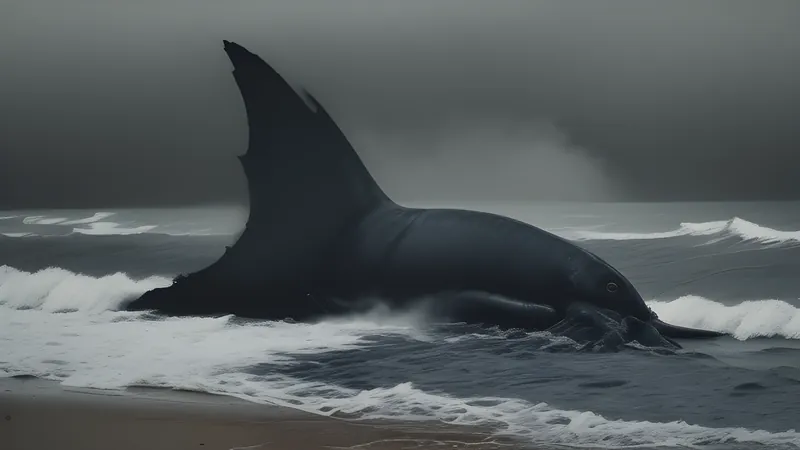
In July 2008, a young woman named Jenna Hewitt and two friends were walking the sand at Ditch Plains beach, just east of Montauk on the far tip of Long Island, when they came across a dead thing at the tideline. It was the size of a small dog, pinkish-grey, hairless, with clawed front limbs and a face that ended in what looked disturbingly like a beak. Hewitt took a single photograph. Within a fortnight that photograph had travelled further than anything else that summer, and a decomposing carcass had been promoted to a monster with a name, a mythology, and a suspect list.
The kernel: what actually washed up
Begin with the boring truth, because the boring truth is completely knowable and, in its way, more interesting than the legend. The Montauk Monster was a raccoon. A very dead raccoon, one that had spent enough time in the water to bloat, slough its fur, and lose the soft tissue of its snout.
The identification was not difficult for anyone who looked at the anatomy rather than the vibe. The tetrapod zoologist Darren Naish, writing at length as the picture spread, laid out the evidence plainly. The limb proportions, the long-fingered “hands” with their curved claws, the leg length, and above all the tooth row — the number and arrangement of teeth visible in the exposed jaw — pointed to a medium-sized carnivore of the raccoon family and to nothing more exotic. The infamous “beak” was the give-away that fooled the most people and should have reassured them. A raccoon’s snout is built partly of cartilage and flesh over the bone; when that soft tissue rots and falls away in seawater, the exposed premaxilla and nasal bones form a hard, tapering, pale point that reads, to an eye expecting a mammal, as a bird’s bill or a dinosaur’s face. It is the same decomposition trick that has been fooling beachcombers for centuries.
That trick is worth dwelling on, because it is the whole engine of the carcass mystery across every era. Water does not preserve a body; it disassembles it in a predictable sequence, and the intermediate shapes that sequence produces are often stranger than either the living animal or the clean skeleton. A drowned, half-decayed familiar creature can look precisely like an unfamiliar one. The same process that turns a rotting basking shark into a plesiosaur turns a rotting raccoon into an extraterrestrial, and the full mechanics of that transformation are laid out in the story of sea serpents and the basking-shark carcass problem. Montauk was that ancient problem, restaged for the age of the camera phone.
The fork: the lab across the water
A rotting raccoon does not, on its own, become an internet legend. What lifted the Montauk Monster out of the ordinary was geography, and here the story touches something genuinely real, which is exactly why it had such purchase. Two miles off the coast, in Long Island Sound, sits Plum Island. On Plum Island is the Plum Island Animal Disease Center, a federal facility that has, since the 1950s, studied dangerous livestock pathogens including foot-and-mouth disease under high biosecurity.
The centre is real, secretive, and legitimately unsettling to its neighbours. It handles diseases that could devastate American agriculture; access is restricted; its history includes documented safety concerns and, in its early years, Cold War research into biological agents that could be used against enemy livestock. A 2004 book by the journalist Michael Christopher Carroll, Lab 257, argued controversially that the facility might be connected to the emergence of Lyme disease and other ailments in the surrounding region — a claim disputed by scientists but widely read. So when a hairless, clawed, beak-faced carcass washed up a short swim downcurrent from a secret government germ laboratory, the leap wrote itself. This was an escaped experiment, a mutant, a thing that was never supposed to exist, delivered to the beach as evidence.
That is the point where the record forks away from the myth, and the fork is clean. Everything solid about Plum Island — its existence, its secrecy, its dangerous pathogens, its documented lapses — is true. None of it has any connection to the raccoon. The centre studies viruses of hoofed farm animals; it does not, and has no reason to, breed hairless beaked monsters. But a real secret sitting two miles offshore is the perfect soil for an unrelated mystery to root in. The public knew it was not being told everything about Plum Island, which was correct, and that justified suspicion supplied the emotional charge that a dead raccoon could never have generated alone.
The other Montauk: a mythology already waiting
There was a second reason the name “Montauk Monster” stuck so fast, and it had been lying in wait for two decades. Montauk was already a conspiracy word. At the eastern end of the point stands Camp Hero, a decommissioned military base with a still-standing radar tower, and around that base a whole occult mythology had grown up through the 1980s and 1990s.
Its author was Preston Nichols, whose Montauk Project books claimed that the base had hosted secret government experiments in mind control, teleportation, and time travel, centred on a device called the Montauk Chair that could turn a psychic’s thoughts into physical reality. None of it stood up to scrutiny; all of it was gloriously detailed and endlessly generative, and it seeded a subculture that decades later helped inspire the fictional Hawkins lab of Stranger Things. So when a monster appeared at Montauk in 2008, it arrived in a place whose name already meant “the site where the government does impossible things and lies about it.” The carcass did not have to build its own legend; it inherited a fully furnished one.
The journey: how it broke the internet
The mechanics of the Montauk Monster’s spread are a small, clean case study in how a viral object forms. Hewitt’s photograph first appeared in a local newspaper, The Independent, in mid-July 2008. It was picked up by the Long Island blog scene, then by the national outlet Gawker, whose readers supplied the crucial ingredients: a memorable name, a chorus of competing theories, and the collective delight of a mystery with no adult in charge. The timing helped enormously. It was high summer, the traditional silly season when hard news is thin and editors reach for anything strange, and the story spread through a young social web that had just acquired the tools to make an image travel worldwide in hours.
Then came the detail that guaranteed immortality: the body vanished. By the time anyone with a scalpel wanted to examine it, the carcass had disappeared. Accounts said a local man had taken it and left it in his yard, or that it had rotted away, or been thrown out; the trail simply ended. A monster you can dissect is a specimen. A monster that washes up, is photographed once, and then vanishes before it can be tested is a legend, because the absence of the body converts every confident identification into “well, they would say that, wouldn’t they.” The missing corpse is the load-bearing element of the whole affair, and it is the reason a raccoon that any competent zoologist identified within days is still called a monster fifteen years later.
The template proved durable. Over the following summers, further bloated carcasses washed up on Long Island and elsewhere and were promptly christened new Montauk Monsters, each one photographed, each one going a smaller and smaller distance around a web that had seen the trick before. The name had become a genre.
The summer of theories
For a few weeks in 2008 the identification of a single dead animal became a genuine popular sport, and the range of answers people reached for is itself revealing. Some looked at the beaked face and proposed a turtle that had somehow lost its shell — anatomically impossible, since a turtle’s shell is fused to its spine and ribs and cannot be shed, but visually seductive. Others suggested a dog, a sheep, a capybara, a rodent of unusual size, an escaped exotic pet. A vocal contingent held out for something with no earthly classification at all. Each theory attached itself to the photograph and refused to let go, because the photograph was all anyone had.
What settled it for those willing to be settled was patient comparison rather than revelation. Set the Montauk carcass beside a reference image of a bloated, waterlogged raccoon that has lost its fur and forefoot webbing, and the resemblance is total: the same slender five-fingered forepaws, the same hind-limb proportions, the same skull shape once the muzzle flesh is gone. Naish and other zoologists walked through it feature by feature, and veterinary readers who had handled drowned raccoons recognised the animal instantly. The mystery was solvable from the single photograph; it simply required looking at the bones instead of the atmosphere. That gap — between what the image showed to a trained eye and what it suggested to an excited one — is where the whole phenomenon lived.
There is a deeper reason the raccoon answer never fully took. To accept it, you had to accept that the exciting version was wrong, and by August 2008 the exciting version had acquired something the correct version never could: momentum. Hundreds of thousands of people had already shared the monster. A raccoon is an anticlimax you have to talk yourself into; a lab-grown mutant is a story that rewards you for believing it. The market for wonder is real, and a corrected raccoon pays no dividends.
What it is really about
Peel the Montauk Monster back to its layers and it is a near-perfect specimen of how a modern legend assembles itself out of true parts. A real animal dies and the sea deforms it into something uncanny. A real secret laboratory sits offshore, keeping real secrets, earning real distrust. A ready-made local mythology of government deception stands waiting to lend its name. A new communications technology arrives just in time to carry the image everywhere at once. And the one piece of evidence that could have closed the case — the body — conveniently disappears. Each ingredient is genuine; the monster is what they make when they combine.
That is why sneering at the people who shared it misses the whole point. They were reasoning from true premises. The government does keep dangerous things on that island and does not tell the neighbours everything. Carcasses do wash up looking like nothing on earth. Institutions do lie. Assemble those accurate intuitions in July, with a strange photograph in hand and no body to check them against, and a mutant from the secret lab is a perfectly rational story to reach for — wrong, but rational, which is the most human kind of wrong there is.
The raccoon, meanwhile, is the quiet moral. It was an ordinary animal that lived and died on Long Island, and for one strange summer a whole culture looked straight at it and saw a message from somewhere else. The impulse to read the washed-up dead as an omen is very old, and it drives its living cousins too — the goat-blaming panic of the chupacabra, the goat-sucker born in 1995 ran on the identical wiring, a real mangy animal transformed by fear and rumour into a monster with a mission. We keep meeting our own dead ends and calling them monsters, and the tide keeps handing us the raw material to do it again.
Related Content