The Min Min Light of the Outback
A light that follows you across the emptiest country on Earth, older than the road it haunts
Contents
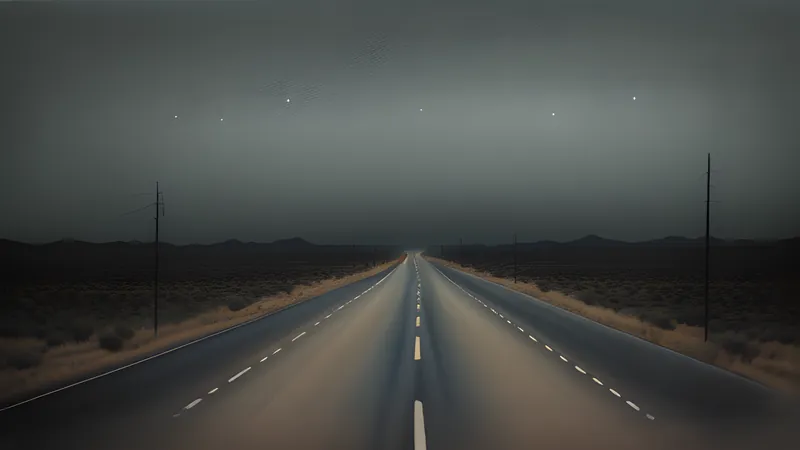
Imagine the emptiest place you can, and then empty it further. The Channel Country of western Queensland is a landscape of such flatness and scale that a person standing in it at night can feel the curve of the earth as a physical fact, the horizon a perfect black ring under a sky thick with stars. There are almost no lights, no towns for a hundred kilometres, no traffic, nothing to fix the eye. And into that immense darkness, travellers have reported for well over a century, a light sometimes comes: a pale, fuzzy glow, low over the scrub, that hovers and follows. Drive toward it and it recedes. Turn away and it comes after you. It keeps its distance and it keeps its company, and it has a name that the whole outback knows. It is the Min Min light.
The Min Min is one of the great Australian legends, told by Aboriginal people long before Europeans arrived and told by stockmen, drovers, truckies and tourists ever since. It has a scientific explanation, a good one, demonstrated by a serious researcher who drove out into that dark and reproduced the light on demand. And like every great light legend, it has survived its own explanation intact, because the thing the Min Min offers has never really been a puzzle about optics. It has always been about what it feels like to be a single small figure alone in an overwhelming emptiness, and about the very old human refusal to believe that such emptiness is truly empty.
The light that keeps its distance
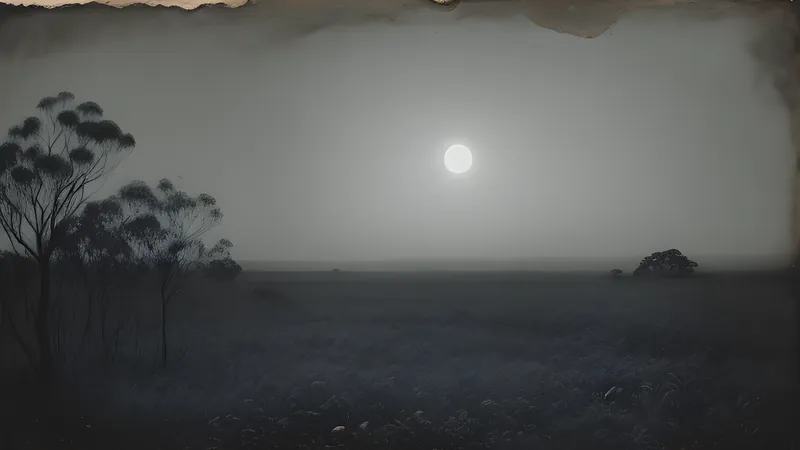
The classic Min Min encounter has a remarkably stable shape across a century of retelling. A person is travelling at night through open country, on horseback in the old accounts, by car or truck in the modern ones, usually alone or nearly so. A light appears, off to the side or behind, a single soft orb, most often whitish but sometimes tinged green or yellow or red. It has a hazy, floating quality, without the brightness of a star or the sharpness of a lamp. And it behaves as though it is aware of the traveller. It maintains a fixed distance. If the traveller stops, it stops. If they approach, it withdraws by exactly as much as they advanced. If they flee, it follows, pacing them across the plain, sometimes for miles, before finally winking out as suddenly as it came.
The name is usually tied to the Min Min Hotel, a lonely staging post and pub that once stood on the rough track between the towns of Boulia and Winton. The building is said to have burned down early in the twentieth century, and the light was reported near its ruins and the small graveyard beside it, which gave the legend its most cinematic origin: a ghost light rising from a dead hotel and its dead. Boulia has embraced the story, styling itself the home of the Min Min light and building a visitor attraction around it. But the hotel origin is a European overlay on something much older, because Aboriginal people of the region knew the light, and lights like it, long before any pub stood on that track.
Older than the settlers
This is where the Min Min becomes genuinely deep rather than merely spooky, and it deserves care. For many Aboriginal people of central and western Queensland, luminous phenomena of this kind are part of a serious spiritual tradition that long predates European settlement. The lights are understood, in various accounts, as spirits or ancestral presences, and they carry meaning: they can be a warning, a sign, or a danger. A recurring theme in Aboriginal tellings is that the light must be respected and left alone, that to chase it or mock it is to invite harm, and that those who pursue the Min Min may be led astray, lost, or worse. This runs deeper than a campfire tale bolted onto a tourist town. It is a strand of an old cosmology in which the land is inhabited and watchful, and in which a light in the dark is a presence to be reckoned with rather than a curiosity to be solved.
That two traditions, Aboriginal and settler, converge on the same light is itself part of the folklore. The European arrivals brought their own inheritance of ghost lights, the will-o’-the-wisp of the marsh, the corpse-candle, the spectral lamp of the drowned or the murdered, and they read the outback light through that lens, attaching it to a burned hotel and a graveyard in the familiar Old World manner. The Aboriginal tradition read it as spirit and warning. The two streams mingled on the Boulia-Winton track and produced the modern legend, a light that is at once ancestral presence and haunted-pub ghost, depending on who is telling it. Layered origins of this kind are the ordinary condition of Australian folklore, where the invader’s monsters and the country’s own were forced into the same landscape, a doubling visible too in how the water-spirit of Aboriginal tradition became the settler-cataloged bunyip.
The neuroscientist who chased it down
In 2003 the Min Min light met a scientist willing to take it seriously enough to test it. Jack Pettigrew, a distinguished neuroscientist at the University of Queensland, proposed that the classic Min Min was a Fata Morgana, a superior mirage, produced by the same atmospheric physics that lofts distant ships into the sky over cold seas. On clear outback nights, the ground cools fast and a layer of cold, dense air settles over it, with warmer air above. That inversion forms an atmospheric duct, a kind of natural pipe that can carry light for extraordinary distances, bending it to follow the curve of the earth instead of shooting off into space.
Pettigrew did more than propose it; he reproduced it. In a now-famous demonstration, he had a vehicle drive with its headlights on far out on the plain while he and an Aboriginal elder watched from a great distance, and they saw a Min Min light appear, hovering and unmistakable, generated by a car below the horizon and carried to them through the inverted air. He calculated that under the right conditions light could be ducted across hundreds of kilometres, meaning a Min Min seen by a traveller might originate from a car, a campfire, or even the glow of a town impossibly far away, lifted over the curve of the earth and set floating on the scrub. The light “follows” because the mirage tracks the observer’s own motion through the atmospheric duct; it “recedes” because the geometry that sustains it shifts as you move. The behaviour that feels so uncannily intentional is the natural consequence of watching a distant source through a slab of unstable air, the very same mechanism that turns highway traffic into the dancing orbs of the Marfa Lights half a world away.
The town of Boulia has turned this inheritance into something visitors can walk into, an animatronic Min Min Encounter attraction that dramatises the pursuit across the plain, and the shire has gathered decades of sighting reports from stockmen, police, mail drivers and tourists. Those reports are strikingly consistent across generations and across the divide between believers and sceptics: a single soft light, a fixed following distance, a sudden vanishing. The consistency is part of what makes the Min Min compelling as folklore, because a legend that mutates wildly in the telling feels invented, whereas one that keeps its shape across a hundred years of very different witnesses feels like a response to something real, whether that something is a spirit or a slab of cold air.
Why the explanation did not end it
Pettigrew’s account is elegant and well evidenced, and it has not diminished the Min Min in the slightest, which tells you the legend was never really a physics problem awaiting a solution. Two things keep it alive. The first is the pre-settlement objection, which is real: Aboriginal people knew the light before European headlights or lamps existed. Pettigrew’s answer is that ducted light does not require cars; the outback of a thousand years ago had campfires, bushfires and the fires of distant camps, any of which the same inversion could carry across the dark. The optics are older than the automobile; only the specific light sources changed. But for anyone who holds the Min Min as spirit rather than mirage, this reply misses the entire point, because the tradition was never a claim about the source of photons.
The second thing keeping the Min Min alive is the experience itself, which no explanation can touch. To be alone at night in that immensity and to see a light detach itself from the dark and begin, quietly, to follow you, is a profound and frightening thing, and knowing the phrase “atmospheric ducting” does very little to unmake the fear in the moment. The legend lives in the body of the traveller, in the prickle at the back of the neck, and the physics lives in a journal. This is the pattern of every persistent ghost light, where a sound scientific explanation coexists indefinitely with a thriving folk tradition, as it does on the wooded ridges of the Brown Mountain Lights, because the two are answering entirely different questions.
What the Min Min is really about
Consider what the outback actually asks of a person. It is one of the largest, emptiest, most indifferent landscapes on the planet, a place where a broken axle or a wrong turn can be fatal and where the scale of the country reduces the traveller to a speck. The human mind is built for a social world full of other minds, not for that kind of emptiness, and it will populate a void rather than accept it, reading agency into the dark, company into the silence, watchfulness into the land. The Min Min is, in this sense, the outback’s answer to being unbearable to be alone in. It gives the emptiness a face, an intention, a follower. It converts the terror of absolute solitude into the smaller, more manageable terror of being accompanied by something.
There is a reason the Min Min belongs to the traveller specifically, and not to the person safe at home. It attaches to movement through danger, to the drover on the long stage, the mail driver on the mustering track, the tourist who has misjudged the distance between fuel stops. The legend rides with people at the exact moment they are most exposed and most alone, which is when the mind is most inclined to manufacture company and most in need of a story to hold. A light that follows you is, among other things, a way of not being quite by yourself. That is why the light behaves the way it does in the telling. It follows, because the deepest fear of the solitary traveller is being watched by the dark. It keeps its distance, because a threat that never quite arrives can be lived with. It punishes those who chase it, because the land teaches, in the hardest currency, that the outback is not to be trifled with, and the legend encodes that lesson as a rule. The Aboriginal tradition understood this most fully, treating the light as a presence that demands respect, which is precisely the right posture toward a country that can kill the careless.
The Min Min light is a real optical phenomenon and it is a genuine piece of ancient and living folklore, and both of those are true at once without contradiction. A neuroscientist can drive into the dark, conjure the light with a set of headlights, and prove exactly how the air carries it, and the drover’s spine will still crawl the next time a pale glow lifts from the scrub and begins to keep pace with him. The explanation tells us what the light is made of. The legend tells us what it is for, which is to keep company with the loneliest people in the emptiest place, and to remind them, in the oldest language we have, that the dark is watching.
Related Content