The Mechanical Turk: The Chess Machine That Hid a Man
How an eighteenth-century automaton beat emperors at chess with a person folded inside it
Contents
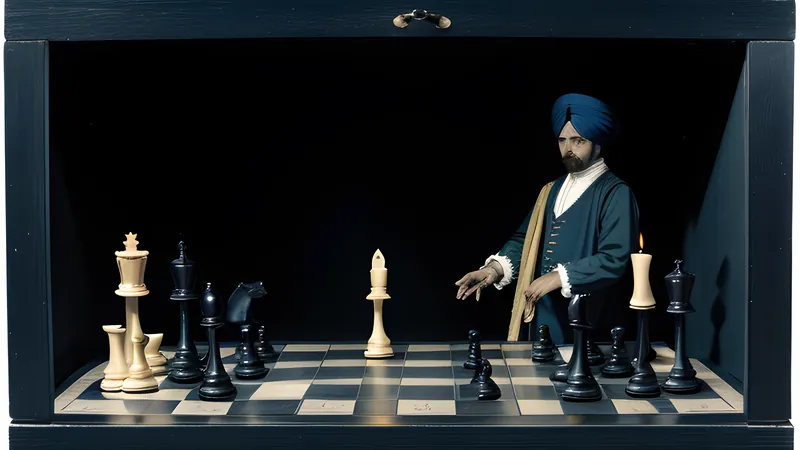
In 1770, at the court of the Habsburg Empress Maria Theresa in Vienna, a Hungarian inventor named Wolfgang von Kempelen unveiled a machine that could play chess. It took the form of a life-sized figure in Ottoman robes and a turban, seated behind a large wooden cabinet with a chessboard on top. Before each performance Kempelen would open the cabinet’s doors and drawers one by one, holding a candle to the interior so the audience could see the dense clockwork inside — cylinders, cogs, levers, the honest machinery of the age of automata. Then he would close the doors, wind the mechanism with a key, and invite a challenger. The turbaned figure would survey the board, lift a piece with its wooden hand, and play. It played well. It beat almost everyone. And for the better part of eighty years, across two continents and through the hands of two owners, it kept a secret that in hindsight seems impossible to have kept at all: there was a man inside.
What the machine actually was
Let us begin with the truth of the thing, because the truth is the most interesting part and the deception only makes sense once you know it. The Mechanical Turk was not a chess-playing machine in any sense. It was a very well-built cabinet designed to conceal a human chess master while appearing, through a carefully choreographed inspection, to contain nothing but gears. The clockwork the audience was shown was largely decorative — real enough to be convincing, but not connected to anything that could reason about chess. The actual player was a person, a skilled human chess master, folded into the cabinet on a sliding seat, hidden behind the very machinery Kempelen so obligingly displayed.
The engineering that mattered was not in the arm or the cogs; it was in the choreography of the reveal. The cabinet was divided into compartments, and its interior was arranged so that the operator could slide sideways and rearrange himself as each door was opened in turn, always keeping a screen of dummy machinery between himself and the candlelight. When Kempelen opened the left-hand doors, the man was tucked to the right, behind the gears on show; when he opened the right, the man had shifted left. The audience believed they had seen the whole interior. They had, in fact, seen it in slices carefully timed so the slices never added up to the man.
The operator followed the game through an ingenious linkage. The chess pieces on top of the board were magnetised, and beneath the board a set of magnets on strings or levers showed the hidden player which pieces sat on which squares — when a piece was placed above, its magnet registered below. The operator, reading the game from inside, made his own move on a small internal board and worked a pantograph mechanism — a system of connected levers — that guided the Turk’s wooden arm to the correct square above. A candle inside gave him light; ventilation and the noise of the winding mechanism, wound theatrically before each game, covered his own small movements and the sound of his breathing.
The kernel: automata really could do astonishing things
The reason the Turk worked is that it did not arrive in a vacuum. The eighteenth century was the golden age of the automaton, and the machines of that era were genuinely, jaw-droppingly capable — which meant a chess-playing cabinet was not, on its face, absurd. Kempelen’s contemporaries had built devices that seemed to cross the line between mechanism and life. The French engineer Jacques de Vaucanson had produced a mechanical flute-player that actually blew air through a real flute with articulated fingers, and a famous mechanical duck that appeared to eat grain, drink, and excrete. The Swiss watchmaker Pierre Jaquet-Droz and his son built humanoid automata — a writer, a draughtsman, a musician — that still function today: the writing boy dips a real pen in real ink and composes a line of text, letter by letter, driven by an interchangeable cam wheel of astonishing complexity.
An audience that had seen a machine write a sentence or play a flute had every reason to grant that a machine might, conceivably, play chess. The genius of the fraud was to hide a human deception inside the one field where genuine mechanical marvels had already trained people to suspend their disbelief. The Turk borrowed the credibility that Vaucanson and Jaquet-Droz had earned honestly. The kernel of truth was not that machines could play chess; it was that machines could already do enough wonders that one more wonder did not break the spell.
There was also a deeper limit the audience could not have understood, because the concepts did not yet exist. Chess is not a matter of clockwork; it is a matter of judgement, of weighing branching possibilities, and nothing built of cams and levers in 1770 could do it. The idea that a machine might genuinely calculate chess would have to wait for the twentieth century, for the theory of computation and the electronic computer. Kempelen’s audiences had no way to draw the line between “automaton that writes a fixed sentence” and “automaton that responds intelligently to a novel position,” because the vocabulary for that line — algorithm, computation, artificial intelligence — was nearly two centuries away. The fraud lived precisely in the gap between what machines could visibly do and what people had no framework to judge them incapable of.
The fork: where showmanship became deception
The honest part of the eighteenth century’s automata is where the Turk diverges sharply from its cousins. Vaucanson’s duck was a real, if exaggerated, mechanism; the Jaquet-Droz androids really do what they appear to do. The Turk did none of what it appeared to do. Its wonder was entirely borrowed and entirely staged. That is the precise point at which a marvel becomes a hoax: when its maker knowingly presents a hidden human faculty as a mechanical one, and stages an inspection designed to foreclose the obvious explanation.
Kempelen himself seems to have been ambivalent about his creation. By several accounts he considered the Turk a somewhat vulgar trick that overshadowed his more serious engineering work — he made genuine contributions, including a speaking machine that mechanically reproduced human vowel and consonant sounds, real acoustic research that historians of speech synthesis still credit. He reportedly tried to downplay or dismantle the Turk more than once, and only brought it back out under pressure from patrons and the promise of money and fame. The man who built the century’s most famous fake was, ironically, prouder of the real inventions nobody remembers.
The journey: eighty years, two owners, a cast of hidden masters
The Turk’s career is astonishing in its length and reach. Kempelen toured it through Europe in the 1780s, where it played — and mostly beat — nobles, courtiers and celebrated minds. It is said to have faced Benjamin Franklin in Paris and to have played a game against Napoleon Bonaparte, who by legend tried illegal moves to test it and had his pieces swept off the board by the affronted automaton. After Kempelen’s death in 1804 the machine was bought by Johann Nepomuk Mälzel, a showman and inventor (and the man whose name is attached to the metronome), who restored it, improved the act, and took it on the road for decades, eventually across the Atlantic to America.
Behind the turban, over those eighty years, sat a rotating cast of strong human chess players — the machine’s real brains, hired in secret and kept out of sight. Their identities were part of the trick; a hidden master would join the operation, tour inside the cabinet, and slip away. The great endurance of the hoax depended on this discretion holding across many people and many years, which is itself a small miracle of stagecraft. The operators had to be excellent enough to beat distinguished challengers, small or flexible enough to fold into the cabinet, and reliable enough to keep the secret.
The exposure came gradually rather than in a single unmasking. Observers noticed suspicious details — the timing of the candle, a wisp of smoke escaping the cabinet during a game, the way the winding never seemed to correspond to the length of play. Pamphlets speculated that a person was concealed inside; some came close to the truth. The American writer Edgar Allan Poe, encountering the Turk on its tour of the United States, wrote a famous 1836 essay reasoning his way toward the conclusion that the machine must contain a human agent, arguing from the irregularity of its play and the theatre of its presentation that no true machine would behave so. His central deduction — that a genuine machine would be perfect and consistent in a way the Turk was not — was sound, even where some of his mechanical guesses missed the mark. The full mechanics were only laid out in detail after the machine’s working life had ended. The Turk was destroyed by fire in Philadelphia in 1854, and it was the family of its last owner who finally published a clear account of how the illusion had been worked.
What the Turk is really about
The Mechanical Turk endured because it sat on the exact seam between real wonder and human need. People wanted to believe a machine could think, and the age had given them just enough genuine marvels to make the wish credible. The fraud did not have to overcome scepticism so much as ride the momentum of legitimate amazement — the same way the Cardiff Giant rode a real appetite for biblical giants and buried antiquity, giving a credulous public the discovery it was already primed to pay for. It belongs to the same family as the Cottingley fairies, where distinguished men granted intelligence and reality to something staged, because the wonder on offer was one they already wished to be true.
The deeper resonance is that the Turk asked a question we still have not finished answering: can a machine do the things we think of as most human — reason, judge, play? For eighty years the honest answer was no, and a man hidden in a box supplied the illusion of yes. There is a straight line from Kempelen’s cabinet to the modern anxiety about thinking machines, and the deception has become a kind of parable. When a large technology company wanted a name for its service that pays hidden human workers to do tasks computers cannot, it called the product “Mechanical Turk” — an open admission that behind an apparently automated system, there is often a person, folded into the cabinet, doing the work the machine takes credit for.
That is the enduring point, and it is not really about chess. It is about how readily we hand intelligence to the machine and overlook the human inside it. Kempelen’s audiences looked at a wooden arm and a case full of gears and chose to believe the gears were thinking, when a person was thinking all along, hidden behind the very machinery on display. The trick worked because we wanted the machine to be the marvel. We still do, and there is still, more often than we admit, someone in the box.
Related Content