The Max Headroom Broadcast Intrusion: TV's Unsolved Hijacking
On one November night in 1987, someone seized two Chicago television signals in a row wearing a rubber mask, said something no one has ever fully explained, and was never identified
Contents
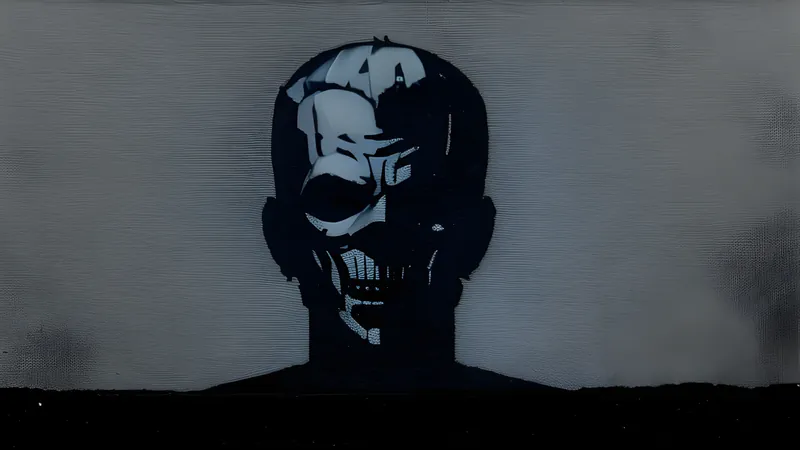
At 9:14 p.m. on Sunday, 22 November 1987, sports anchor Dan Roan was reading the scores on WGN-TV’s nine o’clock news in Chicago when the picture cut away. For about fifteen seconds, viewers across the city saw a grainy, silent image: a figure in a rubber mask modelled on Max Headroom, the stuttering, artificial-intelligence chat-show host who was briefly a genuine 1980s media phenomenon, standing in front of a corrugated sheet of metal that rocked slightly behind him. There was no sound. WGN’s engineers spotted the intrusion, switched their studio-to-transmitter link to a backup frequency, and Roan came back on air with a bewildered laugh: “Well, if you’re wondering what happened, so am I.”
The mask itself was not a random prop, and its familiarity is part of why the intrusion landed so hard. Max Headroom had, by November 1987, become a genuine transatlantic media phenomenon: a stuttering, computer-generated-looking talk-show host, played by the actor Matt Frewer under heavy prosthetics, who had fronted a Channel 4 chat show in Britain since 1985, anchored an American Cinemax and then ABC series that debuted earlier in 1987, and fronted a prominent series of Coca-Cola adverts in the same period. He was, in other words, one of the most recognisable faces on television that year — which made a crude rubber replica of that face, silently staring out of a hijacked news broadcast, land as something closer to a deliberate joke at television’s own expense than a random act of vandalism.
That would have been the whole story — a strange fifteen-second glitch, forgotten by Monday — except that it happened again, ninety minutes later, on a different station, and this time the figure had something to say.
The second intrusion
At around 11:15 p.m. that same night, WTTW, Chicago’s PBS affiliate, was partway through an episode of Doctor Who, “Horror of Fang Rock,” when the same masked figure took over the signal. This intrusion ran roughly ninety seconds — long enough, this time, to carry audio, and long enough for the figure to perform. Through electronically warped, echoing speech, the intruder made a mocking, half-coherent reference to WGN’s sports anchor from earlier that night — “he’s a freakin’ liberal” — hummed a tune, gave the camera an obscene gesture, sang a jingle from an old Coca-Cola advert with an obscenity spliced in, and then, near the end, was joined by a second figure, a woman in the frame, who spanked the masked man with a flyswatter while he made exaggerated noises of pain before the transmission cut and Doctor Who resumed mid-scene as though nothing had happened.
WTTW’s engineers were, if anything, more alarmed than WGN’s had been, because their signal chain was harder to break into. WGN broadcast its studio feed to its transmitter atop the Civic Opera Building using a microwave relay that, in principle, anyone with a sufficiently powerful, correctly aimed transmitter on a nearby rooftop could override — a real, demonstrated vulnerability of studio-to-transmitter links at the time. WTTW’s link, by the engineers’ own account, was harder to access, which meant whoever did this twice in one evening either had access to unusually capable equipment, had scouted both stations’ vulnerabilities in advance, or both. Both stations, in the aftermath, had to explain to regulators exactly how a member of the public could seize a studio-to-transmitter link at all, and the honest engineering answer was uncomfortable for the whole industry: microwave STL relays of that era broadcast an unencrypted signal on a known, licensed frequency, aimed from studio to transmitter tower, and anyone with a directional antenna, a compatible transmitter, and enough power to overpower the legitimate signal at the receiving end could, in principle, ride in on top of it. It was a vulnerability shared by stations across the country, and the case pushed broadcasters nationally to review how exposed their own STL links were.
The Federal Communications Commission and the FBI opened investigations. Signal hijacking of a broadcast television station is a federal offence, carrying, at the time, a possible fine of up to twenty-five thousand dollars and a prison sentence. Neither the FCC nor the FBI ever named a suspect. No one was ever charged. The case remains, formally, open and unsolved.
The kernel: hijacking a signal was a proven, real capability
The Max Headroom intrusion did not invent the idea that a broadcast signal could be seized from outside the station, and it is worth being precise about the real, documented case that came before it, because the contrast between the two is the most instructive part of the whole story. On 27 April 1986, an satellite engineer named John R. MacDougall, working a shift at a Florida earth station, used the facility’s own uplink equipment during a scheduled gap in programming to override HBO’s satellite feed for nearly five minutes, replacing it with a text message reading “GOODEVENING HBO FROM CAPTAIN MIDNIGHT $12.95/MONTH? NO WAY! [SHOWTIME/MOVIE CHANNEL BEWARE],” protesting the network’s newly scrambled satellite signal and the fees cable providers were charging backyard-dish owners for descramblers. MacDougall was identified within weeks — HBO and the FCC narrowed the search to earth stations capable of that specific uplink, and a tip led investigators to him directly — and he pleaded guilty in 1987, receiving a fine and a period of probation.
Captain Midnight proved the theory beyond doubt: a single individual with legitimate access to the right hardware really could hijack a major broadcast signal, deliver a message, and vanish, at least for a few weeks. It also proved something else, which is why the case matters as a kernel rather than a footnote — that this kind of intrusion, however audacious, tends to get solved, because it requires access to identifiable, traceable equipment operated by a limited pool of people. The Max Headroom hijacker had, on the FCC’s own theory, needed something similarly specific: a transmitter powerful and well-aimed enough to override two separate Chicago signals, one of them from a hardened link. That kind of equipment is not anonymous. It has a serial number, an owner, a purchase record. And yet, where Captain Midnight left a trail that led straight to a name within a month, the Chicago hijacker left none that anyone has ever been able to follow to a conviction.
The journey: from a regional oddity to an internet-native legend
For years after 1987, the Max Headroom intrusion was exactly what it looked like at the time — a strange, slightly unsettling local news item, remembered mostly by Chicagoans who happened to be watching PBS that night, filed away in FCC records as one more unsolved signal-hijacking complaint. What changed its trajectory, decades later, was the tape itself: bootleg VHS recordings of the WTTW intrusion, made by viewers taping Doctor Who off-air, circulated in fan and collector circles through the 1990s, and when video-sharing platforms took off in the mid-2000s, those recordings found an entirely new audience that had never lived through the original broadcast era at all.
To that internet-native audience, the clip read less as a solved-or-unsolved crime story and more as a found artefact — genuinely disturbing footage, made stranger by its era’s low-resolution video and its total lack of context, that seemed to demand exactly the kind of investigative unpacking forums and video essays are built for. It became a foundational text of what would later be called “analogue horror” and “weirdcore” aesthetics: a real event, unstaged and undirected, that nonetheless delivered the specific unease those genres try to manufacture on purpose. It sits alongside other internet-native mysteries built from a single unresolved artefact and an eager amateur audience, the way Cicada 3301 turned a handful of cryptic image-board posts into a years-long collaborative hunt: both cases hand a curious public a genuine, dateable object and nothing else, and let the absence of an ending do the rest of the work. True-crime podcasts and documentary series revisited it repeatedly through the 2010s and 2020s, several floating named suspects — engineers with a grudge against WGN, hobbyist hackers with access to microwave equipment — none of which the FCC or independent researchers have ever been able to substantiate to the point of a confirmed identity.
Named suspects have surfaced periodically without ever sticking. Amateur investigators combing through old broadcast-engineering forums and FCC correspondence have floated theories involving disgruntled engineers with grudges against one station or the other, and hobbyist groups known to experiment with unauthorised microwave transmission around Chicago in the 1980s; documentary crews revisiting the case in the 2010s and 2020s interviewed several people who claimed partial knowledge of who was responsible. None of it has produced a name that independent researchers, the FCC, or law enforcement have been able to verify, and no one has ever come forward publicly to claim responsibility, even decades after the statute of limitations on the original offence would have expired. That combination — real interest, real effort, and still nothing confirmed — is unusual for a case with this much public attention trained on it.
What the silence is actually made of
Most unsolved mysteries earn their durability from a gap between what happened and what can be proven, and the Max Headroom case is unusually pure in that respect because so little is actually contested. There is no argument here about whether the intrusion happened — it is on tape, watched live by thousands, corroborated by two separate engineering staffs and a federal investigation. The entire mystery is compressed into a single missing fact: a name. That narrowness is precisely what makes it so satisfying to revisit. Every retelling can add texture — the flyswatter, the mangled Coca-Cola jingle, the strange, almost theatrical commitment of two people willing to put on a mask and a costume for ninety seconds of vandalism with genuinely nothing demanded in return — without ever touching the one fact that would end the story.
That absence of a motive is, in its own way, the detail that keeps people returning longest. Numbers stations unsettle listeners because a coded voice reading digits into the shortwave night implies a purpose being served somewhere, even if the listener will never know it. The Chicago intruder appears to have wanted nothing traceable: no ransom, no manifesto, no repeat performance. Whoever climbed onto a rooftop with enough hardware to override two competing stations in one evening did it once, said something closer to a prank than a statement, and then simply stopped, for good, leaving behind ninety seconds of tape and a federal case file with no name in it. Nearly forty years on, that is still the whole of what anyone can honestly say. The footage is frightening, but what really keeps the case alive is its shape: a story with a beginning, a middle and a genuinely missing end gives an audience the one thing a solved case never can, which is somewhere to keep looking.
Related Content