The Mary Celeste: The Ship Found Sailing Empty
The 1872 salvage record is strange enough on its own. Arthur Conan Doyle is the reason it became a ghost story.
Contents
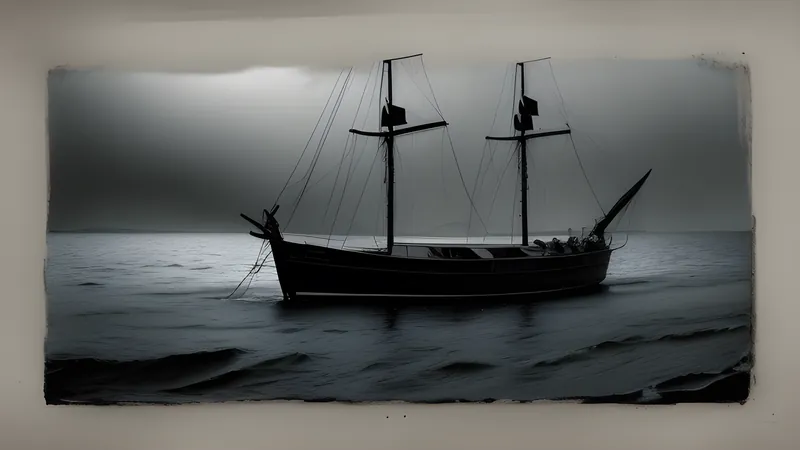
On the afternoon of 4 December 1872, roughly four hundred miles east of the Azores, the crew of the British brigantine Dei Gratia spotted a ship under partial sail, yawing oddly with no one visible on deck. They hailed her. Nothing answered but the creak of rigging and the slap of water in the hold. When First Mate Oliver Deveau led a boarding party across, they found a vessel in genuine disorder but not ruined — sails set though some were torn and badly rigged, a six-month supply of food and water still aboard, the crew’s belongings and even a child’s toys left in the cabins, and not a single living soul, nor any trace of the ten people known to have sailed on her, anywhere to be found. The ship was the Mary Celeste. What happened to the people who had been aboard her has never been established with certainty, and the not-knowing has made her the most famous of all supposed ghost ships. But the sober facts of the case, recorded within days by a functioning maritime bureaucracy, are far stranger and far more interesting than the myth that eventually swallowed them.
What the salvage crew actually found
The Mary Celeste had left New York on 7 November 1872, bound for Genoa under Captain Benjamin Spooner Briggs, an experienced and well-regarded thirty-seven-year-old master sailing with his wife, Sarah, their two-year-old daughter, Sophia, and a crew of seven. Her cargo was 1,701 barrels of denatured alcohol — industrial spirit intended for fortifying wine, rendered undrinkable and highly volatile. Briggs was a part-owner of the ship and by all surviving correspondence a careful, sober captain; his last letter, sent from New York before departure, expresses nothing but routine confidence in the voyage.
When Deveau’s boarding party went aboard, they logged the details with a precision that has survived remarkably well. The ship’s single lifeboat, along with its rigging and davit tackle, was missing, suggesting a deliberate, organised departure rather than a sudden catastrophe. The main hatch cover was found lying on deck rather than sealed in place. Below decks, roughly three and a half feet of water sat in the bilge — a significant amount, though well within what the ship’s pumps could have managed and far short of a sinking vessel. Nine of the alcohol barrels were later found empty, apparently having leaked. A sounding rod — used to measure how much water was in the hold — was found abandoned on deck. The ship’s chronometer and sextant, essential navigational instruments no experienced captain would leave behind voluntarily, were both missing, along with the ship’s papers, though the captain’s log itself was found aboard, its final entry dated 25 November, nine days and roughly four hundred nautical miles before the Dei Gratia’s crew found her drifting alone under a scrap of sail.
The inquiry that suspected everyone but found nothing
The Dei Gratia’s crew sailed the Mary Celeste into Gibraltar to claim salvage, and it was there that the case acquired its second layer of strangeness. The Vice Admiralty Court’s proctor, Frederick Solly-Flood, conducted an unusually aggressive inquiry, convinced from the outset that the crew of the Dei Gratia — captained by Briggs’s friend and former associate David Reed Morehouse — had somehow murdered the Mary Celeste’s people for salvage money, or that Briggs’s own crew had mutinied, got drunk on the cargo, and killed the captain’s family before fleeing. Solly-Flood ordered the ship searched for bloodstains and found what appeared to be a sword with a dark residue in the captain’s cabin; forensic testing available at the time was inconclusive, and later re-examination found no evidence the marks were blood at all. No trial ever followed. No charge was ever brought against anyone. After more than three months of inquiry, the court awarded the Dei Gratia’s crew only a fraction of the ship’s value in salvage, a decision widely read at the time, and since, as the court’s way of expressing lingering suspicion it could not substantiate with evidence. The Mary Celeste’s ten passengers and crew were never found, alive or dead, and no wreckage, body or credible sighting of any of them ever surfaced in the century and a half since.
Where the record actually points
Set aside the murder theories Solly-Flood favoured, which the physical evidence never supported, and the case that best fits what was actually logged is a considerably less lurid one, argued most fully by the maritime historian and marine surveyor Anne MacGregor in the early 2000s and consistent with the physical evidence recorded at Gibraltar. The nine leaking alcohol barrels, made of red oak rather than the more common white oak used for the rest of the cargo, would have released fumes into the hold, plausibly enough for Briggs, hearing a dull rumble from below or seeing vapour rising from the hatch, to fear an explosion was imminent even if the actual concentration fell short of what combustion required. The missing hatch cover, sitting loose on deck rather than sealed, would fit a crew hurriedly opening the hold to vent fumes or check the cargo. Briggs’s most defensible next move, given a suspected explosion risk with his wife and small daughter aboard, would have been exactly what the missing lifeboat and rigging suggest: order everyone into the ship’s boat, tied off to the Mary Celeste by a length of rope, and stand off at a safe distance to see whether she blew.
If that rope then parted — through a snapped line, a sudden squall, or simple bad luck — the Mary Celeste, still under some sail, would have continued drifting on the light winds recorded in the area that week, while the boat carrying ten people with no food, water or navigational instruments beyond what they could grab in a hurry was left behind on the open Atlantic, roughly four hundred miles from the nearest land, with no chance of survival. It is a bleak explanation and an unglamorous one, resting on a captain’s reasonable safety judgement turning fatal through an ordinary accident of rope and weather rather than any deliberate act at all. It also fits every recorded physical detail — the empty barrels, the loose hatch, the missing boat and instruments, the water in the bilge, the untouched food and belongings — more completely than any rival account, including Solly-Flood’s murder theory, has ever managed.
A ship nobody wanted to own
The Mary Celeste herself survived another thirteen years after Gibraltar, and her subsequent career supplied its own, entirely real, strangeness without any need for embellishment. Sold on by owners increasingly reluctant to be associated with her, she passed through a string of hands, several of whom reported unusually bad luck and poor returns, fuelling a reputation among sailors as a genuinely unlucky vessel — a reputation with a mundane commercial explanation, since a ship notorious for scandal was worth less and attracted worse-financed buyers with less incentive to maintain her properly. Her final owner, an American captain named Gilman C. Parker, took her out to the Caribbean in January 1885 loaded with a cargo declared as valuable notions and rubber boots, and deliberately wrecked her on the Rochelais reef off the coast of Haiti. An insurance investigation quickly established that the cargo had been wildly over-declared and partly assembled from worthless goods bought cheaply for the purpose, and Parker and several accomplices were indicted for barratry and conspiracy to defraud the underwriters. The criminal case ended in a hung jury rather than a conviction, but the scandal ruined Parker; he was expelled from his church, his co-defendants faced separate ruin, and he died in poverty within eight months of the trial. The ship that had mystified Gibraltar’s court in 1872 ended her days as the instrument of a comparatively ordinary maritime fraud, a coda so mundane that it rarely makes it into the popular retellings at all, crowded out by a much better story about to be told by a man who had nothing to do with the ship whatsoever.
The story that arrived twelve years later
The Mary Celeste remained a real but comparatively minor maritime curiosity for a decade, discussed in shipping circles and the occasional newspaper retrospective, until a twenty-four-year-old unpublished doctor named Arthur Conan Doyle changed her fate permanently. In January 1884, the magazine Cornhill published his short story “J. Habakuk Jephson’s Statement,” presented anonymously and written with such convincing period detail that many readers took it for a genuine survivor’s account. Doyle renamed the ship the Marie Celeste — a misspelling that has stuck in popular usage ever since — and invented, wholesale, the details that most people now associate with the real case: a fully laid breakfast table with warm coffee and untouched food, as though the crew had vanished mid-meal; a mysterious lone survivor’s testimony; a vengeful freed slave passenger carrying out a plot of racial retribution against the crew, reflecting the racial anxieties of Doyle’s own Victorian readership rather than anything in the actual record. None of it happened. There was no breakfast table, no coffee still warm, no survivor, no avenging passenger. Doyle had taken a genuinely strange piece of maritime history and, with a young writer’s instinct for what a reading public wanted, supplied the ending it lacked.
How embroidery becomes the record
What happened next is the case’s real lesson. Doyle’s fiction was reprinted, retold, and gradually stripped of its byline and its status as invented literature, migrating over decades of retelling into popular “true mystery” anthologies that treated the warm coffee and the untouched breakfast as documented fact rather than as a novelist’s invention. Each subsequent retelling added its own embellishment on top of Doyle’s — pipes still smouldering in the crew’s quarters, a cat found calmly washing itself on deck, sewing left mid-stitch with the needle still threaded — none of it traceable to the Gibraltar inquiry’s actual depositions, all of it repeated confidently enough, often enough, by writers who had read the previous retelling rather than the original court record, that the fabricated version became the one most people now think they know. By the mid-twentieth century the Mary Celeste had become a fixed cultural shorthand for the inexplicable, invoked reflexively alongside sea disappearances of every kind, feeding directly into the broader twentieth-century mythology of vanishing ships and aircraft that later crystallised around the Bermuda Triangle — a myth built from the same raw material of a genuinely puzzling incident, repeatedly reprocessed by writers each working from the last teller’s version rather than the primary record.
What the embroidery was actually for
It is worth asking honestly what the invented details supplied that the true story did not, because the answer says something about why this particular case, out of the thousands of genuine maritime disappearances in the age of sail, became the one everybody remembers. A ship found abandoned through a plausible, unglamorous chain of misjudged risk and bad luck is a tragedy; a ship found with breakfast still warm on the table is a puzzle with no possible mundane solution, which is precisely the shape a good story needs. The warm coffee does narrative work the true cold trail cannot: it compresses the vanishing into a single impossible instant, rules out anything as slow or explicable as a fume scare and a snapped tow-rope, and leaves the reader with nothing to do but marvel. Doyle understood, as a storyteller rather than a historian, that mystery sells better when it looks total rather than merely difficult — the same instinct that inflates the genuinely enigmatic gaps in the Salem witch trial record into tidier and stranger stories than the archives actually support, or that turns a scattering of unrelated frames into evidence of a message deliberately hidden rather than an accident of production. The genuine 1872 inquiry left real, permanent gaps — no body was ever recovered, no wreck of the lifeboat identified, no witness produced who saw what happened after the log’s last entry — and those gaps, honestly reported, are unsettling enough on their own merits. They simply were not unsettling in the specific, tidy, total way a short story needs its ending to be, and so a young writer looking for a striking magazine piece filled them in, and the fill has outlasted the fact in nearly everyone’s memory of the case ever since.
Related Content