The Marfa Lights and the Headlight Hypothesis
A Texas desert glow, a cowboy's campfire, and the students who drove out to test it
Contents
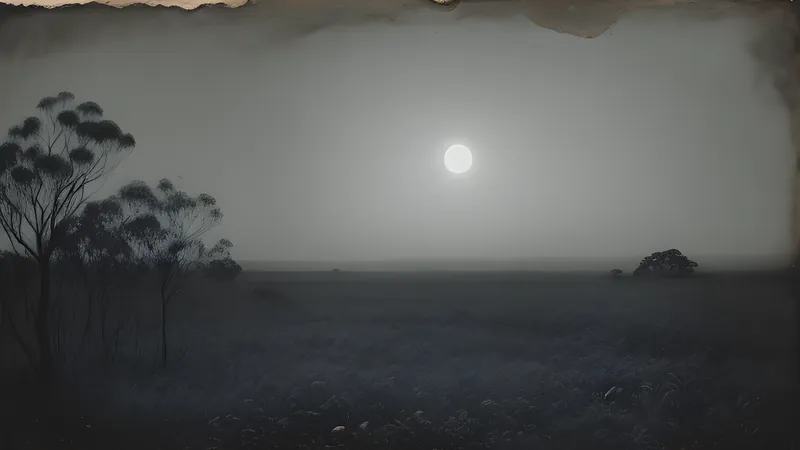
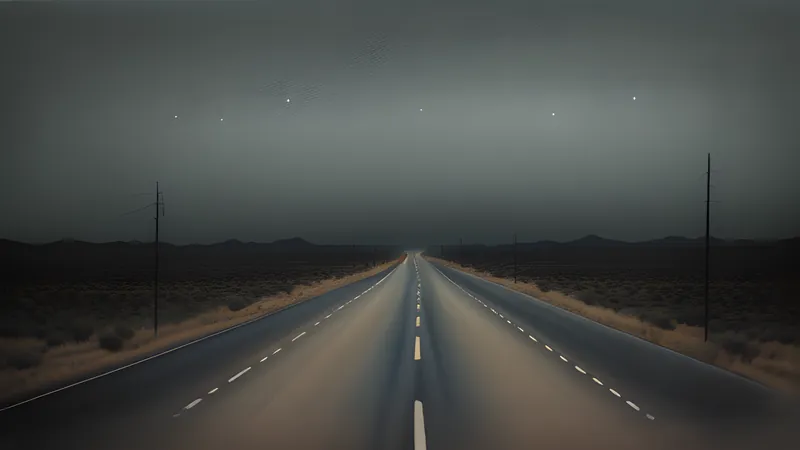
Drive out of Marfa, Texas, on a clear night, head east on Highway 90, and pull into the viewing platform that the state built for the purpose. Look south, across the dark expanse of Mitchell Flat toward the Chinati Mountains, and if you are lucky you will see them: pale lights on the horizon, yellow or white or occasionally red, that seem to hover, then split apart, then drift, then merge, then wink out. They do not behave like anything you can name. They have been seen for well over a century, they draw thousands of visitors a year, and the town has built a festival, a viewing centre and a small economy around the promise that no one has ever explained them.
That promise is the interesting part, because it is only half true. A group of physics students drove out into that desert in 2004 and explained a great deal of what people see from the platform, carefully and convincingly. Their answer is published and repeatable. And yet the mystery survives, undented, because the explanation asks people to give up something they do not want to give up. The Marfa lights are a small, near-perfect study in how a phenomenon can be substantially understood and still remain, in the life of a community, gloriously unsolved.
The lights on the flat
The seductive version of the story is genuinely old. The traditional origin, retold on every plaque and in every guidebook, is that in 1883 a young cowboy named Robert Reed Ellison was driving cattle through the area and saw flickering lights to the southwest. He assumed they were the campfires of Apache. He rode toward them and found nothing, no ash, no camp, no sign that anyone had been there. That story, whatever its exact reliability, set the template: lights that appear on the flat, that seem to have a source, and that yield nothing when approached.
What visitors report today follows the same pattern. From the viewing area, lights appear low over Mitchell Flat, a wide basin of private ranchland closed to the public. They glow steadily or pulse, hold position for minutes or move laterally, sometimes seem to bounce or to split into two and rejoin. They keep their distance. No one drives up to them, partly because the land is fenced and partly because, like Ellison’s campfires, they never seem to be quite where they appear to be. The lights are real in the sense that thousands of sober people have photographed and filmed them; the question was always what produces them.
The students in the desert
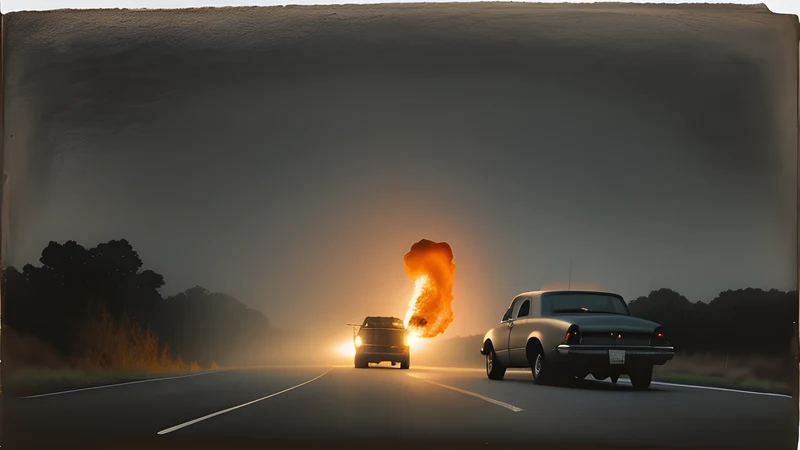
In 2004 the question got a serious, systematic answer. A group from the Society of Physics Students at the University of Texas at Dallas travelled to Marfa and spent several nights doing what almost no casual observer does: measuring. They set up telescopes and cameras at the viewing area, logged the position and timing of every light they saw, and, crucially, coordinated with a vehicle driving the roads to the south. What they found was clean and repeatable. A large fraction of the lights seen from the platform coincided, in direction and timing, with traffic on US Highway 67, the road running south from Marfa toward the border town of Presidio, some distance across the flat.
The mechanism is a well-understood piece of desert physics. On clear nights the Chihuahuan Desert cools rapidly after sunset, and layers of air at different temperatures stack up over the flat ground, creating a temperature inversion, warm air sitting over cooler air or the reverse. Light passing through those layers is bent, refracted, in the same way a straw looks broken in a glass of water. Distant point sources, headlights, ranch lamps, a fire, can be lifted above the true horizon, stretched, doubled, made to shimmer and appear to float, and made to “move” as the air layers shift and as the actual vehicle rounds bends in the road far away. The students demonstrated this directly, watching a light appear on the horizon at the moment a car they were in contact with passed a particular stretch of road. The dancing orbs of Marfa, at least the ones seen most nights from the platform, are distant lights carried and distorted by the desert air.
This is the kernel, the solid, sourced, testable core of the whole phenomenon, and conceding it fully is what makes the rest of the story honest. The Marfa lights are no hoax, no mass hallucination, and no marketing invention. They are a real and reliably repeatable optical effect, and the physics that produces them is beautiful in its own right, a whole desert acting as a lens.
The physics has a name
The effect at work has a proper name and a long pedigree, which is worth dwelling on because naming it makes the mystery less arbitrary and more astonishing. A layer of warm air over cooler air, or the reverse, forms an atmospheric duct that behaves like a lens, and the resulting distortions are the same family that produces the superior mirage and, in its most dramatic form, the Fata Morgana, the effect that has lofted distant ships into the sky and stacked coastlines into impossible cliffs for centuries of bewildered sailors. Over the flat, radiatively cooling floor of a desert basin, these ducts form readily on clear, still nights, which are precisely the nights people go out to Marfa to watch. The conditions that make the lights visible are the conditions that make the air a lens.
That single mechanism accounts for the features people find most uncanny. The lights appear to hover because the true source is far below the horizon and the mirage holds its refracted image aloft. They seem to split and merge because turbulent layers of air can produce multiple, shifting images of one source. They pulse and change colour because the light is passing through a thick, unstable slab of atmosphere that scatters and reddens it, the same reason a low star twinkles and a setting sun turns orange. And they appear to move independently of any road because the image can slide as the air layers ripple, even while the actual car or lamp holds a steady course miles away. Every behaviour that seems to defy a mundane source is, on inspection, a signature of the mundane source seen through an extraordinary medium.
There is a further wrinkle that the honest account has to include: not every light seen at Marfa has been traced to Highway 67, and some observers describe lights on parts of the flat where no known road runs. The careful position is that the traffic-and-mirage mechanism demonstrably produces a large share of the sightings, that other distant sources on the ranchland can feed the same optical machinery, and that a residue of poorly documented reports remains, as it always does, beyond the reach of any single tidy explanation. That residue is real, and it is small, and it is the wedge on which the entire legend continues to balance.
Where the mystery refuses the answer
Here is the fork. The headlight-and-mirage explanation is strong, but it has a genuine gap, and believers have planted their flag squarely in it. Highway 67 carried no automobile traffic in 1883. If Ellison really saw lights on the flat while driving cattle, and if similar sightings predate the motor car, then headlights cannot be the whole story. The pre-automobile accounts are the load-bearing objection, and they are not silly. They are the reason a careful person can hear the physics students out and still say, reasonably, “you have explained the lights I saw last Tuesday, but not the ones the cowboy saw.”
The honest reply is layered. First, the reliability of the nineteenth-century accounts is genuinely uncertain; the Ellison story was written down decades later and has the polished shape of a founding legend rather than a contemporaneous report. Second, and more importantly, the mirage mechanism does not require headlights specifically. It requires distant light sources and the right air, and the nineteenth-century desert had plenty of the former: campfires, ranch lamps, the fires of travellers and, yes, of Apache. A temperature inversion will lift and dance a campfire’s glow exactly as it lifts a headlight’s. The pre-car sightings, if real, are the same optics acting on the light sources of an earlier era.
But believers rarely accept this, and the reason is instructive. To concede the point is to accept that the town’s signature marvel is, at bottom, distant traffic seen through shimmering air, and that trade feels like a loss. So the objection hardens into an article of faith: they can’t all be headlights, the lights do things headlights can’t do, real observers know the difference. This is the same defensive move visible in every earth-light community, the insistence that the mundane explanation covers the ordinary cases while leaving the real lights untouched, a move that appears wherever a natural glow has become a local treasure, from the ridgelines of Carolina described in the Brown Mountain Lights to the recurring plasma of a Norwegian valley in the Hessdalen Lights.
Who carried the story, and why the town kept it
The Marfa lights survived because a community had every reason to keep them alive. Marfa is a small, remote town in far West Texas, hours from anywhere, and the lights are one of the few things that reliably bring visitors and money. The state of Texas built a permanent viewing area on Highway 90 in the early 2000s. There is an annual Marfa Lights Festival. Local businesses trade on the mystery, and the mystery, to keep trading, must remain a mystery. A town does not commission a plaque that reads “distant headlights, refracted.” It commissions one that preserves the wonder.
None of that requires anyone to be lying. The people who run the festival mostly do see lights, mostly cannot explain them on the spot, and mostly find the physics-student account either unknown or unpersuasive when weighed against the vivid thing they witnessed with their own eyes. And the visitors want the mystery too; they have driven a long way in the dark to stand on a platform and see something inexplicable, and “you are looking at cars near Presidio” is not the experience they came for. The legend is held in place by a gentle, mutual, entirely human agreement not to look too hard, sustained on both sides of the fence line.
What the lights are really about
Strip the story to its frame and what remains is a question about what we do with a beautiful, partly solved mystery. The Marfa lights are genuinely lovely; the physics that makes them is genuinely elegant; and the explanation genuinely does not diminish the sight, because a desert that can lift a distant fire into a floating, dancing orb is a marvel in plain fact. The strange thing is how many people would rather the answer stayed hidden, and that preference is the real subject.
Part of it is the ordinary reluctance to trade wonder for mechanism, the sense that explaining a thing is the same as spoiling it. But there is something more specific at work at Marfa. A named, local, ownable mystery is a kind of civic treasure, a source of identity for a place that might otherwise be a dot on a highway. To solve it is to hand the treasure back, and communities protect their treasures. The lights function less as an unexplained physical event than as a shared story a town tells about itself, and shared stories are held together by the willingness of everyone involved to keep believing them, or at least to keep declining to check.
The students who drove out in 2004 did something quietly generous. They took the phenomenon seriously enough to measure it, which is a form of respect, and they came back with an answer that is both true and, if you let it be, wonderful. The lights on Mitchell Flat are real. The air over the desert is doing something extraordinary to ordinary light. And a whole town has decided, understandably, to keep looking at the horizon and telling each other it cannot be explained, because the mystery is worth more to them than the answer, and because standing in the dark waiting for the impossible is a pleasure that no correct explanation has ever quite been able to compete with.
Related Content