The Man in the Iron Mask: A Prisoner, a Legend, and a Velvet Cloth
A real prisoner of Louis XIV, an invented mask, and the two centuries of storytelling that turned a nobody into a king's secret

Contents
On the morning of 19 November 1703, a prisoner died in the Bastille. The register recorded him under the name Marchioly, gave his age vaguely, and noted that he had been buried the following day in the parish of Saint-Paul. The gravediggers were paid, the cell was emptied, and the furniture he had used was reportedly burned. He had been a prisoner of the French crown for more than three decades, moved from fortress to fortress under the same jailer, and in all that time almost no one had learned his name or seen his face uncovered. From that scrap of official secrecy grew one of the most durable legends in Europe: a man whose face was locked inside a mask of iron so that no living soul could recognise the king he might have unseated. The truth is quieter, sadder, and in its own way more interesting than the iron.
The story at its most seductive
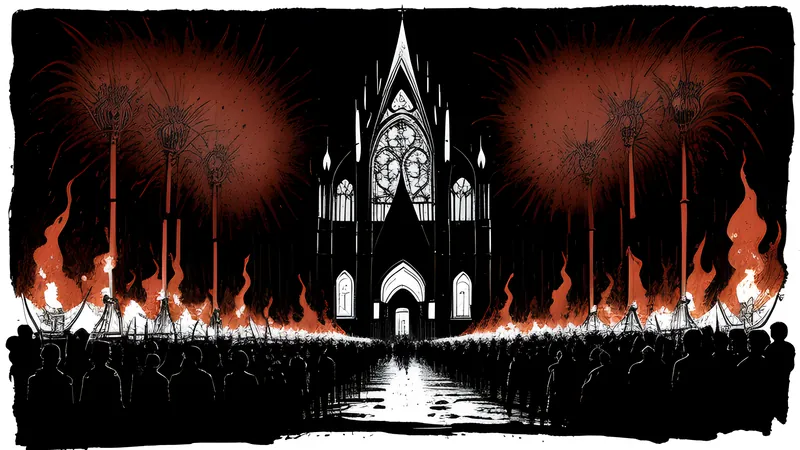
Picture the version everyone half-remembers. Somewhere in the reign of Louis XIV, the Sun King at the height of his glory, a prisoner is spirited between remote fortresses. His head is encased in iron, hinged and padlocked, and the standing order is absolute: if he so much as tells a guard who he is, he is to be killed on the spot. He is treated, oddly, with courtesy — good linen, good food, a doctor when he sickens — the treatment owed to a gentleman, or to someone whose blood makes him dangerous. And that is the seduction of the tale. Why mask a face unless the face is famous? Why kill a man for speaking unless his words could topple a throne? The mask is a locked box, and the human mind cannot leave a locked box alone. It insists there must be treasure inside proportional to the lock.
The answer the legend supplies is the most satisfying one imaginable: the prisoner was the king’s own brother. In the boldest telling he is Louis’s identical twin, born minutes apart, hidden at birth so that no rival claim could ever split the crown — a living duplicate of the most powerful man in Europe, buried alive behind iron precisely because his face was the king’s face. It is a perfect story. It explains the mask, the courtesy, the secrecy, and the terror all at once, and it flatters the listener with the sense of having glimpsed the machinery behind the throne. The only trouble is that almost none of it survives contact with the archive.
The kernel: a real prisoner, real letters, real jailer
There genuinely was a masked prisoner, and we can follow him with unusual precision because the French state was a diligent keeper of correspondence. The man who held him was Bénigne Dauvergne de Saint-Mars, a professional jailer who spent his career guarding high-value prisoners for the crown. In August 1669 the war minister, the Marquis de Louvois, wrote to Saint-Mars — then governor of the fortress of Pignerol, in what is now the Italian Piedmont — to warn him that a prisoner named Eustache Dauger was on his way. The instructions were specific and strange. Dauger was to be held in a cell with double doors so that no one could overhear him; he was to be told that if he spoke of anything beyond his immediate needs he would be killed; and Saint-Mars was to attend to him personally. Yet the same letters make it plain that Dauger was expected to serve as a valet to another, far grander prisoner. A man being groomed to empty another prisoner’s chamber pot is not, on the face of it, a hidden king.
Saint-Mars was a careerist who carried his most secret prisoner with him as he was promoted. From Pignerol the masked man went to the fortress of Exilles, then to the island prison of Sainte-Marguerite off Cannes, and finally, in 1698, to the Bastille itself, where Saint-Mars became governor. The prisoner arrived in Paris in a litter, his face covered. It is here that the material of the mask matters. The most reliable near-contemporary account, from the Bastille’s own second-in-command Étienne du Junca, who kept a private journal, records the arrival of a prisoner “whose name is not spoken” and whose face was hidden by un masque de velours noir — a mask of black velvet. Not iron. A cloth. Du Junca noted the man’s death in the same journal five years later. The velvet is the historical detail; the iron is the legend’s later, heavier, more cinematic upgrade.
The fork: where velvet turned to iron
The point at which the record forks from the myth can be dated almost to the decade, and the man who did the forking is one of the most famous writers in French history. The masked prisoner was already a subject of drawing-room speculation in the early eighteenth century — a secret is a magnet, and Saint-Mars’s theatrical secrecy had guaranteed the gossip. But it was Voltaire who fixed the story in its enduring shape. Voltaire had himself been imprisoned in the Bastille twice, and claimed to have spoken to old servants who remembered the masked man. In his Le Siècle de Louis XIV (1751) he described a prisoner of high birth, masked, treated with deference, and — crucially — in a later edition and in his Questions sur l’Encyclopédie (1771) he floated the theory that the man was an elder, illegitimate brother of Louis XIV, a son of Anne of Austria whose existence would have made Louis’s own legitimacy awkward.
And it was Voltaire, or the editorial tradition that followed him, who reached for the word fer — iron. A mask of black velvet is a jailer’s convenience, a way of moving a face through a public courtyard. A mask of iron is a sentence: it says the state wanted this face annihilated rather than merely hidden. The upgrade from cloth to metal is the whole legend in miniature. Each retelling asked the story to justify its own drama, and cloth simply was not dramatic enough to carry the weight of a hidden king. The velvet became iron because the tale needed it to.
If Voltaire supplied the brother, it was Alexandre Dumas who supplied the twin and the romance. In The Vicomte of Bragelonne (1847–50), the final instalment of his Musketeers cycle, Dumas took the elder-brother rumour and sharpened it into an identical twin — Philippe, secretly swapped for Louis in a doomed plot, then re-masked and returned to his cell. Dumas gave the legend its face precisely by taking the face away, and every film and stage version since has drawn from his well rather than from du Junca’s journal. This is a familiar pattern in the way durable myths are made: a real ambiguity, a famous author who cannot resist improving it, and a mass audience that remembers the improvement and forgets the source.
The journey: who the prisoner might really have been
Strip away the iron and the twin, and historians are left with a genuine puzzle — a real man held in genuine, expensive secrecy — and a handful of sober candidates. The two that survive scrutiny are worth laying out, because the contrast between them is instructive.
The first is Eustache Dauger himself, taken at face value: a valet or minor servant who, in 1669, somehow came into possession of a state secret too dangerous to release. Some historians have speculated it involved a poisoning scandal, or delicate negotiations between France and England — Louis XIV was secretly in the pay of, and paying, players on both sides of the Channel — that a talkative servant could have exposed. On this reading the extraordinary security was never about the man’s face at all but about his tongue. The mask was to stop him being recognised by someone who might realise a supposedly dead or vanished person was still alive and still talking. A secret carried by a servant is unglamorous, which is exactly why the legend could never accept it.
The second candidate, long favoured in the eighteenth and nineteenth centuries, is Ercole Antonio Mattioli, an Italian diplomat who double-crossed Louis XIV over the sale of the fortress town of Casale and was seized and imprisoned by the French around 1679. Mattioli’s Italianate name is tantalisingly close to the “Marchioly” under which the Bastille prisoner was buried, and for a long time the identification looked neat. But the chronology strains: the masked man appears in Saint-Mars’s care a decade before Mattioli’s arrest, and the two seem to be different prisoners whom the secretive jailer’s paper trail has allowed later readers to blur together. The honest position, held by careful historians from the nineteenth century to now, is that the masked man was most probably Eustache Dauger, a servant whose real offence we can no longer recover — and that the crown’s secrecy has succeeded so completely that it defeats us still.
What the legend is really about
Why does a buried valet refuse to stay buried? Because the Iron Mask is not really a story about a prisoner. It is a story about power and its secrets, and it belongs to the same family of tales as every conspiracy that assumes the state must be hiding something enormous behind its silences. The instinct at the heart of the legend — that extraordinary secrecy implies an extraordinary secret — is the same instinct that animates far graver modern suspicions. Sometimes that instinct is right, and the archive vindicates it: the documented programmes of MKUltra and Tuskegee were exactly the kind of thing power hides, and the people who suspected the state were not being paranoid. But the same reasoning, applied to a jailer’s habit of covering a nobody’s face with a cloth, manufactures a hidden king out of nothing. The lock is real; it does not follow that the treasure is.
There is also the particular seduction of the doubled face. A hidden twin of the most powerful man alive is a fantasy about the arbitrariness of who ends up on the throne and who ends up behind the iron — a fantasy that the difference between a king and a prisoner might be an accident of minutes, correctable by a swapped cradle. It is the same wish that animates every changeling story and every tale of a pauper who is secretly royal. The Iron Mask flatters us by suggesting that the grandest structures of power rest on a secret so fragile that a single unmasked face could bring them down.
The velvet cloth is the detail I keep returning to. A jailer needed to walk a prisoner across a public courtyard without the man being recognised, so he covered his face with the cheapest thing that would do the job. Two centuries of storytelling could not bear the smallness of that, and so they forged the iron — the same way the Protocols of the Elders of Zion forged a document to give shape to a suspicion that had no evidence behind it. The prisoner in the Bastille asked for nothing except, perhaps, to be remembered as himself. What we remember instead is the mask we built for him — and the mask, in the end, tells us far more about the people staring at it than about the forgotten face underneath.
Related Content