The Loveland Frog: Ohio's Amphibian Man
A 1955 traveller's tale, two 1972 police reports, and the three-and-a-half-foot iguana that wouldn't end it
Contents
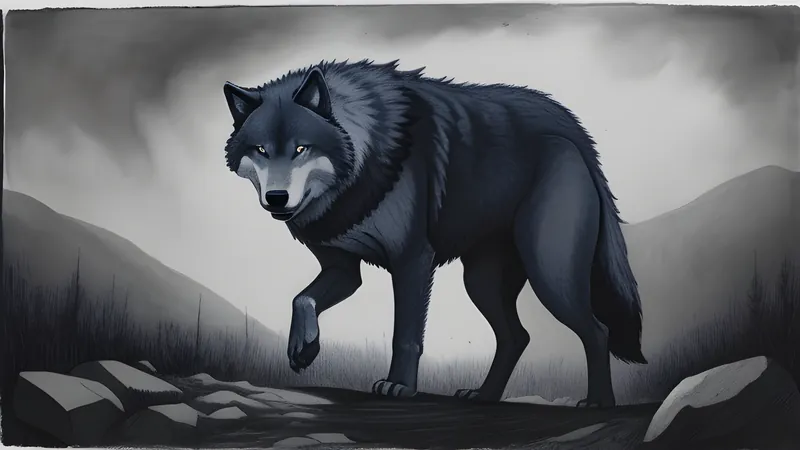
At one o’clock in the morning on 3 March 1972, Officer Ray Shockey of the Loveland, Ohio police department was driving along Riverside Drive, past the old Totes boot factory where the road runs close to the Little Miami River, when something crossed in front of his headlights. It was low to the ground and moving fast, and when the beams caught it, it stood up on its hind legs. Shockey described a creature three to four feet tall, with leathery, wrinkled skin and a wide, frog-like head, that looked back at him for a moment before dropping to all fours and vanishing over the guardrail toward the river. He was a working police officer on a night shift, filing a report he had no obvious reason to fabricate, in a town that had heard a version of this story once already, seventeen years earlier. Loveland has never quite let it go since.
That durability is the interesting part. Three reports, spread across nearly two decades, converge on the same stretch of riverbank, the same low-slung silhouette, the same rise onto two legs. And running underneath all three, an ending almost nobody who tells the story mentions: a second officer, a rifle, and a very large lizard.
The 1955 account and the first sighting
The earliest version of the Loveland Frog story is the shakiest, in the way founding legends often are — no named witness, no filed report, the kind of tale that reaches you as “a travelling salesman told someone.” As it’s usually told, a businessman driving a rural road near Loveland late one night in 1955 saw three creatures standing upright at the roadside, each three to four feet tall, with leathery frog-like faces, gathered as if in conversation. In some retellings they were under a bridge; in one persistent variant, one of them held up what looked like a wand and sparks fanned out from the tip, as though it were some kind of tool or weapon. There is no name attached to this witness in the historical record, no police log, nothing beyond the story itself, and it functions less as evidence than as an origin myth the town could point to once the 1972 reports made headlines: see, it’s always been here.
That backward-reaching quality is worth noticing on its own, because it is one of the most common things a modern legend does. A striking new report arrives, and almost immediately older, vaguer, unverifiable sightings surface to give it a longer pedigree. The 1955 salesman may be a real half-remembered anecdote passed down in good faith. He may equally be a story that only started circulating after 1972, dressed in a date seventeen years earlier to make the Frogman look ancient rather than new. Either way, by the time Ray Shockey filed his report, Loveland already had a frog myth to slot it into.
Two officers, two weeks, one body
What makes 1972 different is that it is documented. Shockey’s report exists; the Cincinnati Enquirer covered it; he was, by every account, a credible and well-regarded member of a small-town police force with nothing to gain from inventing a monster. He did not claim the creature attacked him or spoke to him or did anything except stand up, look at him, and leave. That restraint is part of why the story travelled as far as it did — it read, at the time, like an honest man reporting something he could not explain.
Then, roughly two weeks later, a second Loveland officer, Mark Matthews, reported seeing a similar creature crouched at the roadside in the same stretch near the river. Matthews did what Shockey had not: he shot it. He recovered the body, put it in the trunk of his cruiser, and drove it in to show Shockey and the rest of the department. What he had was a large iguana, about three to three-and-a-half feet long, its tail missing, which had thrown off easy identification and given it, in the dark, a strange, almost bipedal silhouette when it reared up. Matthews’s own theory, offered afterward as the plain detective work of a cop who’d just shot somebody’s escaped pet, was that it had been a released or escaped exotic animal, too large for its owner to keep, that had gone feral along the Little Miami.
Matthews later told an author researching urban legends the full story, iguana and all, and said afterward that the writer’s published account left out the part where he confirmed it was a lizard — printing the sighting but quietly dropping the identification that closed the case. That detail matters more than it might seem, because it shows the myth being edited in real time, at the point of transcription, by someone whose book needed a mystery more than it needed an answer.
A monster with good timing
1972 was a good year for a small-town monster to travel. The Patterson–Gimlin Bigfoot film, shot in the Californian scrub five years earlier, was still doing the rounds on the lecture circuit; cryptozoology paperbacks were filling drugstore spinner racks with the argument that scattered local sightings were really one continuous, half-documented phenomenon; and within four years the television series In Search Of… would be bringing exactly this kind of small-town report into millions of living rooms every week. Shockey and Matthews filed their reports into a media environment already primed to wire an unexplained biped past the county line and print it under a headline, rather than log it as an odd night on Riverside Drive and move on.
The riverbank itself already carried a taste for the strange. A short distance from where both officers made their reports stands Chateau Laroche, the stone castle that World War One veteran Harry D. Andrews began building by hand along the Little Miami in 1929 and kept extending, turrets, dungeon, and moat included, for the rest of his life. Andrews was a documented local eccentric, and a town that already had a hand-built castle on its riverbank had a head start on treating a frog-faced biped as one more strange thing the river had produced, rather than a claim that needed to be run out of town.
The folklorist Jan Harold Brunvand spent the 1980s cataloguing what he termed contemporary legends, and one of his more durable findings was that the stories with staying power are the ones anchored to a real, nameable witness in a real, findable place. A travelling salesman is forgettable within a season. A named police officer with a filed report gives a legend a fixed point that a skeptic has to engage with rather than wave away. Loveland’s frog had that anchor twice, seventeen years and two badge numbers apart, which is a large part of why it outlasted the hundreds of other unexplained-animal reports the 1970s produced and quietly forgot.
The fork: what actually got explained
Here is where a straightforward debunking would stop, and where the Loveland story is genuinely more interesting than a simple hoax. The fork sits between what Matthews’s iguana can plausibly explain and what it cannot. A large lizard, disoriented and tailless, rearing onto its hind legs in a car’s headlights at one in the morning, is a perfectly good account of a frog-man sighting on a dark Ohio road. It says nothing at all about the earlier, undated 1955 story, which predates any known exotic-pet escape by seventeen years and describes three creatures, not one, apparently engaged with each other rather than simply fleeing a road. And it says nothing about why Shockey’s report — filed before Matthews ever fired a shot — so closely matches a shape the town had allegedly been describing since the Eisenhower administration.
So the honest position is that Loveland’s monster has at least two separate strands wound around each other: a genuine, documented case of a startled cop misidentifying an unusual reptile, and a much older, undated piece of local storytelling that the reptile case happened to validate rather than create. Once Shockey’s name was in the newspaper, the two strands became functionally inseparable, because nobody hunting a good story stops to ask which parts happened in which order.
A frog for a town on the river
Loveland is a small city that has leaned into this rather than away from it, in a pattern familiar from other American towns that inherited a monster: there is a mural, a beer named for the creature, a general local fondness for the Frogman as civic mascot rather than civic embarrassment. That embrace tells you something about what the story is actually doing for the people who keep it. A town on a scenic, slow-moving stretch of the Little Miami River, a few bends of water and old rail bridges, gets to have a secret that outsiders don’t — a specific, geographically anchored oddity that belongs to Loveland and nowhere else, the way the Mothman belongs to Point Pleasant, West Virginia, and won’t transplant cleanly to any other river town no matter how hard a chamber of commerce tries, and the way the Jersey Devil belongs to the New Jersey Pine Barrens.
The frog shape itself is doing quiet work too. Unlike the looming, threatening cryptids — Bigfoot’s forest giant, the winged horror over a doomed bridge — the Loveland Frog has never really been cast as dangerous. It stands up, it looks at you, it leaves. Witnesses describe startlement rather than terror. That is a monster built for a town that wants a mystery to be proud of rather than afraid of: strange enough to be worth telling out-of-towners about, tame enough that nobody has ever proposed a posse.
What two credible witnesses were actually reporting
It would be easy to conclude that Ray Shockey and Mark Matthews reported the same thing and one of them happened to catch it. The likelier and, I think, more human reading is that they were primed. By March 1972 the frog-man was already a piece of Loveland’s oral furniture, whether from a genuine 1955 memory or a story that had simply been in circulation long enough to feel old. An officer working a lonely night shift on a road with a known reputation, catching a fast-moving, unfamiliar animal in his headlights for half a second, will reach for the frame his community has already handed him. That is not dishonesty. It is how perception works when it has too little data and too much cultural context to fill the gap.
What’s genuinely rare here is that the story came with its own correction attached — Matthews’s iguana, recovered and identified within weeks — and the correction simply couldn’t compete with the original. A body in a trunk is less vivid than a shape rising up in your headlights on the riverbank at one in the morning. The lizard closed a case file. It never stood a chance of closing the legend, because the legend was never really about what species was on the road. It was about a town’s relationship with its own river, its own dark hours, and its own long-running, low-stakes, oddly affectionate rumour that something is still out there past the bridge, watching the traffic go by.
Related Content