The Loch Ness Monster: A Surgeon, a Photograph, and a Toy
The most famous monster photo ever taken was a toy submarine with a putty head — and the legend was already centuries old
Contents
You have seen the photograph even if you have never gone looking for it. A long neck rises from a sheet of pewter-coloured water, curving forward like a question mark, the head small and reptilian at its tip. Around it, nothing — no shoreline, no boat, no scale. Just the neck and the ripples spreading from where it breaks the surface. It is one of the most reproduced images of the twentieth century, printed in encyclopaedias and lunchboxes and the covers of paperbacks sold in the gift shops that line the A82. For sixty years it was the single best piece of evidence that something old and large was living in Loch Ness. It is a toy submarine bought at Woolworths, fitted with a head modelled from plastic wood, photographed in a quiet bay by a handful of men who wanted revenge on a newspaper. And knowing that changes almost nothing about why we cannot let the loch alone.
A neck in the water
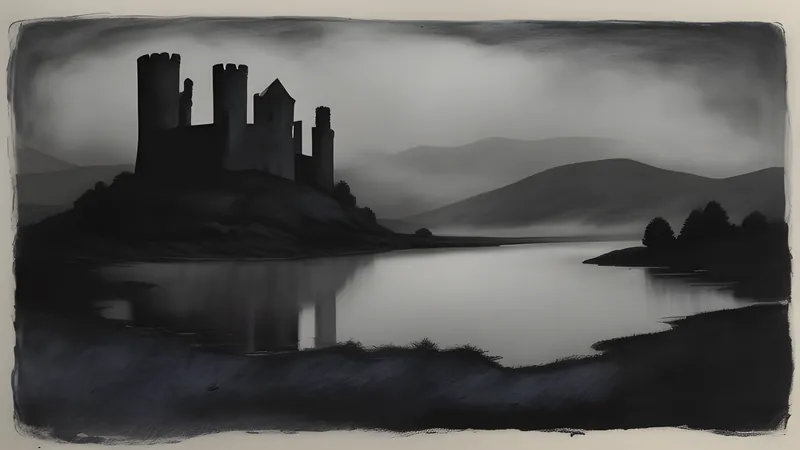
Begin where the believer begins, because the story is genuinely good. Loch Ness is enormous. It holds more fresh water than all the lakes of England and Wales combined, twenty-three miles of it running dead straight along the Great Glen fault, and in places it is more than seven hundred feet deep. The water is stained the colour of strong tea by peat washed down from the surrounding hills, so that a diver a few feet under the surface is already blind. It is cold, it is old, and it does not give up what it holds. Stand on the shore at Urquhart Castle on a still grey afternoon, watch the light go flat and the far bank dissolve into haze, and the idea that something could live down there unseen stops feeling ridiculous and starts feeling almost reasonable.
Into that setting drops the perfect witness. In April 1934 the Daily Mail published a photograph credited to Robert Kenneth Wilson, a London gynaecologist, a respectable professional man with no obvious reason to lie and no interest in monsters. He said he had been driving along the north shore, stopped to look at the water, saw something moving and photographed it. He would not even let his name be attached to it with any enthusiasm; the picture became known simply as the “Surgeon’s Photograph”, as if the anonymity were a mark of its honesty. Here was no showman and no crank. Here was a doctor, and the doctor had a camera, and the camera did not lie.
That is the seduction of it. The image arrived pre-armoured against doubt, wrapped in the credentials of the man who supposedly took it. For most of a century it did its work.
The kernel: a legend older than the road
The photograph was faked. The loch is real, and so is something stranger — the legend is genuinely ancient, far older than any camera, and this is the part that the debunkers who stop at 1934 always miss.
The earliest written trace comes from the seventh century. Adomnán, the ninth abbot of Iona, wrote a Life of St Columba around 690 AD, roughly a hundred and twenty-five years after the events it describes. In it, Columba comes to the land of the Picts around 565 AD and reaches the River Ness, which drains the loch northward to Inverness. The local people are burying a man said to have been savaged by a “water beast”. Columba sends one of his followers to swim across the river to fetch a boat; the beast rises again, roaring, jaws open; the saint makes the sign of the cross and commands it, in the name of God, to go no further and touch the man no more. The creature flees “as if pulled back by ropes”, and the watching Picts are converted on the spot.
Read it as what it is and it tells you a great deal. This is a conversion miracle, a stock episode in the hagiography of the age, in which a holy man tames the wild pagan landscape and its demons to demonstrate the power of the new God. Water beasts are everywhere in this literature; the Highlands were thick with them. The point of the story is Columba, not the animal. But it establishes, in writing, thirteen centuries before the Woolworths submarine, that the waters around Ness were understood to hold something large and dangerous and worth telling stories about.
And the folklore never really stopped. The Highlands are saturated with water-horses — the each-uisge, the kelpie — malevolent shape-shifting spirits that lurk in lochs and rivers, appear as a fine horse or a handsome man, and drag the unwary down to drown and be devoured. Nearly every dark stretch of water in Scotland had one. These were not idle tales; they were warnings, wrapped around real hazards, told to children who might otherwise wander onto thin ice or into a fast peat-stained current where the bottom drops away without warning. The loch already had a monster in the imagination of the people who lived beside it. The twentieth century did not invent Nessie. It photographed a spirit that was already there.
The fork: a road, a courier, and a word
So where does the modern creature — the plesiosaur-shaped tourist attraction — actually branch off from the old folklore? The fork is unusually precise, and it is not the photograph at all. It is a road.
For most of its history the loch’s steep northern shore had no proper road, only a rough track. In the early 1930s the route that became the A82 was blasted and widened along that shore, clearing trees and scrub, throwing up open sightlines across the water for the first time — and putting a steady stream of motorists where before there had been almost nobody looking. The construction blasting also, plausibly, disturbed the water and the wildlife. Whatever the cause, the sightings began to cluster exactly when the road opened.
The modern legend has a birthday: 2 May 1933. On that date the Inverness Courier ran an account of a local couple, the Mackays, who reported seeing an enormous animal “rolling and plunging” in the loch. The report was written up by Alex Campbell, the water bailiff for the loch and the Courier’s part-time correspondent in the district — a man ideally placed to both witness and publicise. It was in the handling of that story, and the ones that quickly followed, that the fateful word appeared in print: monster. Then came a land sighting. In the summer of 1933 a London company director named George Spicer and his wife reported that a creature with a long undulating neck had crossed the road in front of their car near the loch, “the nearest approach to a dragon or prehistoric animal that I have ever seen”. A dragon crossing a road. The old water-beast had climbed out of the folklore, taken the shape of a dinosaur — the newspapers were full of dinosaurs and lost worlds in those years — and walked into the modern press.
That is the branch point. The kernel is a genuine, documented, thirteen-hundred-year-old tradition of water beasts. The fork is 1933: a new road, a hungry local press, a well-placed correspondent, and a single electrifying word.
The journey: revenge, plastic wood, and a doctor for hire
The Daily Mail, scenting a circulation gold-mine, hired a man to find the monster. Marmaduke Wetherell was a big-game hunter, actor and self-styled adventurer, exactly the sort of confident figure a newspaper wanted on the case. In December 1933 he duly found enormous footprints on the shore and announced they belonged to “a very powerful soft-footed animal about twenty feet long”. The Mail trumpeted it. Then the Natural History Museum examined casts of the prints and delivered the humiliation: the tracks were identical, all made by the same foot, and that foot was a hippopotamus — specifically, an umbrella stand or ashtray mounted on a dried hippo foot, a common novelty item of the period. Wetherell had either been hoaxed or done the hoaxing; either way the Mail hung him out to dry and dropped him. He went home disgraced and, by the account that eventually surfaced, furious.
What came next was revenge dressed as a monster. According to the confession that finally broke the case, Wetherell resolved to give the newspaper the creature it so badly wanted, and to watch it swallow the bait. His stepson, Christian Spurling, a model-maker, built the beast: a toy submarine bought at Woolworths for a few shillings, fitted with a head and neck sculpted from plastic wood — a wood-coloured putty — and weighted so it would sit upright and low in the water. It was perhaps a foot high. They floated it in a quiet bay of the loch, photographed it against featureless water so there was nothing to betray the scale, and then needed a respectable name to launder the picture into print. Wilson, the London gynaecologist, was a friend of a friend, willing to lend his profession to the joke. He took the developed plates to the Mail. A surgeon had photographed the monster. It ran on 21 April 1934, and it ran for sixty years.
The confession came at the very end. In 1993 and 1994, Christian Spurling — by then in his nineties, the last man alive who knew — told the researchers David Martin and Alastair Boyd how it had been done, shortly before he died. The submarine, the plastic wood, the umbrella-stand footprints, Wetherell’s grievance against the Mail, the borrowed surgeon: all of it. The most famous piece of monster evidence on earth was a small boy’s toy and an old man’s spite, confessed on a deathbed.
And here is what should give any tidy debunker pause. The exposure of the Surgeon’s Photograph in 1994 barely dented the legend. If anything the story of the hoax became part of the attraction, another good yarn to tell in the visitor centre. Because the photograph was never the foundation. It was a decoration on something much older and much deeper, and you cannot demolish a thirteen-century tradition by admitting that one of its snapshots was staged.
What the loch is really about
The believers did not go home. Instead the twentieth century poured its best instruments into the water and kept looking. In 1972 the American patent lawyer and amateur investigator Robert Rines took underwater photographs that, heavily retouched, seemed to show a rhomboidal “flipper”, and for a time these were treated as the hard evidence the neck-photograph never quite was; later analysis and the extent of the retouching left them deeply contested. In 1987, Operation Deepscan sent a line of boats trailing sonar down the loch in a coordinated sweep, and picked up a few unexplained contacts at depth that were never resolved. Sonar surveys, DNA sampling of the loch water, submersibles, decades of patient watchers with telephoto lenses — the search has been, in its way, magnificently sincere. That sincerity is the thing to understand, and it is the same impulse that keeps people scanning the treeline for Bigfoot and plotting disappearances inside the Bermuda Triangle. We want the map to still have an unmarked corner.
Think about what the loch offers. It is a place where doubt is structurally guaranteed. The water is opaque with peat, the basin is vast and cold and deep enough to hide a whale, and the far shore keeps vanishing into Highland weather. You cannot prove a negative in Loch Ness; you can never be certain nothing is there, because you can barely see your own hand at ten feet down. That is the perfect vessel for a legend. The kelpie lived there for the same reason the plesiosaur does — because the darkness under the surface will hold whatever we need to put into it, and never hand it back to be checked.
And there is the matter of what the monster does for the people around it. A hard economy grew up along that shore: hotels, boat tours, the exhibition centres at Drumnadrochit, a whole living conjured out of a shape in the water. The monster feeds the villages the way the salmon and the deer once did. To want it to be real is, in part, to want the place to remain special, to want the Highlands to keep one secret the modern world has not yet drained and mapped and paved. When the road opened in 1933 it made the loch visible and it made the loch legendary in the same stroke, and the legend has been paying rent on that shore ever since.
There is something almost tender in it. Columba’s monks needed a beast for their saint to tame. The Victorian mothers needed a water-horse to keep their children off the ice. Wetherell needed a creature to shame a newspaper. The 1970s needed a plesiosaur that had somehow outlived the extinction of its kind, a living fossil, proof that deep time still had a survivor. Each age reached into the same dark water and pulled out exactly the monster it required. The remarkable thing is not that one photograph was faked. It is that the loch has answered every single generation that asked it a question, and given each one a different beast, and that the water is deep enough and dark enough that none of us can ever quite prove it was only ever ourselves, looking back up from the peat.
Related Content