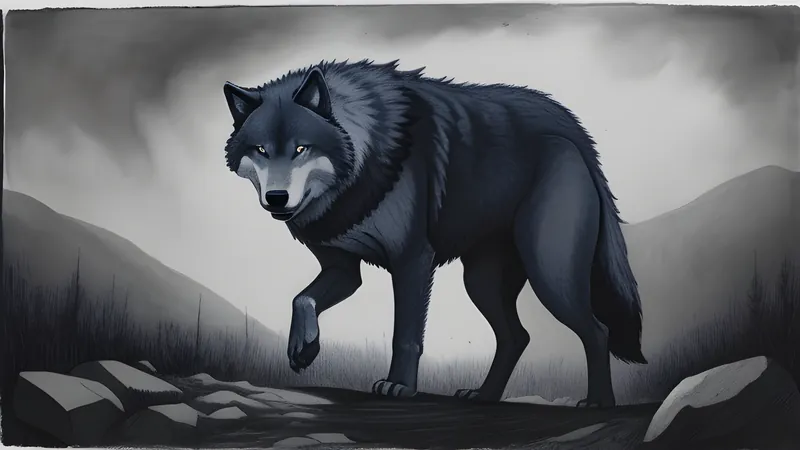
The Kraken: How a Real Squid Became a Sea Monster
The island-sized beast of the Norwegian sea was a story the ocean told about its own darkness, and there was a genuine animal moving underneath it all along
Contents
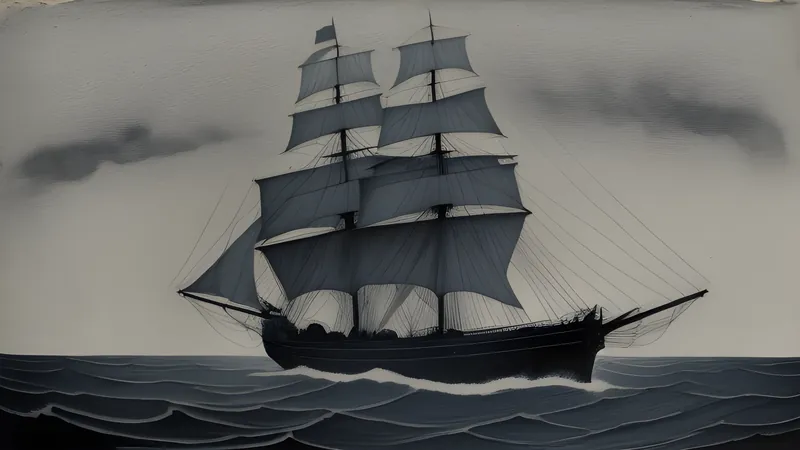
Off the coasts of Norway and Iceland, the old sailors said, there was an animal so large that men mistook it for land. It would rise slowly from the deep until its back broke the surface like a low dark island, wide enough that crews rowed ashore on it and lit fires before the ground beneath them began, terribly, to sink. When it went down it pulled the sea into a whirlpool that could take a ship with it. It was called the kraken, and for centuries it was one of the most fixed and frightening facts of the northern ocean — described in chronicles, catalogued by a bishop, half-classified by the founder of modern biology himself, and believed in by people whose lives depended on knowing the sea.
The remarkable thing about the kraken is not that it was a fantasy. It is that there was a real animal underneath it the whole time, and that the animal turned out to be nearly as strange as the story. The kraken is one of the few sea monsters that science eventually hauled up onto a dissecting table, named in Latin, and finally, in this century, filmed alive in the black water a thousand feet down. This is the story of how a genuine creature became an island-eating god, and of the exact point where the record and the legend part company.
The island that breathes
Begin inside the belief, because the belief is old and coherent and was held by serious people. The earliest full description of a kraken-like beast appears in the Old Norwegian Konungs skuggsjá, the “King’s Mirror,” written around 1250, which speaks of a monstrous animal of the Iceland seas, the hafgufa, so vast that it seemed more like an island than a living thing, and so rarely seen that people doubted there were two of them in all the ocean. From there the creature swims down the centuries through Scandinavian sailors’ lore, gathering detail. It surfaces slowly. It is mistaken for a chain of small islands or for a reef where no reef should be. When it feeds it belches, and the water around it fills with fish, so that a canny fisherman who dared work the boiling sea above a rising kraken might fill his boat and flee before the thing came all the way up.
The fullest account came from a churchman. Erik Pontoppidan, Bishop of Bergen, in his Natural History of Norway of the early 1750s, set the kraken down in the sober language of eighteenth-century natural history. He described an animal a mile and a half across, the largest in the world, that rose until its back and arms showed above the surface, arms tall enough to seize the mast of a great ship and drag it under. Pontoppidan believed he was describing a real if rarely seen creature, and he was writing for readers who took the sea’s dangers as given. Even Carl Linnaeus, the father of biological classification, listed the kraken among the cephalopods in an early edition of his Systema Naturae in the 1730s before thinking better of it and removing the beast from later editions. The kraken was not a campfire joke. It was, for a long stretch, a plausible entry in the natural world, endorsed by a bishop and briefly by the greatest cataloguer of life who ever lived.
The kernel: an animal with ten arms
Under all of it was the giant squid. The genus is Architeuthis, and it is entirely real: a deep-ocean squid that grows to lengths of forty feet and more counting its two long feeding tentacles, with eyes the size of dinner plates — the largest eyes of any animal — a parrot-like beak that can shear flesh, and eight arms and two tentacles lined with toothed suckers. It lives in the deep water of oceans around the world, hunts in the dark, and is itself hunted by the sperm whale, whose skin is often scored with round scars from squid suckers the size of a fist.
For most of history nobody had seen a whole one alive, but the sea occasionally gave up the evidence. Dying or injured giant squid drift to the surface. Storms and currents cast carcasses onto beaches. Sperm whales, harpooned and cut open, sometimes yielded huge squid arms and beaks from their stomachs. A forty-foot animal with writhing arms and a crushing beak, glimpsed thrashing at the surface at the end of its life or washed grey and swollen onto a northern shore, is a real thing that a real sailor really saw. It is the seed. Everything the kraken was is an inflation of that seed, and tracing the inflation is where the folklore becomes legible.
The fork: where a squid becomes an island
Here is the precise mechanism by which the record turned into the legend, and it is worth being exact about, because the interest of the kraken lies in the transformation and not in a tidy list of squid facts. Three ordinary things about the giant squid, passed from mouth to mouth over centuries in a pre-scientific ocean, bend reliably toward the monster.
First, size without scale. A person who sees a large squid arm break the surface, or a vast pale carcass rolling in the swell, has no way to measure it against anything. In open water, with fear doing the arithmetic, forty feet becomes a hundred, becomes an acre, becomes an island. The single most important feature of the kraken — its impossible bigness — is exactly what you would expect a real large animal to become once the story escaped any means of measuring it. Second, the whirlpool. A very large animal sounding, diving suddenly from the surface, does churn the water and drag a swimmer or a small boat toward the vortex it leaves. Multiply that by dread and repetition and you get a maelstrom that swallows ships. Third, the fish. Deep-water upwellings and the disturbance of large animals genuinely do concentrate fish, so the folk belief that good fishing marked the presence of a rising kraken has an honest observational root. Stack those three together — an unmeasurable size, a sounding animal’s turbulence, and the fish that gather over deep disturbances — and a giant squid becomes, step by reasonable step, an island that breathes and drowns whole crews.
The formal turning point, the moment the beast crossed back over the fork into science, came in 1857. The Danish zoologist Japetus Steenstrup gathered the scattered evidence — beaks, a preserved specimen, accounts of strandings — and presented a paper naming the animal Architeuthis, arguing directly that the sea-monster legends of the north had grown up around this real cephalopod. That is the hinge of the whole story. Before 1857 the kraken lived in chronicles and sailors’ talk; after 1857 there was a Latin name and a scientific claim that the monster and the squid were the same creature seen from two different distances.
The journey: from the King’s Mirror to a camera in the dark
The proof took another century and a half to complete, and it arrived in a sequence worth setting down because each step closed a little more of the gap between the legend and the animal. In 1873, off Newfoundland, a giant squid gave science one of its first good bodies. Fishermen in Conception Bay, among them a man named Theophilus Piccot, tangled with a live squid that attacked their small boat; they hacked off a tentacle some nineteen feet long and brought it ashore, and within weeks a nearly complete specimen came into the hands of the Reverend Moses Harvey, a St John’s clergyman and naturalist who draped the animal over his sponge bath and had it photographed and studied. The Newfoundland strandings of the 1870s finally put whole Architeuthis in front of scientists who could describe them properly.
Still no one had seen the animal alive in its own world. That barrier held until this century. On 30 September 2004, the Japanese researchers Tsunemi Kubodera and Kyoichi Mori captured the first photographs of a living giant squid in the deep, off the Ogasawara Islands in the North Pacific, using a baited line and camera lowered to around three thousand feet; the animal attacked the bait and left a severed tentacle behind, and the images were published in 2005. Then, in 2012, Kubodera and a team working with broadcasters descended in a submersible off the same island group and filmed a giant squid alive in the black deep water, its great eye and silver arms lit for the first time on moving film. The King’s Mirror had described an island-sized wonder of the Iceland seas around 1250. Seven and a half centuries later a camera looked the real animal in its enormous eye. The legend and the record finally stood in the same frame.
What the ocean was really carrying
It is tempting to file the kraken away as a squid with good publicity and move on. That would miss what the legend was for, and the kraken was carrying something heavy. The North Atlantic and the Norwegian and Iceland seas were, for the people who worked them, the largest and most lethal blank on any map. The land could be surveyed and farmed and named; the deep sea could not be seen into at all. Below a few fathoms it was total darkness, unmapped, unmeasured, and it routinely swallowed men and ships and gave nothing back. A blank that size and that deadly does not stay empty in the human mind. It fills with a presence large enough to account for the dread, and the kraken — the sea itself risen up as a single animal, big as an island, able to take a whole crew down into the dark — is a nearly perfect symbol of what the open ocean actually was to the people gambling their lives on it.
That is the same reason the peat-black depths of a Scottish loch keep producing the Loch Ness Monster, and the reason a stretch of ordinary but poorly understood ocean got a reputation as the Bermuda Triangle: where people cannot see, and where they genuinely die, they place a monster equal to the fear. And it is the reverse of the disappointment that ends most such hunts. The searchers who go into the Congo after Mokele-Mbembe never find the beast, because the beast was assembled from outside the record. The searchers after the kraken did find their animal, because the kraken had a real body from the start, and the story was only ever that body seen through fear and distance.
The eye in the deep water
The kraken is the rare monster that rewards being taken apart, because taking it apart does not leave you with less. It leaves you with a forty-foot animal with the largest eyes in the natural world, hunting in permanent darkness a thousand feet beneath the keel, doing battle with sperm whales, an animal so genuinely alien that people who saw pieces of it could be forgiven for concluding that the sea contained a god. The bishop who measured it at a mile and a half across was wrong by two orders of magnitude and right about the essential thing: there was a very large, very strange creature down there, and it was worth being afraid of.
What the whole long story really shows is how honest the origins of a monster can be. No one had to lie to make the kraken. A real animal broke the surface, unmeasurable and terrifying, in front of people with no science to steady them and every reason to dread the deep, and over centuries their accurate fear rounded up into an island that breathed. Then, slowly, the same species that had told the story learned to build the instruments to check it — a beak identified in 1857, a body in a St John’s bath in 1873, a photograph in 2004, a film in 2012 — until at last a camera hung in the dark water and met the eye of the thing the sailors had been trying to describe all along. The kraken was real. We simply had to grow up enough to see it at its own size.
Related Content