The Killer in the Backseat
The stranger who flashes his lights, the shape crouched behind the seat, and a fear built into the family car
Contents
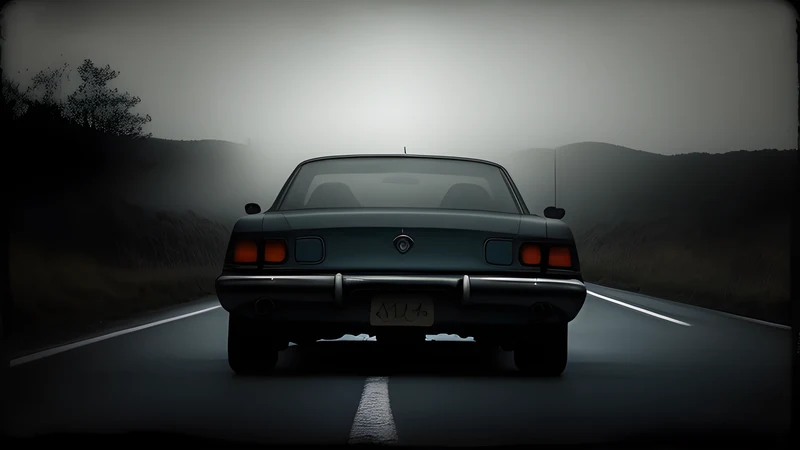
A woman is driving home alone at night on an empty road when a car pulls in close behind her and flashes its headlights. She speeds up; the car keeps pace and flashes again. She changes lanes, turns off the main road, takes the long way, and still the headlights are there, blazing at her every so often out of the dark. By the time she reaches her own driveway she is certain she is being hunted, and she runs for the door screaming for help. Then the driver of the second car steps out and tells her the truth: each time he flashed his lights, it was because a man had risen up from the back seat of her car with a knife, and the light had driven him back down out of sight. The stranger she had fled from all the way home was the only thing that had kept her alive. It is one of the most durable urban legends of the motor age, and its power comes from a single, beautifully cruel inversion, the rescuer mistaken for the threat.
The story and its variants
The legend has been told for at least sixty years, and like all living folklore it shifts its details to fit the teller and the town. In the commonest version the pursuer is an anonymous motorist who happened to be behind her and saw the figure in her back seat silhouetted against passing streetlights. In another widespread strand the warning comes from a petrol-station attendant: the driver stops to fill up, the attendant glimpses the man crouched behind her, and invents a pretext, a problem with her card, a mechanical fault, anything, to get her out of the car and inside the building before quietly calling the police. In some tellings the hidden man is an escaped convict; in others a random predator; in still others the story is attached to a specific stretch of road that everyone in the area claims to know.
What never changes is the architecture. There is a woman alone, a vehicle, a threat concealed in the one place she cannot see, the space directly behind her head, and a stranger whose alarming behaviour turns out to be salvation. The brilliance of the tale, considered purely as a piece of storytelling, is that it weaponises the listener’s own instincts against them. Every reasonable fear the woman has, of the strange car, of the flashing lights, of the man who follows her home, is precisely wrong, and the danger is sitting behind her the whole time, patient and unseen. The legend teaches its audience to distrust their own reading of a frightening situation, which is a large part of why it lodges so deep.
The folklorist’s record
The person who did most to map stories like this one is the American folklorist Jan Harold Brunvand, whose books beginning with The Vanishing Hitchhiker in 1981 gave the modern urban legend its name and its serious study. Brunvand collected the killer in the back seat alongside its siblings, tracing how each surfaced in newspaper filler, in “true story” retellings, and in the photocopied sheets that circulated in offices before the internet, and showing that they travelled the way folklore has always travelled, by word of mouth, mutating at every stop, always told as something that happened to a friend of a friend. The tell is that the story is never quite first-hand; the victim is always someone the teller almost knows, a cousin’s colleague, a neighbour’s sister, which is the signature of a legend rather than a report.
Brunvand’s great insight was that these tales are a functioning oral literature, and they persist because they do a job, packaging a diffuse modern anxiety into a memorable, transmissible shape. The killer in the back seat belongs to a tight cluster of automobile and lovers’-lane legends that folklorists have studied together, and it shares its bloodstream with the hook man of the parked car and the babysitter menaced by calls from inside the house. All of them place a young or lone person in a space that feels private and safe, and then reveal that the safety was an illusion and the threat was near all along.
Was there ever a real one
The honest answer is that the legend has no single founding crime, though people have hunted for one. Real assaults by attackers who concealed themselves in vehicles have certainly happened; the back seat of a car genuinely is a blind spot, and safety advice to check it before getting in is sensible and long-standing. Investigators and journalists have occasionally pointed to mid-twentieth-century incidents as possible seeds, and it is plausible that a real ambush or a real case of a helpful driver flashing a warning contributed a grain of truth somewhere in the story’s long history. But the tale as told, with its perfect structure of misread pursuit and last-second revelation, is a folk composition, refined over decades toward maximum effect, and it outran any particular event long ago.
That looseness is characteristic of the form. A legend does not need a documented origin to feel true, because its truth is emotional rather than factual; it encodes a real fear accurately even when it reports no real event. The back-seat killer is true to the experience of driving alone at night, of feeling watched, of not being able to see the whole of the space you occupy, and that fidelity to a genuine feeling is what keeps it alive regardless of whether it ever happened to anyone in particular.
The car as a haunted room
To understand why this legend fastened onto the automobile, it helps to remember what the car became in the twentieth century. It is the one private room most people carry with them into the world, a sealed capsule in which they are alone, often at night, often on empty roads, frequently a woman by herself in a machine she cannot fully see the inside of while she drives. The car promised freedom and independence, and especially it promised those things to women, and the legend arrived to shadow that freedom with a price. The very autonomy of driving alone is what the story punishes, and it is no accident that the imperilled figure is so often a woman travelling by herself after dark.
The back seat is the crucial stage. It is the part of your own private room you cannot watch, directly behind you, within arm’s reach of your neck, and it is invisible in the ordinary forward posture of driving. The legend takes that architectural blind spot, the small unwatched space we all carry at speed, and fills it with a waiting man. It literalises a feeling every night driver has had, the prickle of the unseen behind you, and gives it a body and a knife. Folklore is very good at finding the exact soft place in a piece of technology and pressing on it, and the unwatchable back seat was the softest place the motor car had to offer.
The warning we cannot read
There is a second, subtler fear the story works on, and it may be the deeper one. The whole ordeal turns on the woman misreading a rescue as an attack. The stranger does everything right, and everything he does looks exactly like menace: he follows her, he closes in, he flashes his lights aggressively, he will not leave her alone. Her terror is entirely rational given what she can see, and it is entirely wrong. The legend dramatises a genuinely frightening feature of the world, that we must constantly judge strangers on incomplete information, that a threat and a warning can look identical from inside the car, and that our instincts, which usually keep us safe, can in the wrong moment aim us straight at the danger.
This is why the story unsettles even people who know full well it is fiction. It is about the limits of our own perception, the awful possibility that the person frightening us is trying to save us and the calm is the trap. In a world of strangers glimpsed for seconds through glass, that uncertainty is real, and the legend gives it a shape sharp enough to remember. It flatters no one and reassures no one; it simply names, in the form of a story you can tell in five minutes at a dinner table, the vertigo of having to decide, alone and at speed, whom to trust.
How the legend keeps itself current
One reason the back-seat killer has never aged out of circulation is that it quietly updates its props while keeping its bones. In the telephone era the petrol-station attendant sometimes called the police from a booth; in later versions he passes the driver a scribbled note because the assailant is watching; in the age of the mobile phone the warning arrives as a text, or the driver is told to keep her doors locked and drive straight to a station. The core inversion survives every technological upgrade, because the fear it serves has nothing to do with the technology and everything to do with being alone and unable to see behind you. Folklorists watching a legend re-tool itself like this are watching the proof that it is alive rather than merely remembered.
The tale also spread far beyond the campfire because it is endlessly useful as a warning dressed up as a story. Parents told it to daughters learning to drive. Safety leaflets and self-defence courses absorbed its practical kernel, the advice to glance into the back seat before you get in, which is sound whether or not the legend is true. The story became a delivery system for a lesson, and a lesson carried inside a good story travels further and lodges deeper than any bare instruction. That is one of the oldest jobs folklore has ever done, encoding a piece of survival wisdom in a form memorable enough to be passed to the next generation without anyone needing to be told why it matters.
Its closest cousins reveal the same machinery at work on the same fears. The choking Doberman, a rumour that grew fingers as it travelled, demonstrates how a single startling image, an intruder’s severed fingers found in a dog’s throat, can carry a story across a continent, and the back-seat killer runs on the same fuel: one indelible picture, the shape rising in the mirror, that lodges in the mind and demands to be retold. They are stories people struggle to forget rather than remember, engineered by long collective polishing to sit in the memory like a splinter.
Why it stays with us
The killer in the back seat has outlived the cars it was first told about and will outlive the ones we drive now, because the conditions that made it resonant have not changed. People still drive alone at night. The back seat is still behind them. Strangers still approach in ways that can be read as threat or help with equal plausibility. The legend gathers all of that into a single vivid image and hands it down, adjusting its surface for each new decade while keeping its cruel machinery intact, and every teller who passes it on is performing the ancient service of folklore, taking a formless dread and giving it edges and a shape.
Understanding the story does not dissolve its grip, and it is not meant to. What it offers instead is recognition: a way of seeing that when we tell this tale we are really talking about the vulnerability of being alone in motion, about the blind spots we cannot escape, and about the terrible thinness of the information on which we must judge the strangers who share the dark road with us. The man behind the seat was always a stand-in for those genuine and permanent fears, and that is why, long after we have laughed it off, we still glance into the mirror and the empty seats before we pull away.
Related Content