The Hook Man: The Lovers' Lane Legend
A hook on a car door handle, a radio bulletin about an escaped killer, and a warning aimed squarely at teenagers in the back seat.
Contents
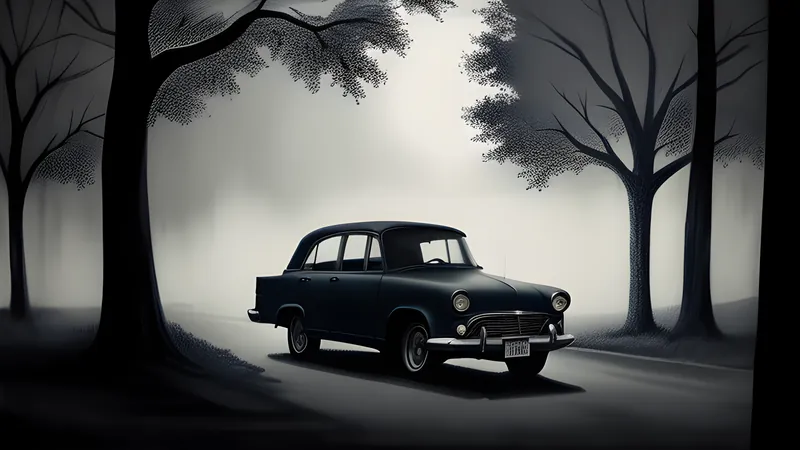
A boy and a girl are parked at the end of a quiet road, the kind of place couples go when they want to be alone. The radio is on low. A news bulletin interrupts the music: a patient has escaped from the state asylum, a man with a hook where one hand should be, and he was last seen near this part of the county. The girl is suddenly frightened and wants to go home. The boy argues, then gives in, annoyed, and starts the engine and pulls away fast. When they reach her house he walks around to open her door, and there, hanging from the handle, torn off at the wrist, is a bloody hook. That is the whole story, and for the better part of the twentieth century almost every teenager in the English-speaking world knew some version of it.
A story with no crime scene
The first thing to understand about the Hook Man is that there is no case behind it. Unlike a legend that grows up around a real unsolved incident, the Hook Man appears to have no founding event at all, no newspaper report of a hook found on a car door, no escaped one-handed killer whose spree seeded the tale. Folklorists who have hunted for an origin have come up empty, and the absence is itself revealing. This is a story that did not need a body to get started. It arrived already fully formed, already doing a job, and the job was never really to describe something that had happened.
The earliest documented appearances are surprisingly precise in time. The story surfaces in American folklore collections and, famously, in a letter printed in the newspaper advice column of Abigail Van Buren, “Dear Abby,” in November 1960. A reader wrote in to relay the tale, and Van Buren printed it, and that publication is often treated as the moment the Hook Man went from campfire property to national text. But folklorists who interviewed people about where they had first heard it found the story circulating widely in the 1950s, passed among teenagers at exactly the point when American teenagers had, for the first time in history, both cars and the privacy those cars provided.
The car was the point
To understand why the Hook Man arrived in the 1950s, you have to understand what the car did to courtship. Before the automobile, young couples were supervised. Courting happened in parlours, on porches, in the presence of family, hedged about with chaperones and curfews. The car dissolved all of that in a single generation. A boy with a licence and access to the family sedan could take a girl somewhere with no adult within a mile, park at the end of a lane, and be entirely unobserved. Parents understood exactly what this meant, and they were, by and large, alarmed. The “lovers’ lane,” a stretch of quiet road known locally as the place couples went, became a fixture of postwar American geography and a fixture of postwar American anxiety.
The Hook Man is a story told into that anxiety, and it is aimed with real precision. Notice who is punished and who is spared. The girl is the one who feels the wrongness of the situation, who wants to leave, who insists. The boy is the one who wants to stay, who is annoyed at having his evening interrupted, who gives in only grudgingly. The girl’s instinct saves them both. The moral, barely hidden, is that a young woman’s discomfort in a parked car is a warning worth heeding, and that the safe thing, the surviving thing, is to go home. The hook on the door handle is the price of having stayed even a moment longer. Read that way, the story is a chastity lesson wearing a monster costume, and the monster is almost incidental.
Why a hook
The choice of weapon does an unusual amount of work, and it repays a close look. A hook is a prosthetic, a mark of a man already damaged, already set apart, and it carries a charge that a knife or a gun would not. In the folk logic of the story the hook signals a man who is both maimed and menacing, an outsider from the asylum, someone whose very body announces that he does not belong near a courting couple. There is something older here, too, a long tradition of the disfigured or disabled figure standing in for danger in folk narrative, which we would now recognise as a prejudice built into the story’s machinery rather than a neutral detail.
The hook also delivers the tale’s single most effective image. The whole story is engineered towards that final beat: the door opened, the hook hanging there, the realisation of how close the danger came. It is a story built entirely to detonate in its last sentence, and the hook, curved, metal, torn off at the wrist and still swinging, is a far more vivid object to leave hanging from a handle than a dropped knife would be. Folklorists note that the most durable urban legends almost always end on a concrete, visual shock rather than an abstract fright, and the Hook Man is a near-perfect specimen. Everything before the final image is setup; the hook is the entire payload.
The company it keeps
The Hook Man does not travel alone. It belongs to a whole family of teenage cautionary legends that flourished in the same postwar decades and share the same anxieties, and it is often told in the same breath as its close cousins. There is “The Boyfriend’s Death,” in which a couple’s car breaks down on a lonely road, the boy goes for help and does not return, and the girl, waiting through the night, eventually discovers his body hanging above the car, his feet scraping the roof, the sound she had taken for branches. There is the babysitter menaced by the man upstairs, a story that punishes a different kind of teenage independence. Across the whole family the pattern holds: a young person is alone, unsupervised, somewhere they perhaps should not be, and something terrible draws near.
These stories were not invented by anxious parents and handed down as propaganda. That is the interesting part. They were told by teenagers, to teenagers, with obvious relish, at slumber parties and around fires and in parked cars. The young people telling them were rehearsing the very fears their parents held, trying them on, enjoying the delicious safe terror of them. A legend like the Hook Man let a generation play at the edge of a real anxiety, the genuine vulnerability of being young and alone in the dark with someone, and defuse it into a shared thrill. The story that scolds also comforts, because in the telling everyone survives, drives home, and lives to describe the hook.
What it was really about
If you strip the Hook Man down to its load-bearing parts, what is left is not a warning about escaped mental patients. Escaped patients are a plot device, borrowed like the asylum-bus in the Bunny Man legend as a convenient source of motiveless menace. What is left is a story about a young woman trusting her own sense that something is wrong, and being right, and a young man learning that her wanting to leave was the most important thing in the car. In the moral world of the 1950s, dressed in the fashions of that decade, that lesson came out as a chastity tale. But the deeper instinct underneath it, that a woman alone with a man should trust her own alarm and act on it without needing to justify it, is not a period piece at all. It is arguably the most useful thing the story has ever taught, smuggled in under the horror.
That may be why the Hook Man has outlived the lovers’ lane that produced it. Teenagers no longer court in parked sedans at the end of country roads, and the specific geography of the legend is now nearly as archaic as the chaperones the car replaced. Yet the story keeps being retold, adapted into films and campfire routines and half-remembered warnings, because the fear it packages is durable even when its furniture is not. Somewhere a teenager is telling another teenager about the hook on the door handle right now, and neither of them is thinking about postwar courtship anxiety. They are thinking about how good it feels to be scared together in the safe knowledge that they will both get to go home.
What the folklorists made of it
The Hook Man has attracted more serious scholarly attention than almost any other American teenage legend, partly because it surfaced just as academic folklore was turning its gaze onto the living, contemporary lore of ordinary people rather than the fairy tales of centuries past. The folklorist Linda Dégh, who spent decades studying how legends circulate, treated the Hook Man as a model case of a story that spreads because its unbelievability is beside the point; what matters is that it can be told, retold, and argued about. A legend, in her account, is a story people perform and negotiate, testing its truth in the telling, and the Hook Man is almost pure performance, engineered for the pause before the final line.
The folklorist Alan Dundes offered a more provocative reading in a widely cited essay, arguing that the story carried a barely concealed sexual charge, the hook standing in for the very thing the parked couple’s evening was building towards, the intrusion and the fright displacing an anxiety that the tellers could not name directly. One need not accept every element of that interpretation to notice that it takes the story seriously as something other than a simple scare, and that is the point worth holding onto. Whether or not the hook means what Dundes said it means, the sheer effort scholars have spent decoding it confirms that the tale is doing more than it appears to. A story that were merely about an escaped killer would not have needed a library of interpretation. The Hook Man invited that interpretation because everyone who told it sensed, however dimly, that it was about them.
There is a quiet dignity in taking a slumber-party story this seriously, and it is the same dignity the whole legend deserves. The teenagers who told it were not being foolish or credulous. They were using the only tools a young person has for handling a fear too large and too intimate to state plainly, turning it into a shape they could pass hand to hand, laugh at, and survive. The Hook Man endured because it gave a generation a way to hold the dark at arm’s length. That is what the best of these stories have always done, and why they outlast every attempt to explain them away.
Related Content