The Hessdalen Lights: The Valley That Glows
A Norwegian valley really does produce lights nobody can fully explain. That honest gap is where the flying saucers moved in.
Contents
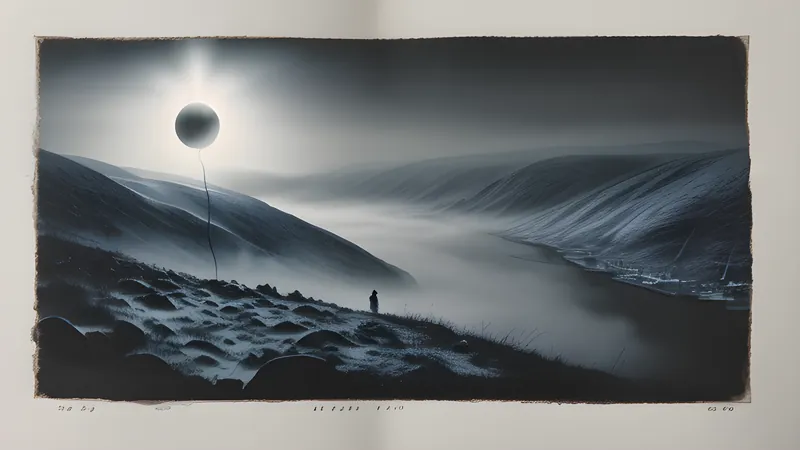
The valley of Hessdalen sits in central Norway, a shallow trough of birch and bog and scattered farms about a hundred and twenty kilometres south of Trondheim, the kind of place where the dark in winter is total and the population is measured in a few hundred people. In the early 1980s something began happening in that dark. Lights appeared — sometimes a steady white glow hanging low over the ridgeline, sometimes a bright ball that drifted slowly along the valley floor and then, without ceremony, went out. Sometimes they flashed and split; sometimes one sat motionless for an hour while a farmer watched it from his kitchen window. At the peak, in the winters of 1981 through 1984, people in the valley were seeing them fifteen or twenty times a week. The residents were frightened, then curious, then, in the way of people who live somewhere remote, faintly proprietorial about it. Their valley had started to glow, and nobody could tell them why.
What makes Hessdalen worth an hour of attention is that this is not a story that dissolves when you look at it hard. Plenty of “mystery light” tales evaporate into headlamps and swamp gas and the planet Venus low on the horizon. Some of that is present at Hessdalen too. But underneath the ordinary explanations there is a genuine, measured, still-open scientific puzzle — a class of luminous phenomena that trained physicists have photographed, tracked on radar, caught on spectrometers, and been unable to fully account for. That honest residue, the part real science has left marked “unexplained,” is the ground the flying saucers grew from. To see how the myth forks off, you first have to give the real thing its due, because the real thing is unusual enough on its own.
The kernel: lights that scientists took seriously
The remarkable fact about Hessdalen is not that people saw lights. People see lights everywhere. It is that when the sightings peaked, actual scientists showed up with instruments and stayed.
In 1983 a small group of Scandinavian researchers and UFO investigators launched what they called Project Hessdalen, led by the Norwegian engineer Erling Strand. Through the winter of 1984 they camped in the freezing valley with cameras, a radar set, a spectrum analyser, a seismograph and a magnetometer, and they waited. They were not credulous. Their explicit aim was to measure whatever was there and describe it in the language of physics. Over about a month of fieldwork they logged scores of observations and captured a number of the lights on film, several of them correlated with readings on the instruments — radar returns that matched a visible light, magnetic fluctuations that coincided with a sighting. Something physical was in the valley, reflecting radar and, at least sometimes, disturbing the local magnetic field. It was not simply a trick of tired eyes.
The work did not stop when that first campaign ended. In 1998 an automated measurement station, nicknamed the Blue Box, was set up in the valley to watch the sky continuously and photograph anything luminous. Since 1999 the university-backed EMBLA campaigns brought in optical and radar teams, including Italian astrophysicists from the national research council; the physicist Massimo Teodorani analysed the light data and published his findings in peer-reviewed and technical venues. Østfold University College in Norway has run a small Hessdalen research programme for years, and students have travelled to the valley to gather data as a formal exercise. This is the genuinely unusual thing about Hessdalen and the reason it deserves respect: it is one of the very few recurring anomalous-light phenomena in the world that has been subjected to sustained, instrumented, open scientific study rather than folklore alone.
And what the instruments found was strange. The lights were often extremely bright for their apparent size. Some emitted a spectrum with distinct lines, hinting at glowing ionised gas — a plasma — rather than a simple reflection or a lamp. Some moved in ways that did not match any obvious craft. Others, on inspection, turned out to be perfectly ordinary: car headlights on distant roads, aircraft, the Moon and the planets, and once a set of lights that proved to be exactly that. The honest scientific position, the one the researchers themselves hold, is that a large fraction of Hessdalen sightings have mundane causes and a stubborn minority do not yet.
The theories that stay inside physics
Before anyone reaches for another civilisation, it is worth seeing how much serious, terrestrial theorising the valley has generated — because the scientists who study it have spent forty years trying to explain it without ever leaving the periodic table.
The leading candidates all describe some way of making a glowing cloud of ionised air in the open. One proposal is that the lights are a form of low-temperature plasma, a pocket of charged gas held together and made to glow by processes still being worked out. Another, developed by the Norwegian researcher Bjørn Gitle Hauge, treats the valley itself as a kind of natural battery: Hessdalen’s rock and soil are unusually rich in metals, with old copper and zinc and sulphur workings, and there is a river running through it. In principle a valley with the right chemistry — different metals separated by a conducting, mineral-laden water flow — can behave like a vast, weak electrochemical cell, generating currents that might, under the right conditions, discharge as visible light. A related idea points to radon, a radioactive gas that seeps from certain rocks; its decay ionises the surrounding air, and clouds of ionised, dust-laden air can in some models be made to luminesce.
None of these is proven, and each has problems — the energies are hard to account for, the behaviour is hard to reproduce, and Hessdalen has an awkward habit of quieting down for years just when a team arrives to study it. But the direction of the science matters. Every serious hypothesis about Hessdalen is a hypothesis about ordinary matter behaving in an unusual way: geology, chemistry, atmospheric physics. The researchers freely say they do not have the full answer. Their unanswered question is a narrow and technical one — what exact mechanism ionises and sustains these particular lights — and it is a very long way from the answer the popular imagination prefers.
The fork: where the plasma becomes a spaceship
Here is the precise seam where the record and the myth part company.
The scientists’ claim is bounded and modest. Some lights in this valley have properties we cannot yet fully explain by known local mechanisms, and we are working on it. Every word of that is defensible. The trouble begins when the sentence is quietly rewritten. “We cannot yet fully explain the mechanism” becomes “science cannot explain them,” which becomes “they are unexplained,” which becomes “they are unexplainable,” which becomes, in the hands of the documentary and the forum thread, “they are craft.” Each step feels small. Together they carry you from a physics problem about ionised air to an alien visitation, and nothing in the evidence made the journey with you.
This is the same conjuring trick that runs through the whole modern lights-in-the-sky tradition. It is exactly what happened at Roswell, where a genuinely classified balloon project — real, secret, and mundane — was reworked over decades into a crashed saucer, the official secrecy read as proof of the extraordinary rather than of the ordinary-but-embarrassing. It is the engine of the Rendlesham Forest incident, where credible military witnesses saw real lights near an air base and the honest phrase “we could not identify it” was steadily upgraded, in retellings, into “it was identified, as a spacecraft.” The pattern is always the gap. An unexplained residue is a vacuum, and the flying saucer is the thing that rushes in to fill it, because a saucer is a more satisfying answer than an unfinished equation.
What is distinctive about Hessdalen is how visible the fork is, because the science is right there beside the folklore, published and dated. You can read Teodorani’s spectral analyses and Strand’s field logs, and you can watch the same footage narrated by a UFO series as evidence of extraterrestrial reconnaissance. Same lights, same valley, two completely different stories laid over them. The lights do not change. Only the sentence wrapped around the word “unexplained” changes, and that sentence is where the whole disagreement lives.
The journey: how a valley became a pilgrimage
The Hessdalen lights arrived at a useful moment. The early 1980s were a high tide of UFO interest across Europe and North America, and a small, dark, photogenic Norwegian valley producing genuine, repeatable, instrument-confirmed lights was almost too good an offering to the culture. Word travelled through the UFO networks first, then into television.
The valley obliged the story in ways it could not help. It is genuinely remote and genuinely dark, which lends every account an atmosphere of the edge of the known world. The lights are genuinely recurring, so a film crew has a real chance of catching something, unlike the one-off apparitions of most UFO lore. And the presence of actual scientists — the thing that makes Hessdalen respectable — became, in the retelling, a form of endorsement. “Scientists have studied these lights and cannot explain them” is technically true and rhetorically devastating; it launders the mystery through the authority of the very people who would wince at the conclusion drawn from their work. The researchers wanted funding and answers. The documentaries wanted wonder. Both needed the lights to remain unexplained, and so the honest scientific “not yet” and the sensational “never” ended up, for once, pointing the same direction.
Over the years the valley has become a minor pilgrimage. Enthusiasts drive up to sit in the cold and watch, sometimes for nights on end. Some see nothing. Some see a distant car and log it as an anomaly. A few see one of the real things — a bright ball drifting silent along the valley — and come home changed. The residents, for their part, have mostly made their peace with living somewhere that glows. They will tell you, without drama, that they do not know what the lights are, which is both the most honest position available and the least satisfying, and therefore the one least likely to survive the trip into popular retelling.
What it is really about
The pull of Hessdalen is the pull of an honest gap, and honest gaps are rare and precious things.
Most mysteries collapse the moment an expert looks at them. Hessdalen is one of the small number that does not entirely collapse, where trained people with good instruments come away saying, in effect, we saw it too and we are not sure what it is. That admission is intoxicating, because it seems to license the imagination to run. If the scientists are stumped, the reasoning goes, then anything is on the table. But the licence is misread. The scientists are not stumped about whether it is a spacecraft; on that they are not stumped at all. They are stumped about a specific mechanism of atmospheric ionisation in a mineral-rich valley. The wonder that the public feels and the puzzle that the physicist feels are aimed at completely different questions, and the whole popular Hessdalen phenomenon lives in the confusion between them.
There is something worth holding onto in the valley’s real story, though, and it is better than the saucer. Here is a corner of the world where the ordinary rules of physics produce something that still, after forty years of serious study, is not fully understood. Its cause is thoroughly earthly, and our own planet turns out to be stranger and less finished than we like to assume. The universe did not have to hide its remaining puzzles in distant galaxies. It left one glowing in a cold Norwegian valley, close enough to drive to, patient enough to be photographed, waiting for someone to work out the last step of a very earthly equation. That the answer is likely to be plasma and geochemistry rather than visitors does not make it smaller. It makes it ours — an unsolved thing in our own back garden, which is a rarer gift than a spaceship, and a harder one to sit with.
Related Content