The Green Children of Woolpit: The Medieval Anomaly
Two children the colour of leaves walked out of a Suffolk harvest field, and England has been trying to explain them for eight hundred years
Contents
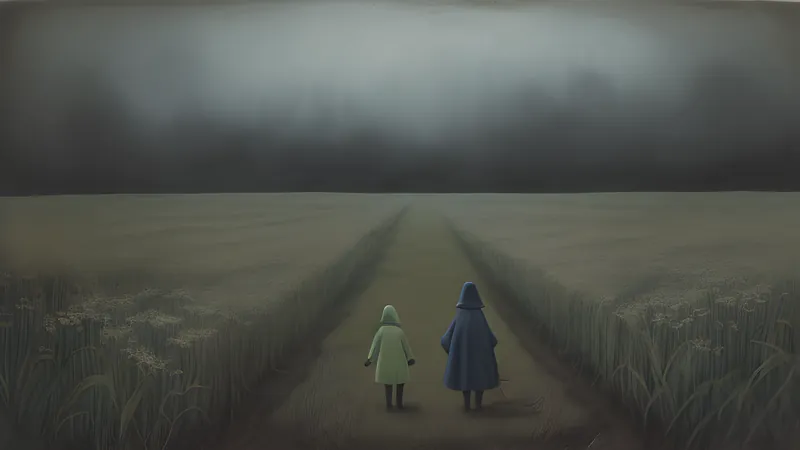
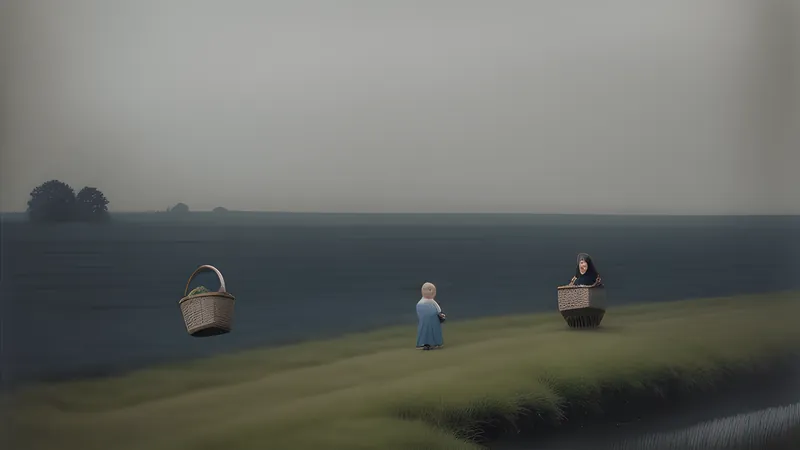
Sometime in the twelfth century, during the harvest, the reapers of a Suffolk village called Woolpit found two children standing at the edge of the field, beside the deep pits from which the place took its name. A boy and a girl, brother and sister by their looks, dressed in clothes of an unfamiliar cut and a material nobody could name. They were weeping and bewildered, and they spoke a language none of the harvesters had ever heard. But the detail that stopped the reapers where they stood, the detail that has carried the story for eight hundred years, was the colour of the children’s skin. It was green. Not the pallor of sickness, the chroniclers are careful to say, but a true and even green, the green of leaves.
Two monks, two accounts
We know the story because two respectable medieval writers thought it worth recording, and their versions largely agree. The first was Ralph of Coggeshall, abbot of a Cistercian house in Essex, whose Chronicon Anglicanum was compiled in the early thirteenth century; Ralph says he had the tale from Sir Richard de Calne, the knight into whose household the surviving child was eventually taken, which makes his account close to a first-hand source. The second was William of Newburgh, an Augustinian canon in Yorkshire, whose Historia rerum Anglicarum was written around 1198. William, tellingly, was a hard-headed man who elsewhere in the same book pours scorn on tall tales and denounces one popular chronicler as a shameless liar. He records the green children with evident unease, admitting he would have dismissed the whole thing had the testimony not been so widespread and so insistent.
Between them they give us the shape of the event. The children were taken into the village and could not, at first, be persuaded to eat anything at all, though they were plainly starving. Then a servant brought in freshly cut broad beans, still on their stalks, and the children seized them with desperate hunger — only to find the pods empty, because they were tearing open the stems rather than the pods themselves. Once shown how to open the pods, they lived on beans for months, refusing all other food. The boy, weaker and more listless throughout, sickened after their baptism and died. The girl thrived. Slowly she lost her green colouring, learned to eat an ordinary diet, was baptised, and picked up the English language.
What the girl said
It is when she could finally speak that the account becomes strangest, and most human. Asked where she and her brother had come from, the girl described a country where everyone was green as she had been, a land of perpetual twilight where the sun never rose fully but hung always at the edge of the sky, and where a great luminous river or a broad water lay across the border. She called her home the land of Saint Martin. She and her brother had been tending their father’s flocks, she said, when they followed the animals into a cavern and heard, deep inside it, the sound of bells. Drawn on by the sound, they emerged at the far end into a blaze of sunlight so violent and unfamiliar that it overwhelmed them, and there they were found, dazzled and lost, by the harvesters of Woolpit. They had never been able to find the mouth of the cavern again.
Ralph of Coggeshall adds that the girl grew up in Richard de Calne’s service, that she was for a time considered rather loose and impudent in her behaviour, and that she eventually married a man from King’s Lynn, some miles to the north in Norfolk. So the medieval account, remarkably, does not end in vanishing or apotheosis. It ends in the utterly ordinary: a foreign girl grows up, works in service, gains a reputation, marries and settles down. The anomaly resolves into a life.
Reading it as history
Because the sources are unusually good for a story of this kind — two literate men, one of them a sceptic, one of them near a named eyewitness — historians have taken the green children seriously as a puzzle with a real event somewhere inside it. The most persuasive rationalist reading treats the children as Flemish. In the twelfth century, Flemish immigrants and weavers had settled in some numbers in eastern England, and they were widely resented; there was a Flemish community at Fornham St Martin, a village lying near Woolpit and just across the River Lark. The bloody Battle of Fornham in 1173, in which many Flemish mercenaries and settlers were slaughtered, may have orphaned children who then wandered, traumatised, malnourished and speaking Flemish, into a strange English village. The land of Saint Martin becomes Fornham St Martin; the glowing river becomes the Lark; the frightening cavern becomes the disorientation of flight through the flooded workings of a mine or a long underground passage, or simply a child’s confused compression of a terrible journey.
The green skin has its own tidy medical candidate. Chlorosis, sometimes called green sickness, is a form of severe iron-deficiency anaemia that can lend the skin a pale greenish or yellow-green cast, and it was well enough recognised in later centuries to be named for the colour. A pair of orphaned children living rough on a poor and monotonous diet — very possibly beans, which are filling but a poor source of usable iron — could plausibly have developed exactly that pallor, which would then fade, precisely as the chronicles report, once the surviving child was fed a normal and varied diet. The colour that made the story immortal may have been the visible signature of starvation.
The Flemish reading has been pressed furthest by the astronomer and writer Duncan Lunan and, more soberly, by local historians who have combed the twelfth-century record for a village of green-clad weavers near a place called Martin. It is circumstantial throughout, and it leans on a chain of plausible guesses, each reasonable on its own and none provable. That is the honest state of the evidence: a good story with a good explanation, and no way left to lay the two side by side and check. The two chroniclers wrote down what reached them in good faith, and what reached them had already passed through a village’s worth of retelling before Ralph or William ever set it in Latin.
The fork the story took instead
That reading is elegant, and it may well be right. What the folklorist notices, though, is that almost nobody who loves the story wants it. The rational account has been available for a very long time, and it has done nothing to dislodge the other readings, which multiply happily beside it: that the children were beings from a subterranean fairyland, kin to the twilight countries of Celtic legend; that they fell through from a parallel dimension; that, in the version popular since the space age, they were the offspring of visitors from another world, dropped for a moment into medieval Suffolk. The land of eternal twilight and the green people slot with almost suspicious ease into whichever cosmology the reteller already believes. The same instinct that later let two Yorkshire girls persuade a knighted author that they had photographed fairies at the bottom of the garden is at work here in reverse: where the Cottingley case offered a photograph and an eager believer, Woolpit offers only two grave and careful monks and a permanent absence of proof, and the absence turns out to be the more durable fuel of the two.
For the twelfth-century audience the green children needed almost no translation, because the medieval landscape was already crowded with entrances to an underground otherworld. Every barrow and hollow hill, every deep cave and old mine, was a rumoured threshold to a country of the dead or the fair folk, a green and sunless land you might stumble into and, if you were fortunate, stumble back out of. A pair of children who walked out of a cavern, spoke no Christian tongue and wore the colour of the underworld fitted that map so exactly that Ralph and William did not have to invent a category for them; the category was waiting. The wonder was that the children were real and standing in a Suffolk field, not that such a country might exist. This is the characteristic behaviour of a real folkloric anomaly. The story is spare, strange and — crucially — genuinely unresolved at the centre, because the true event, if there was one, is eight centuries gone and can never now be recovered with certainty. That irreducible gap is the whole attraction. A mystery that could be closed would be filed away and forgotten; a mystery that cannot be closed stays open forever, a doorway that each generation walks through carrying its own furniture. The medieval reader met the green children with a mind full of fairy-hills and the perilous otherworld under the ground. The Victorian antiquarian met them as a curiosity of natural history. The modern reader, raised on other landing-lights in the sky, reaches for the stars. All of them are furnishing the same empty room.
What we do with an open door
There is a reason a story this thin has outlasted whole libraries of solved cases. Compare it to the countless anomalies that got explained and duly died — every ghost that turned out to be a settling floorboard, every monster that resolved into a known animal, in the way that so many watery terrors dissolve once you notice how readily a rotting basking-shark carcass becomes a sea serpent. Those stories lose their charge the instant the explanation lands, and the crowd drifts away. The green children never lose their charge, because the explanation, however good, can never be confirmed. Sir Richard de Calne is dust; the girl from King’s Lynn left no diary; the beans are long eaten. What survives is the pure shape of the wonder, unweighted by proof either way.
And that shape answers to something durable in the people who keep the story. The green children are the perfect image of the stranger — the child who arrives from nowhere, speaking no known tongue, the wrong colour, refusing our food, weeping at our sun — and of what a community does with such an arrival. In the medieval telling, cruelly and movingly, half of the pair dies of the encounter and the other half survives only by being remade: rebaptised, re-fed, re-languaged, absorbed until the green fades and she is one of us, married off to a man from King’s Lynn. That may be the truest thing the story preserves, whatever really happened by the wolf pits. It remembers, across eight hundred years, exactly how it feels to come from somewhere the people around you cannot imagine, and exactly what it costs to be let in. The people who keep retelling it are, I think, standing at the edge of that harvest field themselves, trying to decide what they would have done, and knowing that the honest answer is uncertain. A story that asks that question of every generation has no reason ever to end.
Related Content