The Green Children of Woolpit: Medieval England's Strangest Arrivals
Two twelfth-century chroniclers, writing independently, recorded the same story from a small Suffolk village: two children with green skin, speaking no known language, who simply appeared
Contents
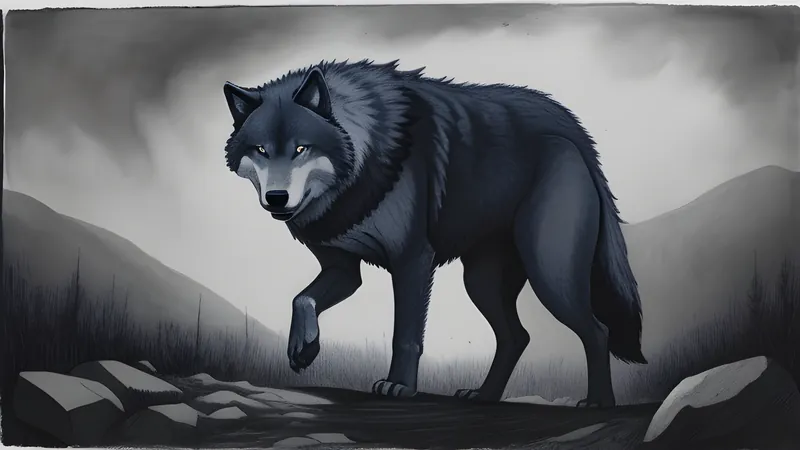
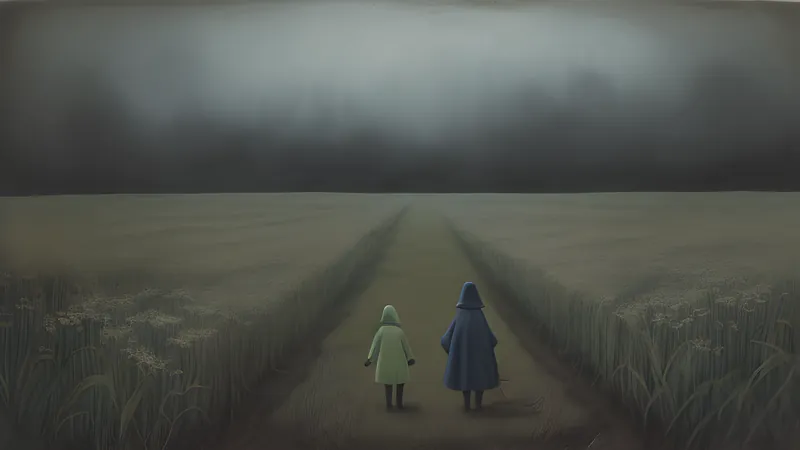
Sometime during the reign of King Stephen, in the middle years of the twelfth century, harvesters working the fields near the Suffolk village of Woolpit found two children standing at the edge of the wolf pits that gave the village its name — a boy and a girl, dressed in clothing of unfamiliar material and colour, speaking a language none of the labourers recognised, and both of them, according to every surviving account, distinctly green-skinned. The villagers took them in. The children would eat nothing that was offered to them until, by chance, someone brought raw beans still in their pods, which they seized on and devoured, and for some time afterward that appeared to be the only food they would accept. The boy sickened and died not long after. The girl lived, gradually lost her green colouring as her diet changed, learned to speak English, was baptised, and reportedly told her hosts she and her brother came from a twilit land where the sun never rose properly, where everyone was the same colour they had been, and that they had been tending their father’s flock when they heard a great noise and found themselves, suddenly and without explanation, standing among the wolf pits of Woolpit.
That story is not folklore reconstructed centuries later from vague oral tradition. It survives because two separate medieval chroniclers, working independently and drawing on what each described as reliable local testimony, wrote it down within a few decades of each other, and their accounts agree on the essentials while differing in exactly the small details that suggest two genuine, separate sources rather than one writer copying the other.
What the chroniclers actually recorded
William of Newburgh, an Augustinian canon writing his Historia rerum Anglicarum in Yorkshire around 1198, includes the Woolpit story as one of several marvels of his own era that he treats with visible caution, noting that he initially found the tale hard to credit before deciding the volume and consistency of testimony obliged him to include it. Ralph of Coggeshall, abbot of Coggeshall Abbey in Essex, writing his Chronicon Anglicanum in the early thirteenth century, gives an independent and more detailed version, naming the local knight Sir Richard de Calne, of the nearby manor of Wikes, as the man who took the children into his household, and adding that the surviving girl grew up, was eventually employed in de Calne’s household, and — in Ralph’s account — later married a man from King’s Lynn. Both writers were serious clerical historians working within the established conventions of chronicle-keeping, and both frame the story as an account of an unresolved local marvel rather than a moral fable with a tidy lesson attached, which is itself unusual for the genre.
Neither chronicler offers a tidy solution, and neither claims to have witnessed events himself; both are recording testimony that had already circulated for years by the time they wrote it down. That gap between event and record, perhaps a generation or more, is exactly the space in which a real, mundane occurrence can pick up the vivid, unexplained shape it reaches the page wearing.
Ralph of Coggeshall’s chronicle is not a solitary source for uncanny sightings from this stretch of Suffolk coast and countryside. The same abbot also recorded, a few decades earlier, the case of the Wildman of Orford: a wordless, fish-like man reportedly caught in fishermen’s nets off the Suffolk coast around 1167 and held for a time at Orford Castle, where he was said to escape back into the sea after refusing all attempts to make him speak. That Ralph treated both accounts with the same careful, non-committal register — testimony reported, doubt acknowledged, no theological lesson drawn — suggests a chronicler working within a genre that already had its own conventions for handling the genuinely unexplained, rather than one inventing marvels to fill blank vellum. Twelfth-century East Anglia, in other words, already had a documented habit of recording strange arrivals from its coasts and fields with a straight face, which makes Woolpit’s green children look less like an isolated fabrication and more like one entry in a wider local practice of taking unexplained encounters seriously enough to write down.
The fork: from marvel to alien contact
For most of the story’s afterlife, it sat quietly in the antiquarian tradition, an oddity noted by local historians and folklore collectors as one of England’s stranger medieval anecdotes, alongside entries like the Green Man carvings found in parish churches or the assorted wild-man legends scattered across the same period. It stayed there until the mid-twentieth century, when the framing shifted decisively toward something the original chroniclers could not have anticipated: extraterrestrial contact.
The Scottish astronomer and science-fiction writer Duncan Lunan proposed, in a widely discussed piece from 1996, that the Green Children story could be read as a folk memory of an actual first-contact event — children arriving from elsewhere, an unfamiliar language, a description of home that sounded almost like a world lit differently from ours — deliberately framing it as a thought experiment about how a genuinely alien encounter might survive only in a medieval chronicler’s imperfect vocabulary for the unfamiliar, rather than as a serious historical claim. That distinction between “thought experiment” and “claim” did not survive contact with wider retelling; the alien reading spread through paranormal compilations and later the internet stripped of Lunan’s own caveats, and the Green Children became, for a couple of generations of casual readers, evidence of a medieval UFO encounter rather than what the two original chroniclers had actually described.
The kernel underneath: chlorosis and a massacre
The most careful modern treatment of the case belongs to the historian John Clark, whose 2006 paper for the Bury St Edmunds and West Suffolk Archaeological Institute, wryly titled after the “small, vulnerable” framing so often applied to imagined aliens, works through the two chronicle texts against the documented history of twelfth-century East Anglia and lands on an explanation that needs no invented spacecraft at all. Green-tinged skin has a known, unremarkable medical cause: chlorosis, an iron-deficiency anaemia historically nicknamed “the green sickness” precisely because of the pale, faintly green cast it can give a malnourished complexion, a condition well within reach of two starving, displaced children fed on a restricted diet for some period before anyone found them.
Clark’s proposed context for how such children came to be wandering, frightened, and speaking a language the village didn’t recognise draws on a real and violent local event: the Battle of Fornham, fought in 1173 a short distance from Woolpit, in which forces loyal to Henry II crushed a rebel army that included a substantial contingent of Flemish mercenaries. Flemish, a language wholly foreign to rural Suffolk ears yet perfectly ordinary in origin, would have sounded exactly as unintelligible to harvesters at Woolpit as any invented alien tongue, and the chaos following a battlefield massacre is precisely the kind of event that could leave two orphaned, malnourished, disoriented children separated from any surviving family and wandering the countryside in unfamiliar clothing. None of this is proven beyond challenge — Clark’s account is a reconstruction built on real, dated local history rather than a document that names the children directly — but it requires nothing beyond documented events any twelfth-century chronicler would have recognised.
The village’s own name is part of the texture here. Woolpit derives from the Old English “wulf-pytt,” a reference to pits dug to trap wolves, a place-name already recorded in documents from before the Norman Conquest and confirmed in Domesday-era records from 1086, decades before the children are supposed to have appeared there. That the chroniclers anchor their marvel to a real, named, mundane agricultural feature of a specific working village, rather than to some vaguer “a wood” or “a field,” is itself a small mark in favour of the story recording a genuine local event rather than a travelling fable attached to Woolpit after the fact, the way legends often drift and settle on whichever place seems to suit them best.
The story also turns out not to be entirely unique, which cuts against a purely invented origin. A broadly similar account, of two green-skinned children appearing near the Spanish town of Banjos, was recorded by the sixteenth-century chronicler in later Spanish sources discussing an event said to have occurred in the twelfth or thirteenth century, close enough in period and detail to the Woolpit case that folklorists have long debated whether one tale influenced the other through the shared clerical Latin culture of medieval Europe, or whether both instead reflect the same recurring human response — chlorosis, displacement, unfamiliar dress and language — arising independently in two separate rural communities confronted with the same kind of frightened, malnourished young arrivals.
What the story keeps being used for
What makes the Green Children of Woolpit worth returning to is not really the mystery of where the children came from. It is how faithfully each era’s retelling reveals what that era wanted a strange arrival to mean. Medieval chroniclers, writing in a period that took wonders and portents seriously as part of the fabric of providence, recorded it as a marvel worth preserving precisely because it resisted explanation and might therefore carry meaning. Victorian and Edwardian antiquarians filed it as a piece of quaint English folklore, evidence of a credulous past best enjoyed at a comfortable historical distance. The mid-to-late twentieth century, newly obsessed with the possibility of contact from beyond the earth, read the same eight hundred-year-old testimony as a garbled transmission from another world. And the twenty-first century, more attuned to migration, displacement, and the disorientation of arriving somewhere your language and your appearance mark you as foreign, has produced Clark’s reading: two children, real and frightened, made strange by starvation and a village’s fear of the unfamiliar rather than by anything otherworldly at all.
The girl’s afterlife within the historical record, thin as it is, adds one more small anchor of plausibility. Some later genealogical traditions identify her with a woman named Agnes Barre, said to have married a royal official and lived out an unremarkable adult life in the region, a detail impossible to verify with certainty this many centuries on but consistent with Ralph of Coggeshall’s own account of a girl who assimilated fully, married locally, and left the marvel of her arrival behind her entirely. A being from another world, in the modern retelling, does not usually get folded so completely into an ordinary medieval marriage record and vanish from the narrative as a person rather than a phenomenon. A frightened, orphaned child, taken in by a local knight and eventually absorbed into the working life of the county she’d been found in, does exactly that.
Woolpit still exists, a small village a few miles from Bury St Edmunds, and its village sign depicts the two green children standing exactly where the harvesters are said to have found them, a permanent local acknowledgement that the strangest thing about the story was never really the children. It was how completely a plausible, well-documented human tragedy — displacement, hunger, a language nobody in earshot could place — can be received, generation after generation, as evidence of something stranger than the world we already know contains. That same instinct, to reach past an unfamiliar traveller for an exotic explanation rather than a mundane one, runs through the Bunny Man’s Virginia bridge and through every vanishing hitchhiker ever picked up on a lonely road: the traveller is always easier to mythologise than to simply ask, plainly, where they have come from and what happened to get them here.
Related Content