The Great Wall Is Visible From Space: A Claim Older Than Spaceflight
A boast printed in 1932, repeated in schoolbooks, and quietly contradicted by nearly every astronaut who looked
Contents
There is a fact that nearly everyone learns as a child and carries into adulthood without ever having reason to test it: the Great Wall of China is the only human-made structure visible from space, or from the Moon, the single work of our hands large enough to register from the void. It is a lovely thing to believe. It flatters the wall, it flatters the civilisation that built it, and it gives the abstract vastness of space a homely reference point. It is also almost entirely wrong, and — this is the strange part — it was being taught as fact for decades before a single human being had gone high enough to check.
A claim that predates the evidence
The most telling feature of this myth is its date of birth. The earliest clear statement of it in English appears in Robert Ripley’s “Believe It or Not!” — the same syndicated cartoon feature that, in a separate panel, would later announce that Einstein had failed mathematics. In a 1932 instalment, Ripley described the Great Wall as the mightiest work of man, the only one that would be visible to the human eye from the Moon. This was 1932. The first human spaceflight, Yuri Gagarin’s single orbit, would not happen until 1961. The first crewed landing on the Moon was 1969. Ripley was not reporting an observation; he was making a rhetorical flourish about scale, and doing it in the confident register of a man who trafficked in astonishment for a living.
The claim had cousins even earlier. As far back as 1895, the English antiquarian Henry Norman wrote that the wall was, besides the works of nature, the only human construction that would be visible from the Moon — again, six decades before anyone could have known. Earlier still, in the 1750s, the English writer William Stukeley had mused in a letter that the wall was a mighty enough work to be noticed from the Moon, drawing a comparison with Hadrian’s Wall closer to home. A myth that arrives fully formed before its supposed evidence is a myth built out of a wish. What people wanted was a way to say the wall was almost unimaginably long, and “you could see it from the Moon” is a far more vivid way to say that than any figure in kilometres. The trouble is that the sentence quietly changed jobs over the following two centuries, sliding from an obvious poetic exaggeration into a literal claim printed in geography textbooks and repeated by teachers who had no reason to doubt it.
What the wall actually is, and why that defeats the claim
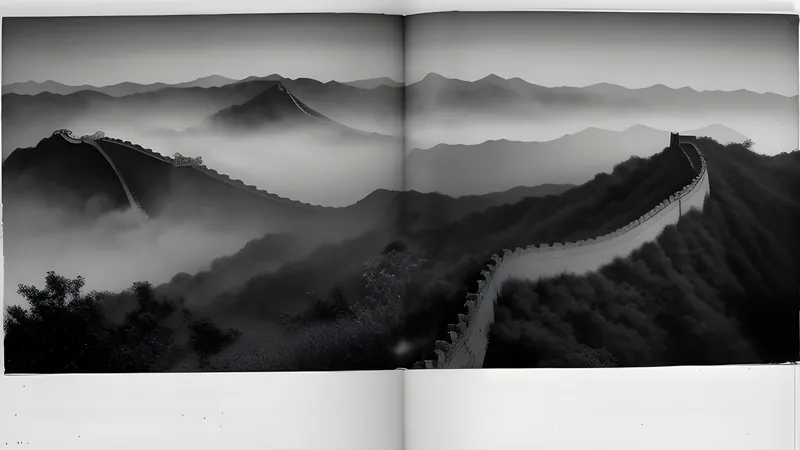
To see why the boast fails, it helps to look honestly at the object. The Great Wall is not a single wall. It is a vast, discontinuous network of fortifications, ramparts and natural barriers built and rebuilt across more than two thousand years, the best-preserved sections dating from the Ming dynasty. A 2012 Chinese state survey put the total length of all its branches and traces at around 21,000 kilometres. That length is the whole basis of the myth — a line 21,000 kilometres long sounds like it ought to be visible from anywhere.
Visibility from a distance depends on width above all, and on that measure the wall is unhelpful. The Ming sections are generally something like five to eight metres wide. A thread that is thousands of kilometres long but only a few metres across, made largely of stone and rammed earth the same greyish-brown as the mountains it runs along, is close to the worst possible candidate for long-distance spotting. Human visual acuity is roughly one arcminute; from low Earth orbit, a few hundred kilometres up, resolving a five-metre-wide feature is at or beyond the limit of the unaided eye even under ideal light, and the wall offers no colour contrast to help. From the Moon, some 384,000 kilometres away, the entire Earth is a marble the size of a thumbnail at arm’s length; the notion of picking out a five-metre ribbon on it is simply absurd. A motorway is wider than the wall and nobody claims to see those from orbit either.
The astronauts who kept saying no
Once people did start going up, the reports came back with tiresome consistency, and they did not match the schoolbook. The American astronauts who commanded Apollo missions and others who looked at Earth from lunar distance were unanimous that no individual human structure was visible from the Moon; from that far away you see continents, oceans, cloud, the green and brown and blue of a whole planet, and nothing made by anyone. Closer in, from low orbit, the record is more interesting and more embarrassing for the wall. Many astronauts reported that highways, airport runways, large cities at night and the wakes of ships were far easier to pick out than the wall, precisely because those things are wider or brighter or more geometric against their surroundings.
The episode that most punctured the myth involved Yang Liwei, China’s first astronaut, who returned from the Shenzhou 5 mission in 2003 and said plainly that he had not been able to see the Great Wall from orbit. This was awkward enough in China, where the claim had become a point of national pride and even appeared in textbooks, that it prompted public discussion and, eventually, revision of some educational material. The astronaut Leroy Chiao later photographed the wall from the International Space Station using a camera with a powerful lens — and even then the images were ambiguous enough that people argued over whether the faint line was the wall or a river. If you need a telephoto lens and still cannot be sure, “visible to the naked eye” has quietly died.
The clearest ground-level rebuttal came, fittingly, from a man who has measured the wall on foot rather than glimpsed it from a cockpit window. William Lindesay, the British explorer who in 1987 became the first person verified to have walked the length of the wall, later founded the conservation group International Friends of the Great Wall and spent decades mapping and documenting the structure section by section. Lindesay has been explicit in his own writing that the space-visibility claim belongs to folklore, not to any survey he has ever conducted, and his authority carries particular weight precisely because it rests on having paced out the thing in person, metre by metre, rather than having merely looked down at it from altitude.
The chain of authority that carried it
A myth this well-travelled does not survive on charm alone; it survives because it is passed hand to hand along a chain of trusted sources, each of whom is repeating rather than checking. A child hears it from a teacher. The teacher read it in a textbook. The textbook writer took it from an encyclopaedia or a popular geography of an earlier generation. That earlier book borrowed it from something like Ripley or Norman, who invented it whole. At no point in that chain does anyone perform the experiment, because the experiment was, for most of the myth’s life, impossible — and by the time it became possible, the claim was so thoroughly embedded that a returning astronaut’s flat denial read as the surprising news rather than the obvious default. This is the ordinary machinery by which false facts outlive scrutiny: authority is inherited, and each link trusts the last. The Great Wall claim is a near-perfect specimen because we can watch the whole chain, from an eighteenth-century letter to a twenty-first-century schoolbook, without ever finding the observation it all supposedly rests on.
A small irony sits inside the correction, too. There is a sense in which something of the wall can be glimpsed from low orbit under exactly the right conditions — a light dusting of snow settling on the ramparts but not the surrounding ground, or a low sun throwing the structure’s shadow far wider than its actual footprint, can occasionally lend it just enough contrast for a sharp-eyed observer with a long lens to trace a segment. Astronauts who have managed it describe it as a hard, marginal catch that depends entirely on weather and angle, nothing like the effortless landmark of the legend. That grain of qualified truth is precisely what lets the myth limp on: a believer can always point to the one snowy photograph and declare the schoolbook vindicated, ignoring that “occasionally, with snow, a telephoto lens, and good luck” is the opposite of “the only structure visible to the naked eye.”
Why a wrong thing sticks so hard
The interesting question is never simply whether a myth is false; it is why this particular false thing found such a comfortable home in so many minds. Part of the answer is that the claim performs a genuinely useful service: it converts an incomprehensible number into a picture. Nobody has an intuition for twenty-one thousand kilometres, but everyone can imagine looking down from the Moon and spotting a line, and the image does the emotional work the statistic cannot. Myths that translate the abstract into the visible are always the hardest to kill, because they are earning their keep every time they are told.
There is also a national and civilisational flattery in it that made people on more than one continent glad to repeat it. For a Western reader it dramatised the exotic grandeur of the East; for a Chinese reader it made the wall a symbol of a greatness so vast the cosmos itself took notice. When a myth pays a compliment that two very different audiences both want to accept, it recruits allies everywhere and critics nowhere. And crucially, the claim is almost self-sealing: most people who repeat it will never be in a position to test it, so there is no friction between the belief and daily life to wear it down. It costs nothing to believe and feels good to say, which is the ideal metabolism for a durable myth.
What is true is stranger anyway
The wall does not need the lie. Its real dimensions — two millennia of construction, a labour toll counted in the hundreds of thousands, a discontinuous system snaking across deserts and mountain ridges for a distance greater than half the Earth’s circumference — are more staggering than the fable that got bolted onto it, and they have the advantage of being checkable. The myth substituted a false, dramatic claim for a true, complicated one, which is the same trade at work in a surprising number of “everybody knows” facts. It is the identical mechanism behind the belief that we only use ten percent of our brains — a vivid, round, flattering figure that turns out to have no measurement behind it — and the same appetite for a comforting round number that keeps the eight-spiders-a-year statistic in circulation despite nobody ever having counted. The Great Wall’s version is simply the oldest and best-travelled of the lot: a poetic boast about scale, first printed centuries before the flight it pretends to report, that spent the intervening years standing in for a view from orbit no one had yet flown.
Related Content