The Great Belt Bridge: The Rumours Under the Span
Every great structure attracts the same whisper — that a man is sealed inside it. The whisper is older than concrete.
Contents
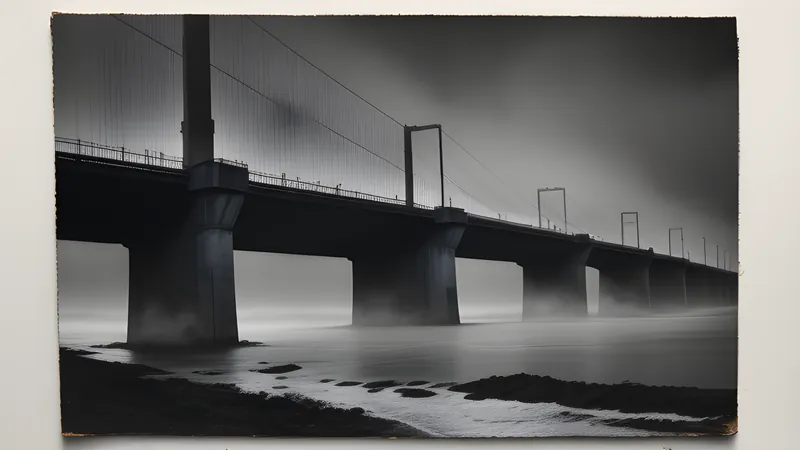
Drive across the Great Belt on a still evening and the East Bridge rises out of the water like something that has no business existing. Two concrete pylons stand two hundred and fifty-four metres above the strait, the tallest points in all of Denmark, and between them the roadway hangs on cables in a single span more than a mile and a half long, the second-longest suspension span on Earth when it opened. It is a place built to make a person feel small, and a place that makes people feel small tends to collect stories. The one told most often about the Great Belt has a particular chill to it. Somewhere in the concrete of a pylon, the story goes, a workman lies sealed — a man who slipped into the wet pour during construction and was never recovered, entombed where he fell because stopping the work to dig him out was impossible. Drivers point at the tower as they pass. He is still in there. The bridge has a body in it.
The story the strait keeps telling
The rumour attaches itself to the Great Belt with the confidence of local knowledge. People will tell you which pylon, sometimes which season, occasionally the man’s trade. The strait itself lends the tale weight, because the Great Belt was never a gentle stretch of water. Before the fixed link opened in 1998, it was crossed by ferries that fought ice and gale for a century, and the older Danish sailors carried their own quieter belief that the belt took a life now and then, as a toll for being crossed at all. It is the same instinct that made a stretch of the Atlantic into a devourer of ships in the folklore of the Bermuda Triangle — a dangerous body of water given an appetite and a will. When a project as vast as the fixed link arrived — a decade of dredging, caissons, tunnelling and pouring across open sea — the toll simply migrated from the ferries to the bridge. The men had worked at height and over deep water for years. Some were hurt. On a build of that scale and duration, some die, as they do on every project of the kind, and the strait’s old reputation stood ready to receive the loss and shape it into a story.
What makes the Great Belt version worth pausing over is that it is not really a Great Belt story at all. The same tale, almost word for word, is told about nearly every enormous structure ever raised. The most famous English-language version belongs to the Hoover Dam on the Colorado River, where generations of tourists have been assured that men are buried standing in the concrete, sealed forever in the great grey wall. It is false, and provably so. Ninety-six workers died in the dam’s construction between 1931 and 1935, from falls, rockslides, heat and machinery, and every death is documented and every body was recovered. Concrete on that scale is not poured as one drowning mass; it is laid in interlocking blocks no larger than a room, each cooled by pipes carrying river water, each small enough that a man who fell into one could be pulled straight back out. Nobody is in the Hoover Dam. The engineering makes the legend impossible. The legend flourishes anyway, told at the visitor centre by people who have just been told it is untrue.
Underneath the rumour is a very old ballad
Follow the rumour back far enough and you do reach a real thing, but it is not a corpse in a pylon. It is a song, and it is very old.
Across the Balkans and the eastern Mediterranean there survives a family of folk ballads that scholars call the building-sacrifice legend, and its logic is always the same. A great work — a bridge, a monastery, a fortress wall — is raised by day and collapses by night, again and again, because the ground will not accept it until something living is given in exchange. A voice, a dream or a wise old man reveals the price: the structure will only stand if a human being is walled into its foundation. Usually the victim is chosen by cruel accident. The masters agree that whichever of their wives brings the workmen’s meal the next morning will be the one immured, and by ill luck it is the youngest and most beloved who comes.
The ballad has real, named forms, sung and written down over centuries. In Greece it is The Bridge of Arta, where the master builder’s own wife is walled into the pier of a bridge over the river Arachthos that would not stand until she was, and her dying curse is softened only so that travellers may cross safely. In Romania it is the legend of Master Manole, the architect of the monastery at Curtea de Argeş, who builds his wife Ana into the wall to make the church stand and is then abandoned on the roof by a prince who wants no rival masterpiece, and falls to his death. In Serbian epic it is The Building of Skadar, where three brothers labour on a fortress the mountain fairy tears down each night until the wife of the youngest, Gojko, is bricked into the ramparts, begging only that a gap be left so she can suckle her infant son. These are not fragments or rumours. They are among the best-documented pieces of European oral literature, collected by folklorists in the nineteenth century and studied ever since as expressions of a single, ancient intuition: that something enormous and permanent must be paid for in life, that you cannot take that much from the world without the world taking something back.
The journey from the foundation to the pour
The building-sacrifice ballad and the body-in-the-concrete rumour are the same story wearing the costume of two different centuries, and you can watch the costume change as the technology does.
The old version needed a real intention. In the ballad, the sacrifice is deliberate and sacred; the builders know the wall demands a life, and they pay it knowingly, with grief and ceremony. That belief made sense in a world where a bridge might genuinely collapse for reasons nobody could diagnose, where engineering was closer to prayer than to arithmetic, and where the only way to explain why one structure stood and another fell was to imagine a bargain with the ground. The sacrifice was a theory of why things hold up.
Modern engineering took the mystery away. We know now why a span stands, down to the last calculation of cable tension and foundation load, and no wise voice needs to name a price for the concrete to set. So the sacrifice went underground. It stopped being a thing the builders choose and became a thing that merely happens — an accident, a slip into the pour, a man lost and left rather than a woman given and mourned. The deliberate offering of the ballad shrank into the industrial mishap of the urban legend, but the emotional core survived the translation intact. The great work still contains a life. The structure still cost a body. We simply relocated the transaction from ritual to negligence, because negligence is the only frame a secular, engineered age has left for the old feeling that something this big must have taken someone.
That instinct — to assume a hidden human cost beneath an achievement too large to fully trust — is one of the most durable shapes the mind makes, and it surfaces far beyond bridges. It is a cousin of the impulse that reads a real corridor of state secrecy into an all-explaining plan, the way a genuine record of hidden programmes hardened into total belief in the immured victims of Cold War mind-control mythology. The concrete rumour is the folk-form of the same suspicion: that the visible, official story of how a thing was built is smooth on the surface and holds a body underneath.
What the rumour is really carrying
Why does the body in the pylon refuse to die, told even by people who half-know it is untrue? Because it is doing a job that the true account of the bridge cannot do.
The honest story of the Great Belt is a triumph of coordination — thousands of engineers and labourers, billions of kroner, a decade of tunnelling and caisson-sinking and cable-spinning, ending in a structure that carries tens of thousands of vehicles a day and has hurt almost no one since it opened. It is a genuinely magnificent thing. It is also, emotionally, a little flat, because pure competence does not haunt. The rumour supplies what the triumph leaves out. It gives the bridge a wound, and a wound is what makes a giant structure feel like it belongs to the people who cross it rather than to the state that built it. The man in the concrete is the crowd’s way of insisting that the bridge is a place where something human happened, something grave enough to be remembered and passed on. He is a memorial the engineers never commissioned, raised by word of mouth to the general truth that these things do cost lives, even when the specific corpse is invented.
There is also, underneath, the older unease the ballads carried and never quite resolved: the sense that we are not entitled to works this large, that spanning a sea a mile and a half wide is a kind of trespass, and that trespass invites a reckoning. The medieval mason built a gap into the wall so the immured mother could feed her child, a small mercy folded into an act of horror. The modern driver points at the pylon and lowers their voice. It is the same flinch — the refusal to believe that something so enormous could be raised out of nothing but concrete and cleverness, with no one paying the old, dark price.
The bridge holds; so does the story
There is no man in the Great Belt’s pylons. The concrete was poured in controlled lifts, every fatality on the project was recorded and recovered, and the engineering that makes the bridge stand is the same engineering that makes the legend physically impossible, exactly as it is at the Hoover Dam and every other giant the rumour has attached itself to. On the plain question — is a body sealed in the tower — the answer is no, and it is not a close call.
But the plain question was never really what the rumour was asking. Look at what the story does rather than whether it is accurate, and it becomes one of the oldest things people make: a way of paying respect to a work too large to comprehend, and a way of admitting that awe and dread are the same feeling seen from two sides. The Bridge of Arta and the Great Belt are the same bridge, sung five hundred years apart, and the wife in the foundation and the workman in the pylon are the same imagined soul, given so that the impossible thing above the water could stand. We stopped believing the ground demands a life somewhere in the last century of engineering. We never stopped needing to say that it did.
Related Content