The Goatman: Maryland's Roadside Bogey
How a suburban county grew its own monster out of lovers' lanes and lost dogs
Contents
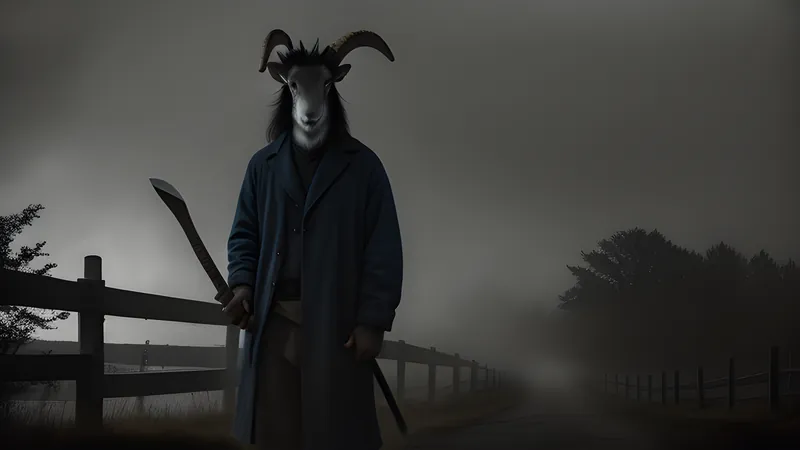
Somewhere on a dark road in Prince George’s County, Maryland, a car is parked where it should not be. The engine is off. Two teenagers are inside. And out of the treeline comes a figure that walks upright but is not quite a man — horned, hoofed, hairy from the waist down, carrying an axe. He brings the blade down on the bonnet, or the roof, or a stray limb, and the car tears away into the night with a new dent and a new story to tell. That is the Goatman, and for the better part of half a century he has been the monster the suburbs south of Washington keep in their back pocket, the thing that lives just past the last streetlight on Fletchertown Road.
The story as it is told
The Goatman legend runs in two channels, and most tellings splice them together without noticing the seam. In the first, he is a straightforward roadside bogey: a half-goat, half-man creature who haunts lovers’ lanes, isolated bridges and the wooded fringes of Bowie and its neighbours, attacking parked cars and the couples inside them. He is nocturnal, territorial, and fond of an axe. He is the reason you do not park on that particular stretch of road, the reason a dog goes missing, the reason of a strange cry in the dark.
In the second channel he has an origin story, and it is oddly specific for a monster. He was, the tale goes, a scientist at the United States Department of Agriculture’s research facility in Beltsville, Maryland, working on experiments involving goats. Something went wrong — a botched injection, a lab accident, a splash of the wrong serum — and the man was transformed, or fused with his animal subjects, into the hybrid that now stalks the county. In some versions he is driven mad by the loss of his human life; in others he is enraged by the death of a child, or a colleague’s betrayal. The precision of the setting — a real, nameable government lab a few miles from where the sightings cluster — is the detail that gives the whole thing its grip.
The kernel: a real lab and a real geography
Strip the legend back and there are true things underneath it, which is exactly why it holds. The Beltsville Agricultural Research Center is real. It is one of the largest agricultural research complexes in the world, run by the USDA, and it does in fact sit in the same part of Maryland where the Goatman is said to roam. It has, over its long history, conducted livestock research, including work with goats and other farm animals. To a teenager in the 1960s or 1970s, “there is a secret government animal lab in the woods near here” was not a wild claim to plant a monster in. It was true, and the monster simply moved in next door.
The geography does the rest. Prince George’s County in that era still had long, unlit rural roads threading between the developing suburbs — the sort of half-wooded, half-built landscape where a city’s edge dissolves into farmland. Fletchertown Road, the address most associated with the legend, was one of these: quiet, dark, hemmed by trees, and precisely the kind of place teenagers went to drink and park where their parents could not see them. A monster that punishes couples for parking on a lonely road is not describing a creature. It is describing the road, and the specific low-grade dread of being somewhere you are not supposed to be, with someone you are not supposed to be with, in the dark.
The fork: where the record leaves off
The point at which the Goatman departs from anything documented is easy to mark, because there is no documentation. There is no missing USDA scientist, no reported lab accident, no contemporary newspaper account of a transformed researcher. The Beltsville facility did the ordinary, dull, funded work of agricultural science; it did not manufacture a horned killer. The origin story is a piece of folk reasoning working backwards — the storytellers had a monster and a nearby lab, and the lab explained the monster. That is the same intuitive machinery that lets a real electromagnetics installation become a weather-control weapon, or a real body of open water become a triangle that eats ships: take a genuine, slightly opaque institution, and let the imagination supply the secret it must be hiding.
The single most concrete event ever tied to the Goatman is stranger and sadder than the lab story, and it is worth telling straight. In 1971 the neighbourhood of Old Bowie was gripped by a spate of dog killings and disappearances; the most cited was a puppy named Ginger whose severed head was reportedly found after she went missing. Local teenagers, already trading Goatman stories, attached the killings to the creature, and a local newspaper covered the panic. Whatever actually killed those animals — a car, a wild dog, a person — the effect was to give the legend a date, a place and a body. A vague back-road bogey acquired a documented episode, and documented episodes are what turn a story people half-believe into a story people repeat as fact.
The journey: how a monster gets a hometown
The Goatman did not spring up whole. He is stitched together from older, wider materials, and the seams are visible if you look. The horned, hoofed, half-goat man is one of the oldest figures in the Western imagination — the satyr and the faun of classical myth, the Devil of medieval woodcuts, Pan in the wild places. A goat-legged man in the dark is an image every Western storyteller already carries; Prince George’s County did not invent it so much as give it a local address and an axe.
The roadside-attack structure is borrowed too. The “monster that menaces couples parked on a lonely lane” is one of the load-bearing plots of American adolescent folklore — the same architecture as the hook-handed killer of the classic “the hook” story, in which a courting couple flee a lovers’ lane and find a torn-off hook on the door handle. The Goatman is that story with a folk-horror costume: same setting, same lesson, same delicious warning that intimacy in forbidden places invites punishment from the dark. Maryland’s contribution was to fuse the ancient satyr to the American lovers’-lane legend and root the hybrid in a real, named lab down the road.
From there the folklore spread the way regional legends do. It was collected and studied by academics with tape recorders in the early 1970s: student folklore collectors working through the University of Maryland gathered Goatman accounts from teenagers across Prince George’s County, and those transcripts survive in the university’s folklore archive as one of the earliest firm datings of the legend. What the collectors found was instructive. No two tellers agreed on the details; the origin flipped between “escaped lab experiment,” “mad hermit,” and “murdered farmer,” and the one stable element was the setting — a dark road, a parked car, a warning. That instability is the signature of living oral tradition rather than a single authored tale, and it is part of why the Goatman is unusually well documented for a suburban bogey. It passed down through school playgrounds and campfire circles and, eventually, onto the internet, where it now sits in every listicle of American cryptids alongside better-known monsters. Like Mothman in West Virginia and the Pope Lick Monster on its Kentucky railway trestle — itself a goat-man of the same broad family — the Goatman is a creature bolted firmly to one landscape, a local deity of a specific set of roads.
What the Goatman is really about
Ask what the Goatman is for, and the answer is not “explaining a real creature.” It is a boundary marker. Every detail of the legend is a warning about where the safe world ends. Do not park on the dark road. Do not go into the woods at the county’s edge. Do not trust the quiet stretch past the last house. The monster is the personification of the rule, and adolescents in particular need those rules dramatised, because the pull toward the forbidden places — the parked car, the unlit lane, the secret from parents — is exactly what the Goatman punishes. He is a chaperone with hooves.
The sexual undertone is not incidental, and the folklorists who collected these accounts noticed it. The Goatman almost always strikes at couples, and almost always at the moment of privacy — the parked car, the darkened lane, the point at which two teenagers have deliberately removed themselves from adult supervision. A goat-legged man is, in the older iconography, a figure of unbridled lust; setting him loose specifically on courting couples turns the legend into a piece of quiet moral instruction, the kind a community transmits without ever meaning to. The monster is the consequence the story attaches to desire pursued in the wrong place at the wrong hour.
There is a class of fear folded into the origin story too, and it is not accidental that the villain is a scientist and the setting a government lab. The Goatman’s transformation is a small parable about institutions you cannot see into: the huge fenced research centre, the men in there doing things with animals that you will never be told about, the sense that official knowledge is happening nearby and is being kept from you. A community that lives beside a secretive-seeming facility will, sooner or later, populate it with a monster, because the monster is a way of naming an unease that has no other outlet. The lab is real; the not-knowing is real; the Goatman is what the not-knowing turns into after dark.
And there is grief in it, at the bottom, in the form of a dead puppy named Ginger. Whatever happened on those Old Bowie streets in 1971, the response — inventing a creature to blame — is a deeply human one. When something small and loved is killed and no one can say why, a monster is almost a mercy. It gives the loss an author. It converts a meaningless, unsolved cruelty into a story with a villain, which is easier to live beside than a story with a blank where the villain should be.
The creature at the county line
The Goatman is still out there in the only sense that matters: children in that part of Maryland still learn his name, still dare each other onto the roads he is said to walk, still feel the specific thrill of half-believing while telling the story to someone younger. He has no body, no lab file, no confirmed sighting that survives daylight. What he has is a job, and he does it well — standing at the edge of the safe world with an axe, marking the line between the lit streets and the dark ones, so that every generation of teenagers gets to feel the woods watching them and know, without quite knowing why, that some roads are best driven through and not parked on.
Related Content