The Georgia Guidestones: The Monument and Its Enemies
How a granite riddle in a Georgia field became a lightning rod for the century's darkest fears
Contents
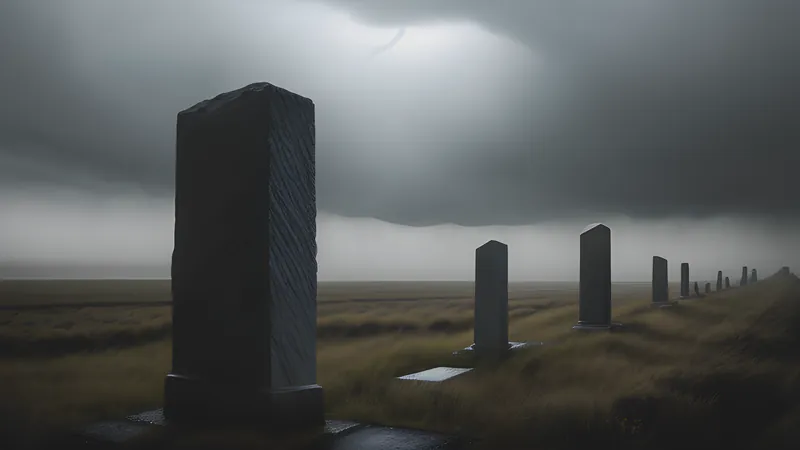
For forty-two years there stood, in a cattle pasture in Elbert County, Georgia, a granite monument that nobody would claim. Six slabs of pale local stone, one of them a central pillar, four of them fanned around it like the vanes of a compass, capped by a lintel and rising nearly twenty feet from the red clay. They weighed something in the region of a hundred and twenty tons. On their polished faces, in eight modern languages, ran ten short commandments for the survivors of some unnamed catastrophe. The first of them, the one that would eventually get the whole thing dynamited, read: “Maintain humanity under 500,000,000 in perpetual balance with nature.”
A man called Christian
The story of how the monument came to exist is unusually well documented, because the people who built it kept careful notes. In June 1979 a well-dressed, silver-haired man walked into the offices of the Elberton Granite Finishing Company and asked its president, Joe Fendley, for a quotation. He wanted a monument of a size the town had never cut. He gave his name as Robert C. Christian and said he represented a small group of Americans who wished to remain anonymous. When Fendley named a price he thought absurd enough to send the stranger away, the man did not blink.
Fendley, sensing either a lunatic or a con, sent Christian to the Granite City Bank and its president, Wyatt Martin. Martin insisted on proof the man could pay before any granite was quarried. Christian agreed to reveal his real identity to Martin alone, on the condition that the banker take the secret to his grave. Martin did exactly that. He would say only that “Christian” was a pseudonym, chosen because the man admired the founder of the Rosicrucians, Christian Rosenkreuz, and that the money came in from banks in several states. The two men corresponded for years. When Martin died in 2021, whatever he knew died with him, and he had by then destroyed the paperwork.
The monument was unveiled in March 1980 before a few hundred people. Its ten guides urged their imagined readers to rule passion with reason, to protect people and nations with fair laws, to prize truth and beauty and love, to leave room for nature, to avoid petty laws and useless officials, to settle disputes in a world court, to unite humanity with a living new language. They were, by any plain reading, the earnest and slightly Utopian wishes of someone frightened of nuclear war, writing a message for whoever might crawl out of the rubble. Christian later cited the Age of Reason and the deist idealism of Thomas Paine as part of his inspiration, alongside the Rosicrucian borrowing in his name. The guides read like a Enlightenment pamphleteer’s letter to the survivors, translated into stone.
The engineering was as careful as the sentiment. The Elberton masons, working from Christian’s specifications, cut a slot through the central pillar aligned so that the sun’s beam would fall in a predictable place at noon on the solstices and equinoxes; they drilled a channel through the same pillar aimed at the celestial pole, so a future observer could find Polaris and reconstruct the calendar; and they set a small aperture in the capstone through which a spot of sunlight tracked the day of the year across the central stone. A future civilisation that had lost its clocks and almanacs could, in principle, stand at the guidestones and recover the year. Christian explained all of this in a small self-published booklet he left with Martin. He wanted the human race to keep its head after the end of the world, and to know what day it was.
The town, for its part, treated the commission as the strangest good fortune Elberton had ever had. Elbert County called itself the granite capital of the world, and a monument of this scale, cut and finished locally and then written up in newspapers as far away as the coasts, was free advertising for an industry that ran on headstones and kerbstones. The Elberton Granite Association placed a tablet of its own at the site explaining the astronomy and recording, drily, that the sponsor wished to stay anonymous. For a good while the arrangement suited everyone: a rich eccentric got his monument, the masons got their fee, and the county got a roadside attraction.
The fork in the meaning
The kernel here is not in dispute. A private citizen, using inherited or pooled money and a false name, commissioned a doomsday monument and paid for it in the ordinary way. The place where the record and the legend part company is the reading of that first guide.
To Christian, “maintain humanity under 500,000,000” was arithmetic about a hypothetical aftermath, a population that a wrecked planet might sustain. To a growing number of readers across the following decades, it was a threat in the present tense: a coded confession that a hidden elite intended to reduce the living population of the Earth from its billions to half a billion, and had carved the plan in stone with the arrogance of people who feared no consequences. The astronomy became sinister. The eight languages became proof of global reach. The Rosicrucian pseudonym became an admission of occult conspiracy. A monument built as a lifeboat was reread as a gallows.
You can watch the reinterpretation gather weight. Early local coverage treated the stones as an eccentric tourist curiosity, and the town, sensing revenue, was happy to oblige. Through the 1990s they drew New Age pilgrims and the odd wedding. Yoko Ono recorded a spoken piece praising them. Then, as the internet gave every anxious reader a printing press, the guidestones migrated into the literature of the New World Order, where they sat comfortably alongside older durable fears about hidden hands steering the world. The same audiences reading about a Bavarian book club and its afterlife found in the Elberton granite a physical exhibit, something you could drive to and photograph, for a suspicion that usually had nothing so solid to point at.
What the monument was made to carry
That solidity is, I think, the whole of its power. Most conspiracy folklore is frustratingly abstract. The phrase that ate the century names a plot with no address, no artefact, no proof you can stand next to. The guidestones offered believers something almost unique: a defendant that could not deny the charge, because it could not speak, and an anonymous author who had gone out of his way to remain unfindable. Anonymity, meant as modesty, read as guilt. A man who signs nothing has, in the grammar of suspicion, something to hide.
There is a well-studied habit of mind at work here, the one that treats a large and troubling design as evidence of a large and troubling designer. A monument that expensive, that deliberate, that strange, feels as though it must mean what it most alarmingly could mean. The alternative reading — a frightened idealist with money, a Cold War imagination, and a taste for Rosicrucian theatre — is duller and therefore, to the anxious mind, less believable. Grand effects seem to demand grand and hidden causes, and the guidestones were nothing if not a grand effect.
The population figure did real work in the drift, because it aged badly. In 1980, with the world holding around four and a half billion people, a target of half a billion was so far below the living reality that it could only describe a distant, depopulated future. But the sentence was carved in the imperative mood — “maintain humanity under 500,000,000” — and an imperative reads as an instruction, addressed to someone, now. Strip away the apocalyptic framing that Christian intended and the same words become a directive from an author who has the power to give directives. Believers did not have to twist the grammar. They only had to forget the frame, and the frame was never carved into the stone. It lived in a booklet in a banker’s drawer, which is to say nowhere the pilgrims could see it.
The languages carried freight, too. Christian chose English, Spanish, Swahili, Hindi, Hebrew, Arabic, Chinese and Russian, with older scripts on the capstone in Babylonian cuneiform, Classical Greek, Sanskrit and Egyptian hieroglyphs. He seems to have meant this as a gesture of universal address, a message to all humanity. Read through suspicion, the same choice became the letterhead of a world government, proof that the authors thought globally because they ruled globally.
The enemies arrive
For most of their life the monument’s enemies confined themselves to graffiti and pamphlets. Polyurethane paint appeared on the stones more than once, daubed with slogans about death and the coming order; in 2008 the vandalism was extensive enough that the granite association had to bring in solvents and scaffolding to clean it. Preachers denounced the stones from Elberton pulpits as an altar to false gods. Local politicians running for office learned that promising to tear the monument down could win a certain kind of applause. Documentary crews came looking for the vanished Mr Christian; a 2015 film advanced a candidate, an Iowa doctor named Herbert Kersten, on circumstantial grounds to do with his views and his correspondence, though nothing was ever confirmed and Martin, faithful to the end, never broke his word.
Then, in the small hours of 6 July 2022, someone drove out to the pasture and set an explosive charge against one of the outer slabs. The blast sheared a panel away and damaged the structure so badly that county authorities, judging what remained unsafe, brought in machinery the same day and took the rest down. Security-camera footage caught the flash and a car leaving. No one has been charged. The Elberton granite that had outlasted four decades of paint and prophecy came down in an afternoon, and the field went quiet.
The reaction told its own story. To many who had read the stones as a manifesto, the demolition felt like a small victory in a large war, the toppling of an idol. Others, of a more melancholy cast, mourned a genuinely odd and rather beautiful piece of public art, an earnest letter to the future that the future had decided to burn unread. The town, which had grown fond of its riddle, mostly seemed sad.
The story we were telling ourselves
What the guidestones finally reveal is less about any secret cabal than about the appetite that the monument was made to feed. A message meant to comfort survivors of an apocalypse became, in the hands of the anxious, evidence that the apocalypse was being planned. The transformation required no new facts. Every detail the believers cited — the anonymity, the population figure, the languages, the astronomy — was there in plain sight from 1980, printed in the local paper. What changed was the reader.
That is the folklorist’s real quarry here. A legend does not need to invent; it only needs to reinterpret, to take a stone that says one thing and hear it saying another, and to find in an inscription the shape of the reader’s own dread. Objects lend themselves to this better than arguments do, because an object cannot answer back or qualify itself. It just sits in the field, mute and monumental, and lets each visitor read it as they need to. The astronomer saw an almanac. The New Age pilgrim saw a temple. The frightened citizen saw a death warrant. All three were looking at the same forty tons of Elberton granite, and the granite obliged them all. The people who feared the guidestones had their reasons. They were living through decades that gave ordinary citizens ample reason to suspect that powerful people met privately and decided things, a suspicion that stories like the club that meets behind the hedge kept warm. Christian’s monument gave that suspicion a face, an address and an apparent confession, and it asked for nothing in return but to be believed. It is easy to see why so many did, and why, in the end, one of them came out to the pasture with a bag of explosives and finally answered the granite in the only language it could not survive.
Related Content