The Georgia Guidestones: A Granite Riddle and Its Ghost
A pseudonymous stranger, a country banker's kept secret, and how ten commandments in granite became proof of a plot to depopulate the earth
Contents
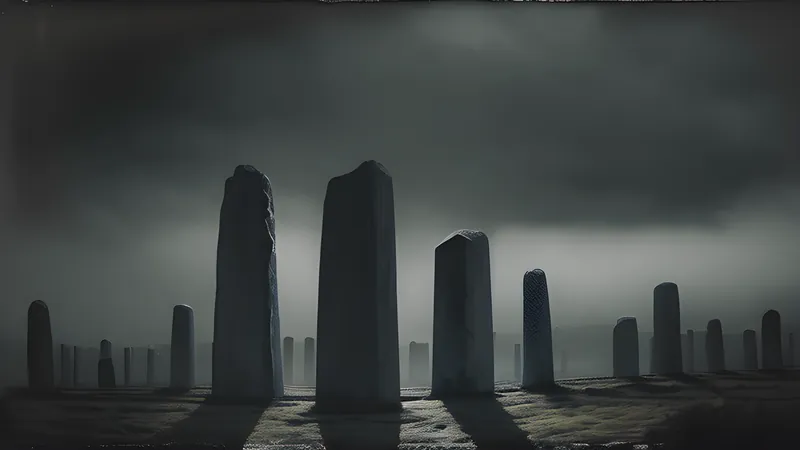
On a low rise in Elbert County, Georgia, in the American South’s granite belt, there stood for forty-two years a monument that almost nobody had asked for and that no one, officially, would claim. Six slabs of pale Pyramid Blue granite, nearly six metres tall, arranged around a central pillar and capped with a lintel, weighing something over a hundred tonnes in all. Carved into the faces, in eight modern languages, were ten terse guidelines for humanity — and the first of them, the one that would haunt the whole structure, read: “Maintain humanity under 500,000,000 in perpetual balance with nature.” The man who commissioned it in 1979 gave the name “R.C. Christian” and said he represented “a small group of loyal Americans” who wished to remain anonymous forever. In July 2022, an unknown person destroyed part of it with an explosive charge in the pre-dawn dark, and the county demolished the rest that same day for safety. Between its raising and its ruin, the Georgia Guidestones became one of the most feverishly interpreted objects in America — a granite Rorschach blot onto which a nation projected its deepest fears about who, exactly, was planning its future.
The riddle, and its most frightening reading
To understand the legend you have to feel the genuine strangeness of the thing, because the strangeness is real and the paranoia is not baseless. Imagine you are a resident of rural Georgia in 1980, and a monument the size of a house appears in a field, paid for by a stranger who used a false name, refused to be identified, and left behind a set of instructions for rebuilding civilisation after some unnamed catastrophe. The ten guidelines counsel a unified world, a common language, rule by “tempered reason,” the protection of people and nations by “fair laws and just courts” — and, at the very top, a cap on the human population at half a billion, less than a tenth of the number then alive.
Read that first line cold, knowing nothing of who wrote it, and the mind runs somewhere dark almost at once. Half a billion people, “in perpetual balance with nature.” The world already held more than four billion. To get from here to there, more than nine of every ten human beings would have to be gone. Who writes such a thing into stone, anonymously, at great expense, and erects it as a message to the survivors of a future collapse? To many who encountered it, the answer wrote itself: this was a manifesto, carved in granite by the people who intended to do the culling — a public confession by a global elite of its plan to depopulate the earth, hidden in plain sight in the safest possible place, an American cow pasture. The monument was read as the New World Order’s cornerstone, an admission of genocidal intent, even, in some tellings, a satanic altar. And the more the origins stayed secret, the more certain the reading became. The anonymity was not a gap in the story; the anonymity was the story.
The kernel: who actually built it, and how
Here the record is unusually complete, because building a hundred-tonne monument is not a quiet business and it left a thick paper trail of ordinary commerce. In the summer of 1979 a well-dressed, articulate man walked into the office of the Elberton Granite Finishing Company and asked its president, Joe Fendley, to quote a price for a monument of a scale the company had never attempted. He gave his name as Robert C. Christian, admitted at once that it was a pseudonym, and explained that he represented a small group who had been planning the project for twenty years and wished to remain forever anonymous. He wanted the stones aligned to the sun and stars, engraved with his guidelines in eight languages, and he wanted his identity to die with him.
Fendley, taking him for a crank, quoted an inflated price to be rid of him — and was startled when Christian agreed and asked where he could arrange payment. For that, Christian was sent to the president of the Granite City Bank, Wyatt Martin, and it is Martin who becomes the quiet hero of the whole affair. Christian confided his real identity to Martin alone, on the condition of absolute secrecy, and Martin — a small-town banker with an old-fashioned sense of a promise — kept that secret for the rest of his life, refusing every interviewer, every documentary maker, and every conspiracy theorist who came to his door across four decades. Martin knew who R.C. Christian was, and he told a journalist for Wired, in a 2009 investigation by Randall Sullivan, only a few things: that the man was highly educated, from outside Georgia, a member of no group Martin could identify as sinister, and, in Martin’s assessment, entirely sincere and entirely harmless. The money was real, wired from banks in several cities to conceal the trail. The monument went up in March 1980. And the identity, as promised, went into the grave with the men who knew it.
The fork: from an old man’s testament to a genocidal plot
The gap between the mundane commercial record and the terrifying legend is enormous, and it is worth locating exactly where the two part company. Everything we can document points to a wealthy, elderly, idealistic man — steeped, by the internal evidence, in the anxieties of his own era — commissioning a personal testament and hiding behind a pseudonym for reasons that are eccentric but not sinister. The 1970s were the decade of The Population Bomb, of Club of Rome forecasts of civilisational overshoot, of Cold War dread that a nuclear exchange might end the world at any hour. A monument counselling the survivors of some future catastrophe to rebuild a smaller, calmer, better-governed world is a recognisably 1970s document — the earnest, slightly grandiose product of a mind marinated in overpopulation panic and nuclear fear. Read in its own context, “maintain humanity under 500,000,000” is advice to hypothetical survivors of a collapse that has already culled the species — the counsel of a man imagining the ashes, trying to help whoever crawls out of them. The plan is for rebuilding, and reads as a threat only if you assume its author intended to do the killing first.
The conspiratorial reading forks off precisely by ignoring that context and reversing the arrow of causation — by reading a message to survivors as a threat against the living. It also requires the anonymity to mean the opposite of what the evidence suggests. If a cabal genuinely intended to exterminate nine-tenths of humanity, carving the plan into a public monument and inviting the world to photograph it would be a spectacularly strange way to keep it secret. The pseudonym “R.C. Christian” is itself a clue the legend prefers to overlook: it is almost certainly a nod to Christian Rosenkreuz, the semi-legendary founder of the Rosicrucians, an esoteric tradition of moral and philosophical self-improvement. The name signals a starry-eyed idealist steeped in Enlightenment-flavoured mysticism — an unlikely alias for a génocidaire signing his work. The fork, as so often, is the point where a genuinely unsettling ambiguity gets resolved always and only in the direction of maximum malice.
The journey: how a mystery becomes a monster
The Guidestones grew their legend slowly and then, with the internet, all at once. For their first two decades they were mostly a local curiosity, a strange roadside attraction that drew the occasional bewildered tourist. The interpretations that would consume them arrived with the age of the web, when the monument became endlessly reproducible as an image and endlessly annotatable as a text. A photograph of the population line, stripped of its 1970s context and pasted into a video or a forum post, is a perfect engine of dread — a real object, verifiably standing in a real field, saying a genuinely alarming thing in genuinely permanent stone. Unlike a leaked document that might be forged or a rumour that might be traced, the Guidestones were undeniably there. You could drive to Georgia and touch the plot with your own hand. That physical reality gave the conspiracy an anchor most conspiracies lack, and the anonymity supplied an inexhaustible blank for the imagination to fill.
And fill it did, across the whole spectrum. Some read the stones as the manifesto of a depopulationist elite; others as a Rosicrucian or Masonic monument; others still as satanic, an altar to a coming age of darkness. Guesses at the true identity of R.C. Christian ranged from the media magnate Ted Turner, a Georgian with well-known environmental and population concerns, to a shifting cast of secret societies. None was ever confirmed, because Wyatt Martin never spoke. The monument even acquired admirers on the other side: the artist Yoko Ono once praised the guidelines as “a stirring call to rational thinking.” The single object held a genocidal plot and a humanist prayer at once, depending entirely on what the viewer brought to the stone. That is the defining property of a Rorschach blot, and it is why the Guidestones outgrew every attempt to fix their meaning.
The story ended in destruction. In the small hours of 6 July 2022, someone detonated a charge that toppled one of the great slabs; the state demolished the rest that day, citing the danger of the remaining unstable granite. No one has been charged. The bombing was, in a grim way, the legend’s final act of interpretation — the moment a section of the public decided the granite riddle was dangerous enough to require an answer in dynamite.
What the Guidestones are really about
The Georgia Guidestones were a mirror, and what people saw in them was themselves. The half-billion figure did real work in the American imagination because it landed on a genuine, unhealed nerve. The twentieth century actually contains regimes and institutions that decided some human lives were surplus and acted on it — the eugenics movements that flourished in America and Europe, the forced sterilisations carried out on the poor and the disabled, the Tuskegee study in which the United States Public Health Service let Black men die of syphilis to watch the disease progress. A public already carrying that history in its bones does not read “maintain humanity under 500,000,000” as an academic thought experiment. It reads it as a threat, because threats exactly like it have been carried out before. The fear is not manufactured from nothing; it is memory, misapplied to a stranger’s granite testament.
Anonymity did the rest. Human beings cannot leave an unexplained secret alone — the mind treats a locked box as a promise of treasure proportional to the lock. A mystery donor who hid his name forever guaranteed that the vacuum would be filled with the darkest available content, in the same way that a jailer’s silence built a hidden king behind the man in the iron mask. The Guidestones asked the public to sit with genuine ambiguity — an idealist or a monster, a prayer or a plot, no way to be sure — and sustained ambiguity is one of the things people can least tolerate. So the ambiguity was resolved, over and over, in the direction of the most frightening certainty available, until someone finally resolved it with explosives.
What actually stood in that Georgia field, on the best evidence we have, was the last testament of an anonymous idealist frightened by the 1970s — a man who imagined the world after a catastrophe and wanted to leave the survivors some calm advice, carved in the most durable stone he could buy. He got his anonymity, and the price of it was that his monument outlived his meaning entirely, and became a screen onto which a fearful century projected its oldest nightmare: that somewhere, someone powerful has decided there are too many of us. The stones are gone now. The nightmare that read them is not, and it did not come from the granite. It was always ours, waiting for a blank surface to appear on.
Related Content