The Foo Fighters: What Wartime Pilots Really Saw
Small glowing lights paced Allied night fighters over Germany in 1944 — the sightings were real, and so were the explanations
Contents
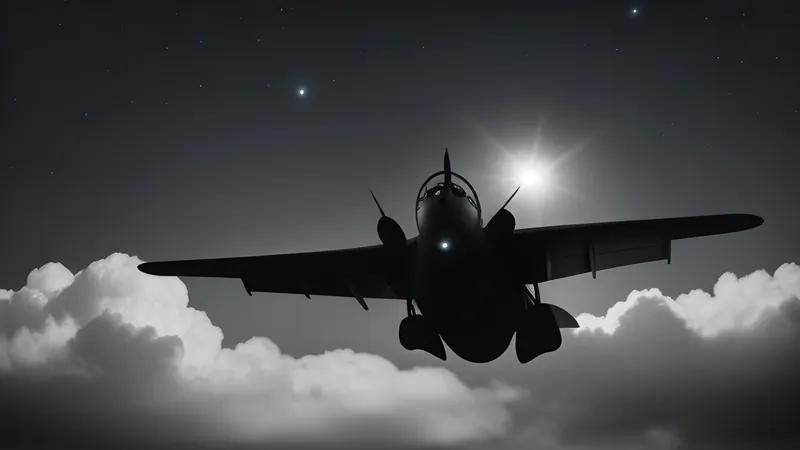
Late in 1944, over the night skies of the Rhine, radar operators and pilots of the US Army Air Forces began filing reports that made their intelligence officers uneasy. Small balls of orange, red, or white-hot light were shadowing their aircraft in the dark — climbing when they climbed, banking when they banked, sometimes holding a tight formation off a wingtip for minutes at a time before peeling away into the night. The men flying these missions were not green recruits. They were trained night-fighter crews, flying radar-equipped aircraft on some of the most technically demanding sorties of the war, and they were describing something that behaved less like a weapon and more like a companion. They called them foo fighters, and eighty years later the name has outlived nearly everyone who used it first.
The strongest case: this was not a story someone made up
The case for taking the foo fighter reports seriously starts with who was doing the reporting. The sightings are most closely tied to the 415th Night Fighter Squadron, which flew radar-equipped Bristol Beaufighters and later Douglas A-20 Havocs and Northrop P-61 Black Widows on intercept missions over occupied Europe. These were specialist crews, selected and trained for night work precisely because it demanded a cooler head and a sharper eye than daylight combat — misjudging a shape or a distance in the dark could mean colliding with terrain, missing an enemy fighter closing from behind, or shooting at a friendly aircraft. Radar observer Donald J. Meiers is generally credited with coining the name itself, borrowing “foo” from the American comic strip Smokey Stover, in which the cartoonist Bill Holman had his fictional fire chief use the nonsense phrase “where there’s foo, there’s fire” as an in-joke placeholder word. The name was gallows humour among men who took the phenomenon seriously enough to keep logging it.
What makes the reports hard to dismiss as a rumour that snowballed among one nervous unit is how widely they were independently corroborated. American aircrew reported them. British aircrew reported them. German aircrew reported seeing the same kind of lights pacing their own aircraft — and by some accounts, so did Japanese aircrew in the Pacific theatre, describing comparable “balls of fire” trailing their planes at night. That spread matters. If foo fighters had been a single secret weapon deployed by one side, the other side would have had no particular reason to report seeing the same thing happening to them. Adversaries were describing an experience that crossed the lines of the war itself, which argues strongly against any single national programme being the whole explanation and argues just as strongly against simple invention — it is a much harder thing to fabricate the same story independently on both sides of a front than to imagine one nervous squadron talking itself into a shared delusion.
The military response also tells you the reports were treated as real intelligence, not campfire talk. US military intelligence opened an investigation into whether the lights represented a German secret weapon, precisely because the descriptions were specific and consistent enough to warrant it: small, self-luminous, capable of manoeuvres the crews judged too abrupt for any aircraft they knew, and persistent enough to be logged mission after mission rather than as a one-off fluke. None of this required believing the lights were extraterrestrial or supernatural. It required only believing that trained observers, flying in a warzone at night, were seeing something real enough and strange enough to put in a report that their commanding officers then took to intelligence.
Chasing the ghost of a secret weapon
The intelligence investigation into a German origin never produced a device. In the decades since, a rumoured Nazi anti-aircraft weapons programme — sometimes referred to as “Feuerball,” German for fireball — has circulated as the tidy answer: a secret German aircraft or drone built to harass Allied bombers with disorienting lights. It is a satisfying story, not least because it would explain everything at once. But no wartime German engineering records, design documents, or postwar interrogations of Luftwaffe personnel have ever substantiated such a programme. Historians who have gone looking for it generally conclude that Feuerball is itself a postwar myth — a story invented to explain the foo fighters that has no more documentary footing than the foo fighters themselves. It is myth trying to explain myth, and the fact that it has never closed the case is itself informative: the actual wartime record, thorough as it was, never found a manufactured object behind the lights.
What was probably happening in the cockpit
Ruling out a secret weapon does not mean ruling out an explanation. Physicists and aviation historians point to several genuinely well-understood phenomena that fit the foo fighter descriptions closely, and more than one was very likely operating on any given night.
St Elmo’s fire is the most frequently cited. It is a corona discharge — static electricity built up in a charged atmosphere, often around thunderstorms or at altitude, that ionises the air around a pointed object and produces a visible, sometimes mobile glow. Propeller tips, wingtip antennae, and gun barrels are exactly the sort of protruding metal points where it appears, and it can look uncannily like a small light clinging to or trailing the aircraft. Ball lightning, a rarer and still incompletely understood atmospheric electrical phenomenon, produces free-floating glowing spheres and has been reported, however infrequently, in conditions consistent with wartime European skies.
Flak added its own visual noise. Anti-aircraft shells exploding at a distance, seen in darkness through a moving cockpit canopy, produce brief glows whose apparent motion is difficult to judge accurately — a burst behind and below can appear to be pacing the aircraft if the observer’s frame of reference is their own plane rather than fixed ground. And the canopy itself was a source of illusion: instrument lighting and exhaust flame reflected off perspex can produce a ghost image that appears to hang alongside the aircraft, because it moves exactly in step with the observer’s own head. A pilot glancing sideways at a genuine external light and an artefact of his own cockpit glass could, in the stress of a night sortie, struggle to tell the two apart.
Then there is the simple, unglamorous fact of what night combat flying does to perception. Fatigue, oxygen debt at altitude, and the specific disorientation of flying with few visual reference points reliably produce misjudged distance, size, and motion even in trained, competent aircrew, doing exactly what the physiology of night flight does to everyone. This is not a slight against the witnesses. It is well-documented aviation medicine, and it is precisely because the crews were skilled and honest that their reports are worth taking seriously enough to explain rather than wave away.
Being fair to the men who saw them
It would be too easy to stop at “flak plus fatigue plus static electricity” and call the case closed, and that would not be entirely fair to the record. Many of the men reporting foo fighters were exactly the sort of witnesses whose testimony ordinarily carries weight: experienced, technically literate, flying hundreds of hours at night in aircraft equipped with radar they understood in detail, and describing specific, repeated behaviours rather than a single confused glance. Some individual encounters almost certainly have mundane explanations that were simply never nailed down for that particular pilot on that particular night — nobody went back after the war and matched a named airman’s specific sighting to a specific flak burst or a specific reflection. That is a real, narrow sense in which some reports remain unexplained. It is a very different claim from saying they are unexplainable, and a very different claim again from saying they prove anything extraterrestrial. Honest uncertainty about a single data point is not the same as mystery about the phenomenon as a whole, and Wren would rather sit with that honest gap than paper over it with a tidier answer than the evidence supports.
The lights that lit the way to 1947
The foo fighters did not stay a wartime curiosity. A widely cited Associated Press story in December 1944, followed by postwar magazine coverage once the reports were declassified, put the phenomenon in front of the American public for the first time — pilots, official-sounding investigations, unexplained lights in the sky, all delivered with the residual credibility of a just-won war. That coverage primed an audience that, two and a half years later, was ready to receive a very different kind of sighting.
On 9 June 1947, civilian pilot Kenneth Arnold reported nine strange objects flying in formation near Mount Rainier, Washington. A newspaper reporter, paraphrasing Arnold’s description of how the objects moved rather than how they looked, coined the term “flying saucer” — and the modern UFO age began almost overnight. It is worth noticing how directly one story feeds the other. The foo fighters gave the postwar public a vocabulary and a precedent: the idea that trained pilots could see something genuinely anomalous in the sky and that the military itself might take it seriously enough to investigate. Arnold’s sighting landed on ground the foo fighters had already prepared. Related aerial mysteries followed the same arc for decades afterwards — the Roswell incident just weeks later, the military encounters at Rendlesham Forest in 1980, and the still-unresolved Hessdalen lights in Norway all sit downstream of the same basic pattern the foo fighters established first: credible witnesses, an unexplained light, and a public primed to wonder.
The name itself outlived the war by half a century in an unexpected way. When Dave Grohl formed his band in 1994, he named it Foo Fighters directly after the wartime phenomenon — a small piece of aviation folklore now more commonly recognised as a rock act than as the thing Donald Meiers and his crewmates logged in their mission reports over Germany.
What the foo fighters actually offer, eighty years on, is a rare case where the sightings were genuinely real, genuinely witnessed by credible people, and genuinely explicable by ordinary physics without needing a hidden weapon or a hidden visitor. Those two things are not in tension. The lights were there. The men who saw them were not lying, and were not fools. The atmosphere over a warzone at night, full of static charge, flak, exhausted eyes, and reflective glass, was simply strange enough on its own to produce them — and strange enough, once the story got home, to make an entire postwar public ready to look up and wonder what else might be watching back.
Related Content