The Flatwoods Monster: A West Virginia Night and a Falling Meteor
A real fireball crossed the sky over Braxton County in 1952, and seven frightened people climbed a dark hill to meet what came down
Contents
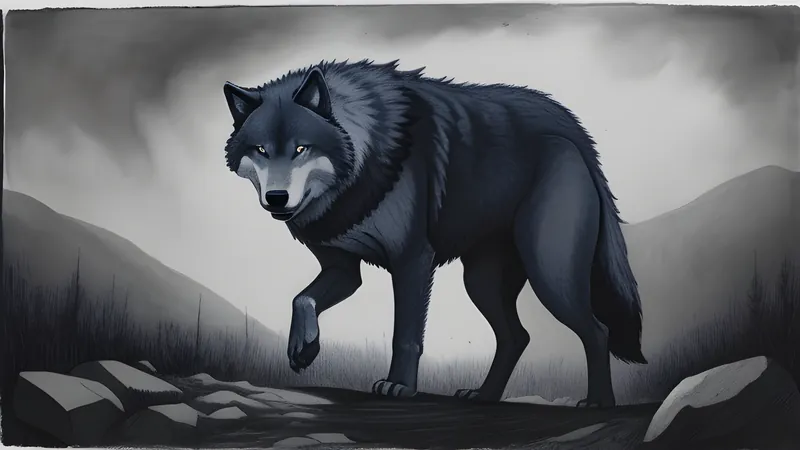
The creature that West Virginia now paints on its road signs is ten feet tall, with a face the colour of a stoplight, two glowing eyes, a body that hangs in dark green folds, and rising behind its head a great stiff cowl shaped like the ace of spades. It hisses. It glides rather than walks, floating a few inches above the grass, and it leaves behind an oily mist that makes the throat burn and the stomach turn. Six children, a young National Guardsman and a farmwife met it on a hilltop on the evening of 12 September 1952, and by the next morning the Braxton County Monster was on the newswires and on its way to becoming one of the most recognisable figures in American folklore.
The people who climbed that hill were not lying, and they were not fools. Something crossed the sky over West Virginia that night, and it was real, and it was witnessed by thousands of people across half a dozen states. The mistake, if it was one, happened in the last hundred yards, in the dark, at the end of a torch beam. To understand the Flatwoods Monster you have to take the fear seriously and then reconstruct, patiently, what a group of terrified people were actually looking at.
A light on Fisher’s hill
The evening began with a game of football. Two brothers, thirteen-year-old Edward May and twelve-year-old Fred, were playing with friends near the schoolyard in the small town of Flatwoods when they saw a bright object streak across the darkening sky and appear to come down on the hilltop of a neighbour, G. Bailey Fisher. To boys in 1952 this could only mean one thing: a flying saucer had landed, and it had landed close enough to go and see.
They ran to the Mays’ house and collected the rest of the party. There was Neil Nunley and Ronald Shaver, and Tommy Hyer, and seventeen-year-old Eugene Lemon, a member of the National Guard and the oldest of them, and Kathleen May, the boys’ mother, who came along with a torch. A dog ran ahead. The group set off up the hill in the dusk, the light failing fast, the excitement curdling into something closer to nerves as they climbed.
Near the top they walked into a bank of mist that stung the eyes and caught in the throat, and they saw a pulsing red glow off to one side. Then Lemon swung the torch toward a large oak, and the beam caught a shape. Accounts of that moment vary, as accounts of a few seconds of terror always do, but the shared core is a towering figure with a dark, drape-like lower body, a small blood-red face, two eyes that threw back the torchlight, and behind the head a pointed hood or cowl. It made a hissing sound and moved toward them, seeming to float. The nerve of the whole party broke at once. They turned and ran down the hill in the dark, and several of them were sick that night, retching and complaining of irritated throats and eyes.
That is the story at its most seductive, and it is genuinely frightening. A dark hill, a landed light, a mother and a cluster of children, and a thing in the trees. Begin the unpicking, though, and the first thread comes loose in the sky.
The kernel: a fireball with a timetable
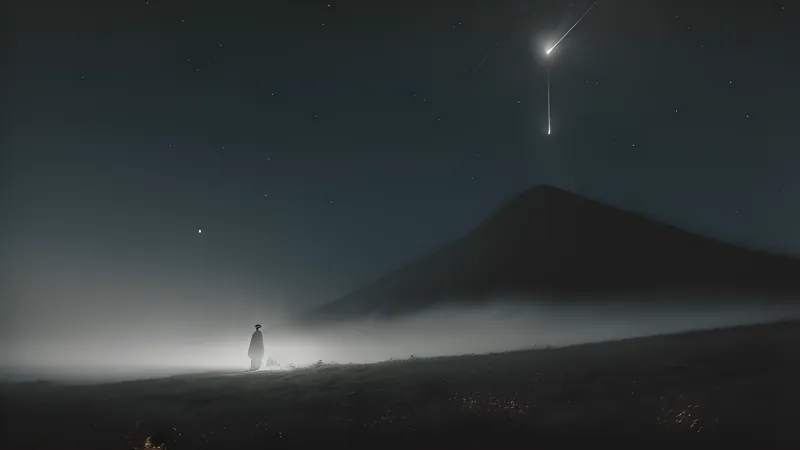
The object the boys saw crossing the heavens was real, and it has a paper trail. On the evening of 12 September 1952 a large, brilliant meteor — a bolide, the kind of fireball that briefly outshines everything else in the sky — passed over the eastern United States and was reported by observers across Maryland, Pennsylvania and West Virginia. Newspapers the next day carried accounts of the fireball from people who had no interest whatever in monsters; astronomers logged it. Three separate groups in three states reported seeing a bright object in roughly the same window that evening.
A meteor at altitude, sliding across the sky, will seem to descend and land just over the nearest hill, because the eye has no way to judge the distance of a light with nothing around it for scale. This is the same illusion that makes a setting aircraft look as though it has touched down in the next field. The thing the children watched come down on Fisher’s farm never came anywhere near Fisher’s farm. It was tens of miles up and moving on, burning out somewhere far beyond Braxton County. The hilltop was empty of any craft. But the boys had already been handed a certainty — a saucer has landed, right there — before they took a single step up the slope. They climbed the hill looking for a spaceship, and the mind that goes looking for something is halfway to finding it.
The fork: an owl in the torchlight
So what was in the oak tree? The most careful reconstruction was done by the investigator Joe Nickell, who visited Flatwoods, walked the ground, and published his findings in the Skeptical Inquirer in 2000. His account has the great virtue of explaining every element the witnesses described, rather than waving the whole thing away.
The pulsing red light on the hill was almost certainly one of three aircraft-warning beacons that stood on the ridgelines around Flatwoods, red lamps that blinked through the night and that a frightened group, primed for a landed craft, could easily read as the glow of the thing itself. The mist was the ordinary night fog that pools on a wooded hilltop after a warm day, thickened in memory by fear. The nausea and the burning throats are the classic signature of acute fright and hyperventilation in a group that has just run headlong down a hillside in the dark, and quite possibly of the fog itself.
And the monster was a barn owl. A barn owl perched on a branch of that oak, lit suddenly by a swinging torch, gives you the whole figure. The bird’s pale, heart-shaped facial disc becomes the small startled face; the eyes blaze in the beam because owl eyes throw torchlight straight back. The talons and half-spread wings supply the “clawed hands.” Behind and around the perched bird, the foliage and the shadowed shape of the branches and the bank rising behind the tree assemble into the towering body and the great pointed cowl. Judged against a dark hillside with no reference, an owl on a high branch can be read as a giant standing on the ground. When it launched from the branch and beat away over their heads, it “glided” at them and they ran. Every distinctive feature of the Braxton County Monster — the red face, the glowing eyes, the spade-shaped hood, the floating approach, the hiss — is a feature of a barn owl surprised in torchlight and seen by people who already knew, with total conviction, that a spaceship had landed on that hill.
The journey: from a hilltop to the saucer press
A local error becomes a national monster only with help, and the Flatwoods creature got expert help almost at once. That same night, A. Lee Stewart Jr., co-owner of the Braxton Democrat, went up the hill to look. He reported a lingering, acrid odour in the air and marks on the ground that he took for skid marks. His account gave the story a veneer of adult, on-the-record confirmation, and the wire services did the rest. Within days the “Braxton County Monster” and the “Phantom of Flatwoods” were running in papers far outside West Virginia.
Then the specialists arrived. Gray Barker, a West Virginia native who was about to become one of the founding figures of American flying-saucer writing, took up the case and published “The Monster and the Saucer” in Fate magazine in January 1953. Barker would go on to seed much of the mythology of the Men in Black, and Flatwoods was one of his launching pads. The naturalist and writer Ivan T. Sanderson also came to investigate. In their hands the hissing shape in the oak stopped being a possible bird and became a visitor: an armoured alien pilot, stepped out of the craft that the children had watched land.
The timing could hardly have been better for that reading. The late summer of 1952 was the height of the great American saucer wave. Only weeks earlier, in July, unidentified blips had appeared on radar over Washington and been chased by jets in incidents splashed across every front page in the country. The public was already looking up, already frightened, already fluent in the grammar of the visitor from the sky. A red-faced apparition on a lonely hill in West Virginia dropped into a nation that had been primed for months to expect exactly that, and it found an audience ready to carry it. The same appetite that turned a weather balloon into a spaceship at Roswell went to work on an owl in Braxton County.
What the hilltop was really carrying
It would be easy, and cheap, to end by laughing at a mother and some children for mistaking a bird for a Martian. That misses everything interesting about the case. What happened on Fisher’s hill is a small, clean example of how a real event and an ordinary animal combine, under fear, into something that outlives everyone who saw it.
Consider the ingredients honestly. A genuine fireball, one of the most dramatic things a person can see in the night sky, appears to come down over the next rise. A group of children, already steeped in a year of saucer headlines, take that as a landing and climb toward it in the dark. On the hill they meet real fog, a real blinking red beacon, and a real owl in a real tree, and their minds — working exactly as human minds are built to work — assemble those honest fragments into a single coherent threat, because a threat is the thing the brain most needs to resolve in the dark. Nobody had to lie. The terror was true. Braxton County did not suffer a hoax; it suffered a completely sincere collision between a natural spectacle and a natural fear.
That sincerity is why the debunking rarely lands, and why it does not need to. The families of Flatwoods did not gather to invent a creature. They ran down a hill because something on it frightened the life out of them, and the fright was real even though the giant was a bird. Taking the witnesses seriously and taking the owl seriously are the same act.
The green man of Braxton County
The town, in the end, made peace with its monster by adopting it. Braxton County now keeps a Flatwoods Monster Museum in the county seat at Sutton, sells the green figure on mugs and shirts, and has planted a series of tall, friendly Flatwoods Monster statues along its roads as a tourist draw. The thing that sent seven people fleeing into the night in 1952 has become a mascot, waved at by passing cars. The hill has been forgiven.
There is a lineage here worth following. The Flatwoods creature belongs to the same family as West Virginia’s other great apparition, the winged omen of Mothman, and to the broader American habit, visible in the Jersey Devil, of hanging a monster on a poor rural place and letting it stand for everything the outside world half-expects to find there. In each case the shape in the dark tells you less about what was in the trees than about who was standing in front of them, and what they had been taught to fear.
The last thing to say about the Flatwoods Monster is the kindest and the most unsettling. On a clear September night, three states watched a fireball cross the sky, and it was magnificent, and it was true. A handful of people in one small town happened to be standing where it seemed to land, and they walked up into the dark to meet it. What waited for them was an ordinary bird on an ordinary branch. Everything else — the ten-foot height, the ace-of-spades hood, the burning eyes, the visitor from another world — they brought up the hill with them, in their own heads, and left there for the rest of us to keep finding.
Related Content