The Fiji Mermaid: Barnum's Stitched-Together Marvel
How a monkey sewn to a fish tail became the nineteenth century's most profitable monster
Contents
In the summer of 1842, New Yorkers queued to see a mermaid. The advertisements had promised something ravishing — the pale, long-haired sea-maiden of the popular imagination, the figure of ballads and ships’ figureheads. What they found, behind the showman’s curtain, was a shrivelled, grimacing horror perhaps three feet long: the withered torso, arms and head of a small monkey grafted seamlessly onto the dried tail of a large fish, the whole blackened thing frozen in a posture of apparent agony, jaw open, tiny claws raised. It was not beautiful. It was, by every honest account, hideous. And it was one of the most successful attractions the American showman P. T. Barnum ever exhibited, precisely because the gap between what was promised and what was delivered turned out to be no obstacle at all.
The object itself
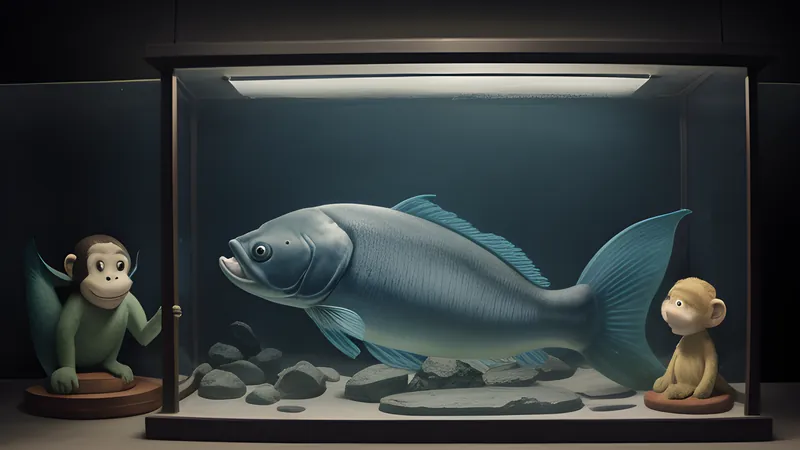
The “Feejee Mermaid,” as Barnum spelled it, was a manufactured specimen of a type that had been made for a long time before it reached him. Such things were produced by craftsmen — many of the surviving examples are associated with Japanese or East Indies fishing communities, where they were fashioned as curiosities or ritual objects — by joining the upper body of a monkey or ape to the lower body of a large fish, drying and treating the composite, and finishing it with papier-mâché, wire and stitching until the seam vanished. The result was a genuinely uncanny object: too anatomically coherent to dismiss at a glance, too grotesque to match the mermaid of romance. Whoever made the specimen Barnum exhibited had done the work well enough that a casual viewer could not simply see the join and laugh.
Barnum did not create the mermaid. He acquired the use of it. The specimen had reportedly been bought years earlier by an American sea captain, passed through hands and estates, and come into the possession of Moses Kimball, a Boston museum proprietor and Barnum’s friend and occasional collaborator. Kimball and Barnum entered into an arrangement to exhibit it, and it was Barnum — the supreme salesman of the age — who supplied the thing it actually needed: a story, authenticity being beside the point.
The specimen’s earlier life is documented well enough to trace, and it is a small tragedy in its own right. It was carried west, by most accounts, by an American sea captain named Samuel Barrett Eades, who bought it at Batavia, in the Dutch East Indies, around 1822 for something on the order of several thousand dollars — a sum he raised by selling a ship, the Pickering, that he only part-owned, ruining himself and his partner in the process. Eades exhibited the creature in London that autumn to large, paying crowds at the Turf Coffee House, where the anatomist Sir Everard Home’s circle pronounced it a manufacture, an orangutan’s cranium and a fish’s body cleverly married. The verdict did nothing to Eades’s debts, which followed him for the rest of his life. The mermaid eventually descended to his son and was sold on to Moses Kimball’s Boston Museum, where it sat among the stuffed birds and waxworks for close to two decades before Kimball lent it to Barnum in the summer of 1842.
The kernel: mermaids were a serious question, and composite fakes were a real craft
Two true things underpin the hoax, and both matter. The first is that, in 1842, the existence of mermaids was not self-evidently absurd to a general audience. The oceans were vast and mostly unexplored; sailors returned with accounts of strange sea-creatures; and the recent history of natural science had repeatedly proved that the sea held animals stranger than anyone had imagined. When European naturalists first received a preserved platypus from Australia in the 1790s, several suspected a hoax — a duck’s bill stitched to a mammal — precisely because a fur-bearing, egg-laying, duck-billed animal seemed exactly the sort of thing a trickster would sew together. The world had lately produced real animals as improbable as any fake, which meant a member of the public could not safely rule a mermaid out on principle. Nature had been setting the bar for absurdity, and clearing it.
The second true thing is that the fabricated mermaid was itself a real and skilled artefact — an actual, tangible object with a real history of hand manufacture. The craft of joining monkey to fish was a genuine tradition, and the specimens it produced were solid, three-dimensional things a viewer could stand before and inspect. This is the ground on which the deception stood: a real, tangible, expertly finished object, exhibited in an age when the boundary between the possible and the impossible sea-creature was genuinely blurred.
The fork: from ambiguous object to confident marvel
The specimen was ambiguous; Barnum’s campaign was not. The genius, and the deception, lay in the manufacturing of certainty around an uncertain thing — and Barnum did it not by asserting the mermaid’s reality in his own voice but by engineering an atmosphere in which the public would assert it for him. He planted the ground with a now-famous piece of theatre: he arranged for letters to reach New York newspapers from southern cities, purporting to come from a distinguished English naturalist, a “Dr Griffin” of the “Lyceum of Natural History” in London, who was said to be travelling with a genuine mermaid specimen. “Dr Griffin” was in fact Levi Lyman, an associate of Barnum’s, playing a part. The letters, printed as news, primed the public to expect a credentialled scientific marvel before the object was ever shown.
Barnum then flooded the city with woodcut handbills and posters depicting mermaids in the traditional, alluring form — beautiful bare-breasted women with elegant tails — imagery that had nothing to do with the shrivelled specimen but everything to do with drawing a crowd. He supplied newspapers with the engravings and the story, distributing conviction wholesale. By the time the “Feejee Mermaid” went on display at his American Museum, the public had been told by apparent scientific authority that mermaids might be real, shown seductive pictures of what one looked like, and worked into a state of anticipation that the ugly little thing behind the curtain could disappoint in appearance without ever quite dislodging. People had already half-decided to believe before they arrived.
This is the exact junction where showmanship crosses into hoax, and it is the same move that powered the Cardiff Giant a generation later and, in its way, the Great Moon Hoax of the decade before: take an object or a claim of genuine ambiguity, dress it in borrowed scientific authority — a learned society, a distinguished naturalist, a citation — and let a primed public carry the belief the rest of the way. Barnum understood, earlier and more clearly than almost anyone, that the crowd is not persuaded by evidence so much as by the appearance of consensus that the evidence has already been weighed by someone qualified.
The journey: the humbug that told on itself
What separates Barnum from an ordinary fraud is that he made the exposure part of the entertainment. Barnum was the great theorist of what he cheerfully called “humbug” — the delicious, half-consensual game in which the showman makes an extravagant claim, the public pays to test it, and a good part of the pleasure lies in arguing afterwards about whether one has been fooled. He did not need every viewer to believe the mermaid was real. He needed them to be unsure enough to pay their admission and find out, and entertained enough by the puzzle that they told their friends to come and be puzzled too. Doubt, for Barnum, was not the enemy of the box office. It was the product.
The mermaid toured. It went south, it went to London, it drew crowds and controversy and the scorn of naturalists who pronounced it an obvious composite — and every learned denunciation was, from Barnum’s point of view, free advertising that framed the object as a thing worth having an opinion about. The specimen Barnum showed is generally thought to have been destroyed in one of the fires that consumed his museums in the 1860s, though the murk around its later history is such that various “Feejee mermaids” in collections today claim descent from it, and the object’s very unkillability as a legend is part of its afterlife. The type outlived the specimen: composite mermaids continued to be made, exhibited and puzzled over, and the “Fiji mermaid” became a generic name for the whole grotesque genre.
Its influence on the trade was permanent. Barnum had demonstrated that a curiosity earned its value through the talk it generated, whatever the truth of it, and the dime museums and travelling sideshows that followed him took the lesson to heart. The Fiji Mermaid became a template for a whole century of “genuine” wonders — the preserved this, the petrified that, the last of some vanished race — each sold with the same recipe of pseudo-scientific pedigree, lurid advertising and a knowing wink to the customer who suspected the truth. When a modern museum of oddities displays a two-headed calf or a shrunken head of dubious origin, it is working in a tradition Barnum inherited and perfected around this one small, hideous, monkey-tailed thing.
What the mermaid is really about
The Fiji Mermaid is a lesson in the economics of wonder, and its most surprising teaching is that ugliness did not matter. A conventional fraud tries to deliver exactly what it promised and hopes the mark does not look too closely. Barnum did the opposite: he promised a beauty and delivered a monstrosity, and thrived, because he understood that people were not really paying to see a mermaid. They were paying to participate in a question — is it real? — and to earn the small social currency of having seen the thing everyone was talking about and formed a view. The object could be as hideous as it liked so long as it kept the question alive.
There is something almost honest in Barnum’s dishonesty, and it is worth sitting with rather than simply condemning. He treated his audience as willing players in a game whose rules they broadly understood, and he was proud, in his memoirs, of the very tricks he had pulled — he explained the mermaid’s manufacture and the Dr Griffin ruse himself, in print, and the confession sold more tickets. The humbug flatters the audience’s intelligence even as it exploits it: you are invited to be the clever one who sees through it, and that invitation is itself the hook. It is a more knowing, more modern transaction than the earnest frauds that merely lie and hope, and it is why Barnum’s name, alone among the century’s hoaxers, became a byword rather than a warning.
The deepest thing the mermaid exposes is that the appetite it fed has never gone away. We still queue, in our fashion, for the ambiguous object dressed in authority and rumour — the viral photograph, the “leaked” specimen, the marvel that might be real. We still find that the pleasure of the thing lies as much in the debate as in the truth, and that a story we get to argue about will always draw a bigger crowd than a fact we simply have to accept. Barnum sewed a monkey to a fish, called it a mermaid, told us it might be a fake, and charged us to decide. Nearly two centuries on, the queue has not moved. It has only changed what it is looking at.
Related Content