The Fiji Mermaid and Barnum's Grift
A monkey sewn to a fish, a fake naturalist, and the American art of the happy swindle
Contents
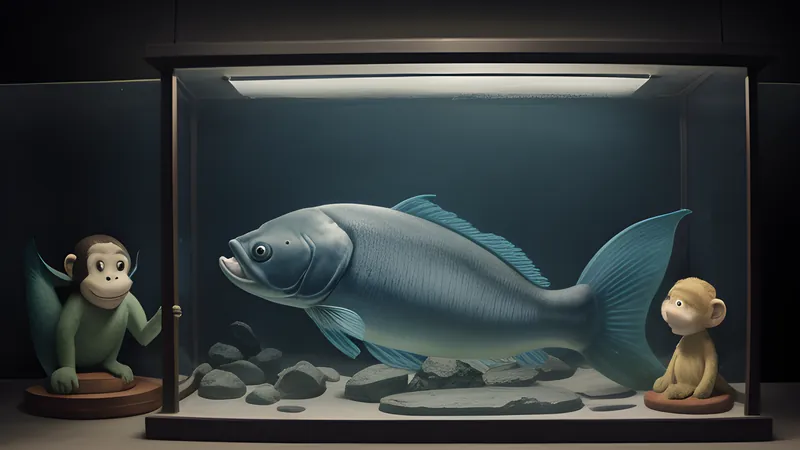
The thing itself was hideous. Roughly a metre long — often much smaller in the surviving examples — it had the withered torso, arms and screaming face of a small ape joined at the waist to the scaled tail of a fish, the join disguised with papier-mâché and glue, the whole shrivelled brown object looking less like a maiden of the sea than like something dredged up from a nightmare. This was the Feejee Mermaid, and in the summer of 1842 New Yorkers queued and paid to look at it, having been told it was the genuine preserved body of a creature caught in the South Pacific.
The man who showed it to them was Phineas Taylor Barnum, and the way he did it is a small masterpiece of the American nineteenth century, worth taking apart piece by piece — because the mermaid was a monkey stitched to a fish, and everyone half-knew it, and they came anyway.
The object and its makers
The mermaid was not Barnum’s invention, and its real origins are more interesting than the fiction he wrapped around it. Composite mermaid mummies of this kind were a genuine craft tradition in Japan and the East Indies, where artisans sewed the upper bodies of monkeys to fish tails, or built the figures up from papier-mâché, wire, fish skin and animal parts, to produce ningyo — mermaid or merman figures with real religious and folkloric weight.
In Japanese belief the ningyo was a potent creature. To eat its flesh was said to grant extraordinarily long life; the legend of Yao Bikuni tells of a woman who unknowingly consumed mermaid meat and lived for eight hundred years. Dried ningyo were kept in temples as sacred objects and as protective talismans against plague. The grotesque little mummies that Western sailors bought in the ports of the East were, in their home culture, closer to holy relics than to carnival gaffs. The craftsmanship was serious even where the biology was invented.
One such figure was bought in 1822, in Batavia — modern Jakarta — by an American sea captain named Samuel Barrett Edes, who reportedly paid around six thousand dollars for it, dipping into his ship’s funds to do so, so convinced was he of its value. It passed after his death to his son, and eventually into the hands of Moses Kimball, proprietor of the Boston Museum, who in 1842 brought it to New York and leased it to his friend Barnum. Everything that made the object real — the Japanese craft tradition, the sacred ningyo, the credulous sea captain — Barnum discarded. He kept the corpse and built it a brand new story.
The grift: how to sell a stitched monkey
Barnum understood that the mermaid could not simply be put on display. It had to be authenticated, and authenticated by someone who appeared to have no interest in the box office. So he manufactured a scientist.
A man calling himself Dr J. Griffin arrived in New York, presenting himself as a naturalist attached to the “Lyceum of Natural History” in London, in possession of a remarkable specimen he had acquired in the Pacific and was reluctantly willing to exhibit. Dr Griffin was in fact Levi Lyman, a longtime associate of Barnum’s, playing a part. He gave learned interviews. He allowed the press a private viewing. He spoke of the mermaid with scholarly caution, which is far more persuasive than showman’s bombast.
Meanwhile Barnum salted the newspapers. He arranged for letters about the mermaid to be sent to several New York papers from correspondents in other cities, so that editors received the story as news arriving independently from multiple directions. He commissioned woodcuts of beautiful, conventional mermaids — lovely half-women combing their hair on rocks — and distributed ten thousand pamphlets, so that the image in the public mind was of a graceful sea-maiden, primed for the moment the paying customer met the shrivelled reality. He did not tell people the mermaid was beautiful; he let the pictures do it, and let the gap between the promise and the withered brown truth become part of the entertainment. When the mermaid finally went on show at Barnum’s American Museum, attendance reportedly tripled.
The showman who had done this before
Barnum did not stumble into the mermaid method by luck. He had rehearsed it, in a far darker key, seven years earlier. His first great sensation, in 1835, was Joice Heth, an elderly, blind and partly paralysed enslaved woman whom Barnum exhibited as the 161-year-old former nurse of the infant George Washington. He toured her, sold pamphlets telling her supposed life story, and — when public interest began to flag — anonymously planted a rival rumour in the newspapers claiming she was in fact an automaton made of whalebone and rubber, precisely so that curious people would pay again to settle the question for themselves. When she died in 1836 he charged spectators to attend her public autopsy, which found her to be perhaps eighty years old. It is the ugliest episode of his career, and it is essential context: the mermaid’s genial “everyone’s in on the joke” charm sat atop a technique first perfected on a human being who was in on nothing and consented to none of it.
That history sharpens what Barnum meant when he later spoke of the humbug as harmless fun. The method was always the same — manufacture a mystery, seed contradictory stories in the press, and monetise the public’s urge to resolve it — and it was invented in the 1830s, the same decade that produced the Great Moon Hoax of 1835, when a New York newspaper sold vast print runs describing bat-winged people living on the Moon. American mass media and American humbug grew up together, feeding the same appetite. The mermaid was simply the version where the technique found its most willing audience and its least injured subject.
The philosophy of the humbug
To understand why this worked, you have to understand what Barnum meant by a humbug, because he was quite open about it and even wrote a book on the subject. A humbug, in his usage, was a kind of game played between showman and public, in which the customer paid a small sum for the pleasure of examining a mystery and deciding for themselves — and in which being fooled was part of the fun, provided the fooling was clever and the price was fair.
Barnum’s audiences were, on the whole, in on it. Educated New Yorkers of 1842 did not believe the seas were full of monkey-tailed maidens. What they bought a ticket for was the chance to inspect the famous fake at close range, to argue about how it had been made, to feel the small delicious vertigo of not being quite sure, and to catch the showman out if they could. The debate was the product. Barnum grasped, earlier and more clearly than almost anyone, that a public will pay handsomely for the experience of doubt, and that a good hoax is a machine for generating conversation. The mermaid gave every viewer a story to tell at dinner, and the telling sold more tickets.
This places the Feejee Mermaid in a very particular American lineage of the joyful swindle. It is the sibling of the Cardiff Giant, America’s favourite fake fossil — a buried gypsum “petrified man” that drew paying crowds a generation later, and which Barnum, denied the original, simply copied and out-exhibited. It belongs to the same family as the Mechanical Turk, the chess machine that hid a man, where audiences delighted in a marvel they suspected was a trick. In each case the pleasure lived precisely in the space between wanting to believe and knowing better.
The journey and the ashes
After its New York triumph the mermaid toured, drawing crowds in the American South until, the story goes, hostile audiences and clergymen offended by the display forced it off the road. It returned to Kimball’s Boston Museum, and there the trail grows uncertain. Barnum’s American Museum burned in 1865, and Kimball’s Boston Museum suffered its own fire; somewhere in those flames the original Feejee Mermaid is generally thought to have been lost. What survives is a scattering of similar specimens in museum collections — including a battered example held by Harvard’s Peabody Museum that may descend from the Kimball line — and an unknowable number of later imitations, since the moment the mermaid became famous, the sideshow trade began manufacturing more of them to meet demand.
Modern science has finally been able to look inside the surviving ningyo, and the results honour the craft rather than the biology. When researchers in Japan CT-scanned a venerated mermaid mummy kept for centuries at a temple in Okayama Prefecture — an object long treated as a sacred relic — they found no single animal at all, but an assembly of cloth, paper, cotton wadding, animal bone, fish skin and scales, built up by a skilled hand into a convincing whole. The examination confirmed what Barnum’s showmanship had always exploited: these figures were works of deliberate art, made to be believed in, and the belief was the point of the making.
That proliferation is itself the folklorist’s clue. A single fraud is an event; a fraud that spawns a whole industry of copies is a form. By the late nineteenth century “Feejee mermaids” were a standard item of the dime museum and the travelling show, gaffs made to a recognised recipe, exhibited by men who no longer needed a Dr Griffin because the audience already knew the game and enjoyed playing it anyway.
What it is really about
The mermaid has been half-real in every human culture that ever looked at the sea, and that is the ground the whole grift is planted in. Long before Barnum, sailors reported mermaids and meant, in most cases, manatees and dugongs glimpsed at distance — sea cows nursing their young at the surface, their forelimbs and postures suggesting something human enough to ache for. The mermaid is what the lonely, homesick imagination puts into the empty water: a woman, a companion, a promise that the sea is not entirely alien. Barnum’s shrivelled monkey worked because it plugged into that ancient longing and then betrayed it, and the betrayal was the joke everyone had paid to be in on.
What Barnum really sold was a licensed holiday from certainty — a safe, cheap, communal encounter with the unverifiable, in an age that was rapidly making everything else measurable. His public lived in a century of railways and telegraphs and rising scientific authority, a world getting steadily more legible and less enchanted, and for the price of admission he handed them back a small controlled dose of wonder, with a wink built in. They knew the maiden was a monkey. They queued to be uncertain about it anyway, because uncertainty, in careful doses, is one of the things people have always been willing to pay for, and Barnum was the first man to industrialise the selling of it.
Related Content