The Estonia: A Bow Visor, a Storm, and the Rumours That Followed
Eight hundred and fifty-two dead, a wreck sealed off from divers, and a real secret about military cargo that gave the rumours their teeth.
Contents
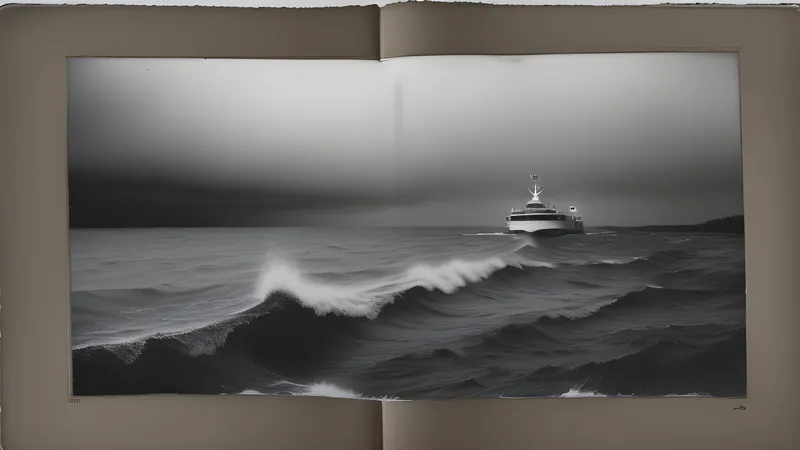
Shortly after one o’clock in the morning on 28 September 1994, passengers asleep in their cabins on the ferry Estonia were woken by a sound none of them ever forgot: a heavy metallic bang from somewhere forward, and then another, deep in the hull, like a great door being torn from its frame. Within minutes the ship, crossing the Baltic from Tallinn toward Stockholm in a full gale, began to list. She went over so fast that most of the sleeping passengers never reached the deck. Of the 989 people aboard, 852 died in the black, freezing water that night, and 137 lived. It remains the worst peacetime shipwreck in modern European waters. Almost at once, and for the thirty years since, that first metallic bang has carried a second meaning. To the official investigators it was the sound of a bow visor failing. To a great many others it became the sound of something the authorities did not want the world to hear. The reason the second reading has never gone away is that, on one specific point, the doubters were right.
An hour in the Baltic
Set down first what is not in serious dispute, because the disaster itself is documented in painful detail by survivors and by the wreck on the seabed.
The Estonia was a roll-on/roll-off ferry, a design in which vehicles drive straight through the hull along a continuous car deck. She had been built in Germany in 1980, first sailing as the Viking Sally, and by 1994 ran the overnight route between the newly independent Estonia and Sweden. Like many ro-ro ferries she loaded through the bow: a large hinged visor at the front lifted up, and behind it a ramp lowered to let cars drive aboard. That open-plan car deck, unbroken by watertight bulkheads, is efficient for loading and lethal once water gets in, because liquid slopping across a wide flat space — the “free surface effect” — can capsize a ship with terrifying speed.
On the night of 27–28 September the Baltic was rough, with waves of four to six metres, an ordinary autumn storm for that crossing but a hard one. The official Joint Accident Investigation Commission, formed by Estonia, Finland and Sweden, concluded in its 1997 final report that the locks securing the bow visor were too weak for the forces the sea was throwing at them. Under the repeated hammering of the waves the locks failed, the heavy visor wrenched free and fell away, and as it went it dragged open the loading ramp behind it. The sea poured onto the car deck. Water surged across that open space, the ship took on a violent list to starboard, and in well under an hour she rolled over and sank. The bang the survivors heard was the visor tearing off; the bang after it was the ramp. The visor itself was later found on the seabed more than a kilometre from the main wreck, which fits a visor that came off first and separately — a physical fact strongly supporting the official account.
That is the kernel of the disaster, and it is grimly ordinary: a known design weakness in a class of ship, a storm, and metal that was not strong enough. No villain is required to sink a ro-ro ferry with a failed bow door. It has happened before and since.
The secret that was actually there
Now the part that a fair account cannot skate over, because it is the true engine of everything that followed. The suspicion around the Estonia was not conjured from nothing. There was a genuine secret, and it took the governments involved a decade to admit it.
The Estonia had been used to carry military equipment. In the years after the Soviet collapse, the Baltic was a channel for materiel moving quietly westward, and the ferry was part of it. Swedish customs officers came forward with accounts of military cargo aboard, and in 2004 and 2005 the Swedish government confirmed that on at least two voyages in September 1994 — including one shortly before the sinking — the Estonia had transported military equipment on behalf of the Swedish armed forces. The state that had spent years insisting there was nothing unusual about the ship’s cargo turned out to have been moving defence materiel across the Baltic on it.
This is exactly the kind of confirmed, delayed admission that gives a conspiracy theory its spine. Once a government concedes that it did keep one real secret about the ship, every denial it ever issued becomes suspect in retrospect. The reasoning is not foolish. It is the same instinct that keeps the grassy knoll alive in Dallas and that grew a mythology around the sealed Soviet file at Dyatlov Pass: when the authorities are caught having hidden something true, the public rightly stops taking their word, and then struggles to know where the hiding stops. The Estonia’s military cargo is a real fact, honestly conceded at last. The question is what weight it can bear.
The fork: from cargo to catastrophe
Here is the precise point where the record ends and the theory begins, and it is a leap that deserves to be looked at squarely rather than mocked.
The confirmed fact is narrow: the ferry carried military equipment on certain voyages, transported openly enough that customs officers knew of it. The theory extends that fact into a chain: that the ship was carrying sensitive Soviet or Russian military technology on its final voyage; that a struggle over this cargo, or a bomb, or a deliberately holed hull, sank her; and that the three governments then concealed the true cause behind the bow-visor story to protect an intelligence operation. Each link stretches further from the evidence than the last. That military gear rode on earlier crossings does not establish that it rode on the last one, still less that it caused the sinking, still less that a hull was breached by an explosion.
And the physical case for the visor is strong and independent of any of this. The visor lay on the seabed apart from the hull, its locks failed. Survivors’ testimony — the forward bang, the sudden starboard list, the speed of the capsize — matches water flooding the car deck through the bow, not an internal blast. Metallurgical examination of the recovered locks showed them overwhelmed by sea load. The theory has to explain away a great deal of concrete evidence to make room for a bomb, and it does so mainly by pointing to the one thing that made the whole affair feel like a cover-up from the start: what the governments did to the wreck.
The grave they sealed
If any single decision turned a shipping disaster into a conspiracy, it was this one, and it was made with the best of intentions and the worst of optics.
The Estonia went down in relatively shallow, accessible water, with hundreds of bodies still inside her. Families expected them to be recovered. Instead, in 1995 Sweden, Estonia and Finland signed an agreement — later given force of law in each country — designating the wreck a protected grave and making it a criminal offence to dive on the site. The stated reason was to let the dead rest undisturbed and to spare families the horror of a partial, dangerous recovery from a hull lying on its side in cold, deep water. There was even discussion, quickly abandoned, of encasing the wreck in concrete. The bodies were left where they lay.
Whatever the humane logic, consider how it reads to a grieving relative or a suspicious public. A ship sinks with a real, later-admitted secret aboard. Hundreds of dead are left unrecovered. And then the very states that carried the secret make it illegal to go and look at the wreck. A diving ban imposed to protect a grave is almost impossible to distinguish, from the outside, from a diving ban imposed to protect evidence. The measure meant to honour the dead became, for many, the proof that something was being hidden. Sealed access does to suspicion what darkness does to fear: it fills the space with shapes.
Into that sealed silence the carriers of the theory stepped. Investigative journalists in Sweden and Germany pressed the cargo question for years. In 2000 a German journalist, Jutta Rabe, mounted a private dive to the forbidden wreck and produced material she said pointed to an explosion — findings that were disputed and never independently confirmed, but that kept the alternative story alive. Each new claim ran headlong into the diving ban, which meant the official account could not easily be tested, which in turn made every claim harder to lay to rest.
The hole, and the rock beneath
The most recent chapter shows both how a live mystery mutates and how, given access, it can begin to resolve.
In 2020 a documentary team filmed the wreck in defiance of the diving ban and revealed something the 1990s survey had not clearly shown: a hole roughly four metres high in the starboard hull. To many this was the smoking gun at last — evidence of a breach that the official investigation had missed or suppressed. The footage forced the issue. Estonia and Sweden amended their laws to permit a fresh, lawful examination, and a new investigation went down to the wreck with modern equipment.
Its findings, reported across 2021 to 2023, did not vindicate the explosion theory. A geological survey of the seabed found that the Estonia rests against a hard, rocky bottom, and the damage to the starboard hull was consistent with the ship grinding and settling onto that rock as she sank and came to rest — mechanical damage from the seabed, with no signature of a blast. The reopened inquiry reaffirmed the essential 1997 conclusion: the bow visor failed, the car deck flooded, the ship capsized. The dramatic hole, once seen, turned out to have a duller author than a bomb. It was the rock the wreck had been lying on for a quarter of a century.
What the Estonia is really about
Strip away the cargo and the hole and the sealed dive site, and what remains is the oldest thing a disaster leaves behind: eight hundred and fifty-two people gone in an hour, most of them never brought home.
The theories around the Estonia are, at bottom, about that unrecovered grief. When a ship goes down in a storm because a bow door was too weak, the loss is total and the cause is almost unbearably banal. There is no one to blame proportionate to the size of the wound — no enemy, no assassin, only cold metal and cold water and a design flaw. The mind recoils from that imbalance, the same recoil that manufactures a second gunman in a plaza or a monster on a Ural mountainside. A cover-up, however painful, at least makes the deaths mean something: a secret worth 852 lives, a hidden operation, an enemy. It restores proportion to a catastrophe that had none.
And the diving ban gave that need a wound it could keep touching. Grief that cannot bury its dead does not settle; it circles. Families forbidden to bring their people up from the seabed were handed, by the state’s own hand, a permanent grievance and a permanent question. Add the genuine, admitted secret about military cargo, and the theory almost writes itself — not out of stupidity, but out of the entirely rational refusal to trust governments that had, on one real count, deceived them.
The honest close is not a verdict banged down on the doubters. The Estonia sank because her bow visor tore off in a storm and the sea took the car deck; the wreck and the physics say so plainly. The military cargo was real, and admitting it late was a genuine failure of candour. The diving ban was meant kindly and read as concealment. All of that is true at once. What the theory is really carrying has nothing to do with a bomb in the hull. It is eight hundred and fifty-two absences, most of them still down there in the dark against the rock — and the human impossibility of accepting that so many were taken by nothing grander than a door that would not hold.
Related Content