The Dancing Plague of 1518
Frau Troffea danced in a Strasbourg street for days, and by autumn hundreds had joined her — a real event that keeps outrunning its own explanations.
Contents
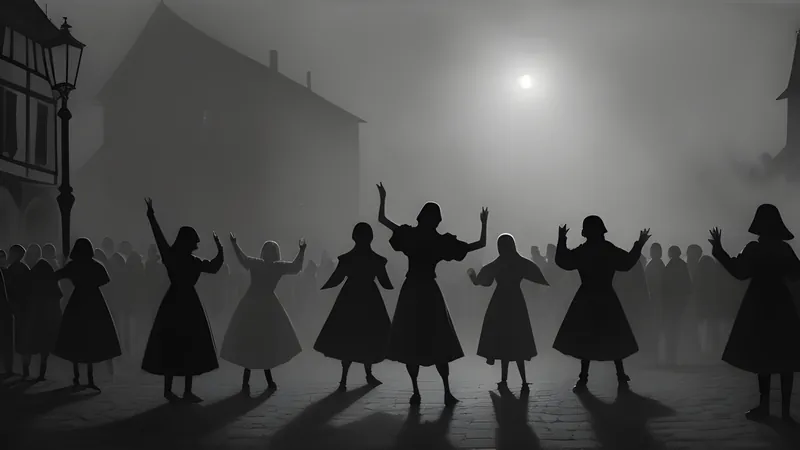
In July 1518, in the free imperial city of Strasbourg, a woman named Frau Troffea stepped into a narrow street and began to dance. She had no music. Nobody had asked her to. By most contemporary accounts she carried on, with only short breaks, for somewhere between four and six days, until her feet were reportedly bloodied and she collapsed from exhaustion. Within a week or so a few dozen other people had joined her, dancing in the same compulsive, apparently involuntary way in the streets and open squares of the city. By the time the episode finally burned itself out, sometime in September, city physicians and chroniclers were describing a phenomenon that had drawn in, by the more credible estimates, several hundred people, some of whom reportedly danced until they collapsed, and a number of whom, in the more extreme contemporary accounts, are said to have died of exhaustion, stroke or heart failure. This is not a folk tale reconstructed centuries later from garbled oral tradition. It is one of the best-documented mass phenomena of the pre-modern era, described in real time by named physicians, town councillors and clergy who watched it happen in front of them, and five hundred years of scholarship still has not settled on a single agreed explanation for what, exactly, was happening to those people’s bodies.
The chronicle record
The dancing plague of 1518 is unusually well attested for a sixteenth-century event precisely because Strasbourg was a literate, well-governed city with active civic record-keeping, and because the episode was strange enough that multiple independent observers wrote it down at the time rather than decades later. The German humanist and satirist Sebastian Brant, author of the celebrated Ship of Fools and by 1518 a senior legal official in Strasbourg, is among the contemporaries whose writings reference the event, and the city’s physicians’ guild and council minutes from that summer describe the authorities’ actual response to what they were seeing in their own streets, which is where the story takes its strangest documented turn.
Strasbourg’s civic and medical authorities did not initially treat the dancing as sin, madness or demonic possession requiring punishment or exorcism, though clergy would later push in that direction as the crisis dragged on. Their first, remarkable response was medical: local physicians diagnosed the dancing as a “natural disease,” specifically attributing it to overheated blood, drawing on the era’s standard humoral medical theory. The prescribed treatment, astonishingly to modern ears, was more dancing. On the guild physicians’ advice, the city cleared space in the grain market and the guildhalls, hired musicians to play, and even built a wooden stage, on the theory that the afflicted needed to dance the fever out of their systems continuously, day and night, until it burned off. The plan backfired badly. Far from curing anyone, the organised, music-accompanied dancing appears to have drawn in more participants and intensified the episode, and after some days of watching the crowd of dancers grow rather than recover, the city council reversed course entirely — banning public dancing and music, and instead shipping many of the worst-affected dancers off to a shrine dedicated to Saint Vitus, patron saint associated in regional folk belief with a compulsion to dance, in the hope that religious intervention would succeed where medicine had failed.
The context nobody argues about
Whatever caused the dancing, the conditions of Strasbourg and the wider Alsace region in 1518 are not in serious dispute among historians, and they matter enormously for judging any explanation. The years immediately preceding the outbreak had been catastrophic for the region’s food supply: famine, driven by poor harvests, was widespread across the Rhine valley, and the same period saw outbreaks of syphilis, smallpox and leprosy circulating through the population, alongside the ordinary background misery of a city already straining under high taxation and heavy civic debt. Contemporary sources describe a population that was hungry, frightened, and had recently endured years of compounding hardship even before a single person started dancing. Any credible account of the dancing plague has to explain why it happened specifically in one of the hardest stretches Strasbourg’s population had faced in living memory, rather than in some ordinary, comfortable year.
The fork: ergot versus the mind under siege
The two leading modern explanations both accept the chronicle record as broadly reliable and diverge entirely on mechanism, which is what makes the case such a clean example of a real, well-documented event that still forks sharply once the interpretation begins.
The older and more famous theory blames ergotism — poisoning by Claviceps purpurea, a fungus that grows on damp rye and produces alkaloid compounds chemically related to LSD, capable of causing convulsions, hallucinations and involuntary muscle spasms in people who eat contaminated bread. Given the region’s ongoing food crisis and the reliance of the poor on cheap rye bread, the theory has obvious surface appeal, and it has been the explanation most often repeated in popular retellings since the twentieth century. It runs into serious trouble on close examination, though. Ergotism reliably produces two recognised clinical forms, gangrenous (causing tissue death, especially in the extremities) and convulsive (causing seizures, spasms and altered mental states), and neither form’s symptom profile matches what the Strasbourg chronicles actually describe. Convulsive ergotism does not produce sustained, coordinated, walking-and-dancing motion over multiple days; it produces uncontrolled jerking, spasm and seizure that would make the sustained, purposeful movement described by witnesses — people dancing continuously, in step, for days — physically implausible. Historians who have examined the medical literature on ergot poisoning in detail, most prominently John Waller, have concluded the toxicological match is poor enough that ergotism is very unlikely to be the correct explanation, whatever its intuitive appeal.
Waller, a historian of medicine, has instead argued at length — in his 2008 book A Time to Dance, a Time to Die and in earlier academic papers — for a psychogenic explanation: mass psychogenic illness, sometimes called mass hysteria, in which extreme collective psychological stress produces genuine, involuntary physical symptoms that spread through a population by observation and suggestion rather than by any pathogen or toxin. Waller’s case rests on the specific combination of factors present in Strasbourg in 1518: a population under severe, sustained stress from famine and disease; a well-established regional folk belief, tied to Saint Vitus, that certain forms of psychological affliction could manifest as compulsive dancing, which supplied the population with a culturally available script for exactly this kind of breakdown; and — critically — the documented behaviour of the authorities themselves, who by organising public dancing spaces and hiring musicians, arguably reinforced and legitimised the behaviour, feeding a stress-induced psychogenic episode rather than containing it. Waller’s account does not require inventing anything the chronicles don’t already describe; it takes the physicians’ own documented response as part of the mechanism that spread the crisis rather than as an unrelated historical curiosity.
The journey: from chronicle to case study
The 1518 outbreak was not, contrary to how it is sometimes retold, a wholly isolated freak event. Strasbourg’s dancing plague was the largest and best-documented instance in a longer, loosely connected European tradition of “dancing mania” episodes recorded intermittently from at least the fourteenth century onward — outbreaks are recorded in the Rhineland in 1374, and smaller, less thoroughly documented instances continued to be reported in parts of Europe for generations afterward, generally in similarly stressed, famine- or plague-adjacent conditions. The association with Saint Vitus specifically hardened over this period into a genuine regional folk category, referenced in period medical and religious writing as “Saint Vitus’s Dance” — a label later, confusingly, borrowed by nineteenth-century medicine for Sydenham’s chorea, an unrelated neurological condition involving involuntary movement, which has caused no small amount of confusion in popular accounts that conflate the two conditions across three centuries of shared terminology.
By the twentieth century the 1518 episode had migrated out of specialist medical history and into popular culture as a favourite anecdote of the “history is stranger than fiction” variety, frequently retold in a compressed, decontextualised form that keeps the vivid image of hundreds of people dancing to their deaths while dropping the two things that actually explain it: the famine and disease pressing on the city that summer, and the physicians’ own disastrous decision to treat the compulsion with more dancing rather than less. Waller’s scholarly reconstruction has slowly pushed the psychogenic reading back into the popular retellings over the last fifteen years or so, though the ergotism explanation remains the version most people encounter first, because a fungus makes for a tidier story than a population’s collective nervous system giving way under famine. The pattern is familiar from other cases where a single chemical culprit has been proposed for a documented historical mass event: the ergot theory for the Salem witch trials has followed almost exactly the same arc, popularised by a single influential paper decades after the fact, seized on by writers who preferred a fungus to a harder conversation about fear and social pressure, and steadily walked back by historians once the symptom profile and the social context were both examined more carefully. In both cases the toxicological theory offers something the psychological explanation cannot: a single, external, blameless cause, rather than an uncomfortable claim about what ordinary human minds can do to ordinary human bodies under enough pressure.
What a five-hundred-year-old dance floor still teaches
What makes the Strasbourg case valuable, beyond its sheer strangeness, is how cleanly it separates two things that popular retellings of “mysterious historical mass phenomena” usually blur together: the reliability of the record and the certainty of the explanation. Nobody seriously disputes that hundreds of people in Strasbourg danced compulsively, some to apparent collapse or death, over roughly two months in 1518, because too many independent, contemporaneous, professionally credentialed witnesses wrote it down for that core fact to be in doubt. What remains genuinely open is the mechanism — and the honest answer, after a century of retrospective diagnosis by historians and physicians who never saw a single patient, is that the toxicological case for ergot is weak on the actual symptom profile, and the psychogenic case, while considerably better supported by the documented context, is still an inference rather than a chart-confirmed diagnosis five centuries after the fact.
That gap between “we are certain this happened” and “we are still working out why” is worth sitting with rather than resolving prematurely, because it says something true about how collective breakdown actually works: bodies under sufficient, sustained, culturally primed stress can do things that look, from the outside, indistinguishable from possession or plague, and the line between a genuine physical epidemic and a psychological one running through hundreds of connected people at once is far blurrier, even to trained physicians watching it unfold in real time, than either explanation on its own would like to admit.
It is worth remembering, too, that Strasbourg’s authorities were not passive observers of an event that simply happened to them — their own interventions, well-intentioned and grounded in the best medical theory available to them, appear to have measurably worsened the crisis before anyone thought to try the opposite approach. That particular shape, a stressed population, a culturally available script for how the breakdown should look, and an authority response that unintentionally amplifies rather than contains it, recurs across centuries and is not unique to the sixteenth century; something structurally similar was at work three and a half centuries later when the Satanic Panic took private, individual anxieties about childcare and, through media coverage and credentialed experts who took the wrong theory seriously, turned them into a coordinated, self-reinforcing social crisis with its own rituals and its own casualties. Five hundred years apart, in both cases believing the wrong explanation, and acting on it, did more damage than the original affliction ever would have on its own.
Related Content