The Cottingley Fairies and Conan Doyle's Belief
Two girls, a borrowed camera, and the paper cut-outs that fooled the man who invented Sherlock Holmes
Contents
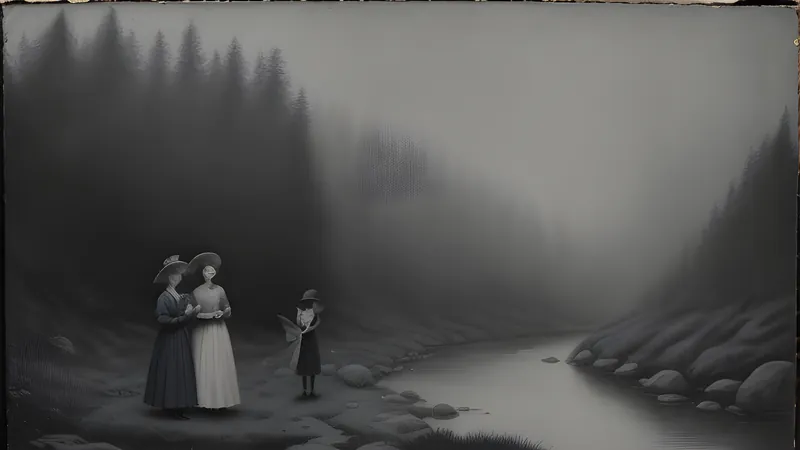
In the summer of 1917, two cousins borrowed a camera and walked down to the beck at the bottom of the garden in the village of Cottingley, near Bradford. Elsie Wright was sixteen; Frances Griffiths, recently arrived from South Africa, was nine. When Elsie’s father Arthur developed the single glass plate that evening in his darkroom under the stairs, it showed Frances leaning her chin on her hand, gazing at the camera with an expression of complete calm, while in front of her four winged fairies danced in the air. A second plate, taken by Frances a few weeks later, showed Elsie holding out her hand to a foot-high gnome.
Arthur Wright thought it was a prank and lost interest. His wife Polly did not, and it was Polly who, two years later, carried the pictures into a lecture on fairy life at the Theosophical Society in Bradford, and set in motion a chain of events that would end with the creator of Sherlock Holmes staking his reputation on the reality of fairies.
How two girls made a fairy
The mechanics of the Cottingley photographs are, in the end, almost heartbreakingly simple, and the girls themselves eventually explained them in full. Elsie was artistically gifted; she had briefly worked at a photographer’s and in a greetings-card factory, and she could draw. The fairies in the first four photographs were drawings — figures copied and adapted from a popular children’s anthology of the period, Princess Mary’s Gift Book of 1914, whose illustrations included dancing girls in exactly the fashionable poses the fairies strike. Elsie traced and coloured them, cut them out of card, and the cousins propped them up in the grass and among the branches with ordinary hatpins.
That is the whole of the trick. Look closely at the first photograph and the fairies are stiff, fashionably coiffed, and lit slightly differently from the girl behind them; one of the hatpins is arguably visible as a smudge at a gnome’s middle. The photographs are competent, but they are the work of a clever teenager with a paint-box and a hatpin, and they were never meant to fool the world. They were meant, at most, to answer the adults who kept teasing the girls about the amount of time they spent playing by the stream, and to explain why Frances kept coming home with wet feet: she had been down at the beck with the fairies, and here, finally, was proof.
The believers arrive
The girls lost control of their small deception the moment it left the family. At the Bradford Theosophical Society the photographs reached Edward Gardner, a prominent Theosophist who saw in them evidence for the astral and etheric beings his movement already believed in. Gardner had the images examined by Harold Snelling, a photographic expert, who pronounced them single-exposure, unfaked, taken in the open air — technically true, in the narrow sense that no darkroom manipulation had occurred, since the deception was entirely in front of the lens. Kodak’s technicians, asked to weigh in, more cautiously declined to certify the fairies as real while conceding they could see no obvious signs of a studio trick.
Then Gardner brought the pictures to Sir Arthur Conan Doyle. And with Conan Doyle, the Cottingley affair stopped being a village curiosity and became a national argument, because Conan Doyle believed, and Conan Doyle had the largest megaphone of any writer alive.
Why the father of Sherlock Holmes wanted fairies to be real
This is the part of the story that matters most, and the part most often flattened into a joke: how could the mind that built Sherlock Holmes — the great fictional engine of deduction, the man who reasoned rings around every deception — be taken in by two girls and some cardboard? The answer is that by 1920 Conan Doyle was a man in grief, and grief had reorganised everything he believed.
The First World War had gutted his family and his generation. His son Kingsley, wounded at the Somme, died of influenza in 1918. His brother-in-law and other relatives were killed. Across Britain, an entire cohort of young men had vanished into the mud, and the bereaved numbered in the millions. Conan Doyle turned, as so many did in those years, to Spiritualism — the belief that the dead survive and can be contacted — and he turned to it with the total, evangelical commitment he had once given to fiction. He lectured on it, wrote books on it, spent his fortune and his standing on it. For a man who now needed, with his whole heart, the material world to be more porous than science allowed, fairies at the bottom of a Yorkshire garden were a gift. If tiny living beings could be photographed dancing in the grass, then the visible, measurable world was not the whole of reality, and the door through which his son had gone was not sealed.
So when Conan Doyle wrote up the Cottingley photographs for The Strand Magazine at Christmas 1920, and expanded the case into his 1922 book The Coming of the Fairies, he was being human in the most understandable way there is. He examined the evidence through the lens of a hope so large it bent the light. The Holmesian scepticism was still there in principle; it had simply been overruled by a deeper need. That collision — between a great rational mind and an unbearable loss — is the true subject of the Cottingley story, and it is why the affair keeps its grip on us. The same longing to photograph the departed drove the whole Victorian and Edwardian craze for spirit pictures, of which the Brown Lady of Raynham Hall, the most famous ghost photograph is the enduring emblem.
Houdini, and the price of belief
The depth of Conan Doyle’s conviction is best measured by what it cost him. In the early 1920s he struck up a warm friendship with Harry Houdini, the escapologist, who shared his fascination with the possibility of contacting the dead. But Houdini was a professional deceiver who had spent his life learning exactly how illusions are built, and he used that expertise to expose fraudulent mediums, whose tricks he could reproduce at will. Conan Doyle, watching Houdini duplicate séance-room phenomena, drew the opposite conclusion from the obvious one: he decided that Houdini himself must possess genuine supernatural powers and was merely denying them. The friendship broke apart over it, painfully and publicly. A man who could believe that the world’s greatest debunker was secretly a psychic was never going to be stopped by a smudged hatpin in a Yorkshire garden.
His fairy advocacy did real damage to his standing. Newspapers mocked him; the phrase “the man who wrote Sherlock Holmes believes in fairies” became a byword for the failure of a great intellect. He cared less about that than he grieved. He toured the world lecturing on Spiritualism, spent a fortune he could ill afford, and went to his death in 1930 still certain that the veil between the living and the dead was thin, and that the Cottingley girls had photographed something true. The cost was his reputation; the thing he bought with it was the possibility of seeing his son again.
The cameras and the afterlife
For the 1920 sitting that produced the last three photographs, Edward Gardner had supplied the cousins with better equipment and marked photographic plates, hoping to rule out fraud; the girls, of course, simply repeated the cut-out method with slightly more assurance. Those cameras and the original prints survive today in the collection of the National Science and Media Museum in Bradford, a short distance from the beck where it all began, and the prints and related material have periodically surfaced at auction for substantial sums. The images that a sixteen-year-old made with a paint-box are now catalogued artefacts of British cultural history.
The story refused to fade because it was too good to let go, spawning films and books through the decades, its very name becoming shorthand for the sincere fake and the willing believer. Cottingley endures as a fixed point people return to whenever the question arises of how the clever come to be fooled, and the answer it keeps giving is that cleverness was never the vulnerable part.
The long silence and the confession
What is remarkable is how long the girls kept their counsel. Elsie and Frances took a fifth and final fairy photograph in 1920 and then let the matter rest, growing up, marrying, moving abroad, carrying their teenage prank into old age while scholars and enthusiasts argued over it for decades. They had never expected to fool grown men, and once they had fooled the most famous author in the country, confessing became almost impossible; the truth would have humiliated kindly Edward Gardner and the beloved, grieving Sir Arthur, and it would have made two respectable elderly women into liars. So they said little, deflected, and waited.
Only in the early 1980s, both now elderly, did they finally speak plainly. In interviews and a magazine account they admitted that the first four photographs were faked with the paper cut-outs, describing the hatpins and the Princess Mary’s Gift Book originals. And yet the confession carried a twist that keeps the story from ever quite closing. Frances maintained to the end that the fifth photograph was genuine, and that whatever they had faked, the two of them really had seen fairies by the beck when they were girls. Elsie was more sceptical of her cousin’s insistence, gently unsure. Two old women who had shared the secret of their lives could not, in the end, fully agree on what had actually happened at the bottom of that garden.
What it is really about
Strip the Cottingley affair down and it holds two entirely separate truths that we keep trying, wrongly, to merge into one. The photographs were faked; that is settled by the makers’ own testimony and the cut-out sources. And the belief the photographs unleashed was completely sincere; that is settled by everything we know about Conan Doyle’s grief and the world that produced it. The hoax was real and the yearning was real, and the interesting thing is how easily a very small deception found a very large emptiness to fill.
That emptiness is the folklorist’s real quarry. Fairy belief is ancient in the British Isles — the beings at the edge of the field, in the green places, down by the water, who steal children and lead travellers astray, and who appear in the same imaginative territory as the changelings and otherworld visitors behind older mysteries like the green children of Woolpit. What the twentieth century added was the camera, a machine that seemed to guarantee truth precisely because it recorded what the eye could not doubt. Put an old, deep, aching belief in front of a new machine that everyone trusted, in a decade drowning in grief, and Cottingley becomes almost inevitable. The technology did not create the fairies; it only gave a very old hope a new and irresistible form of proof.
The two girls, meanwhile, spent their whole lives faintly astonished at what they had started. They had wanted to stop being teased. They ended up giving a heartbroken nation, and one of its greatest writers, permission to hope that the world was larger and kinder than it looked — and it is hard, knowing that, to feel anything as small as scorn. What they photographed was cardboard. What everyone saw was the thing they could not bear to have lost, and that, more than any hatpin, is what kept the fairies at the bottom of the garden alive.
Related Content