The Choking Doberman: A Rumour With Fingers
A vet pulls three human fingers from a choking dog's throat, and a burglar is bleeding in the hall. A perfect story, told everywhere, true nowhere.
Contents
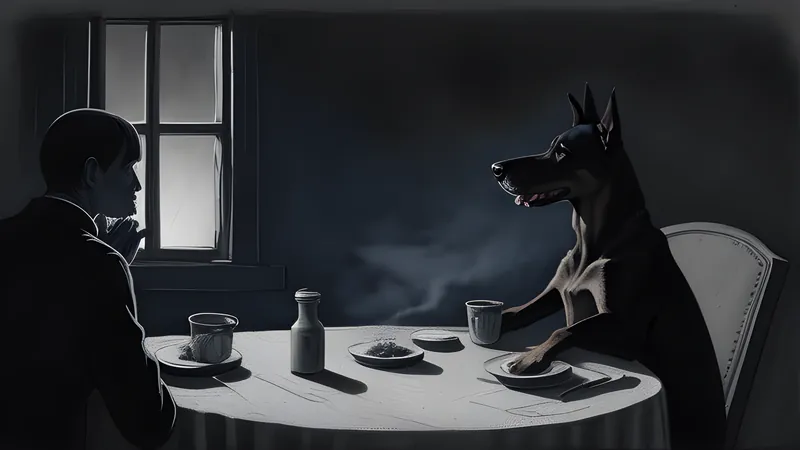
A woman comes home to find her Doberman in distress, gagging and choking on something lodged in its throat. Alarmed, she rushes the dog to the vet and leaves it there for an emergency examination, then drives home. As she walks in, the telephone is ringing. It is the vet, and his voice is urgent: get out of the house, he says, get out right now and call the police, I am calling them too. Bewildered, she does as she is told. When the police arrive they search the house and find a man crouched in a wardrobe or a bathroom, unconscious and bleeding heavily, two fingers missing from his hand. The dog had choked because lodged in its throat, the vet had discovered, were three human fingers. The intruder had been bitten as he broke in, and the loyal dog had been quietly guarding the house, one hand of the burglar already in its throat, the whole time.
The most satisfying story in the file
It is difficult to design a better rumour. Every element of the Choking Doberman rewards the teller and the listener in turn. There is the mystery of the choking, the false errand to the vet, the sudden urgent phone call, the instruction to flee, the search, and the grotesque, perfect revelation that ties everything together: the fingers in the throat, the fingers missing from the hand, the loyal dog that had been protecting the family all along without anyone knowing. Nothing is wasted. The dog’s suffering is explained, the intruder is caught, the homeowner is vindicated for trusting her pet, and the listener gets a jolt of physical horror wrapped around a warm core of reassurance. Crime is punished, loyalty rewarded, and the whole thing snaps shut like a well-made box.
That perfection is the first clue that we are dealing with folklore rather than fact. Real events are messy; they have loose ends, irrelevant details, unsatisfying gaps. The Choking Doberman has none. It is too well made to have happened, engineered rather than reported, and its very tidiness is a signature. Folklorists learn to be suspicious of any account that resolves this cleanly, because reality does not write endings this good. The story reads like the last five minutes of a thriller because that is essentially what it is, a piece of collective authorship polished by thousands of retellings until every rough edge is gone.
The folklorist who named it
The person who did the most to document this story was Jan Harold Brunvand, an American professor of English and folklore at the University of Utah, who in a series of popular books beginning with The Vanishing Hitchhiker in 1981 gave the modern urban legend its name and its serious study. His second collection, published in 1984, took the Choking Doberman for its title, and it became one of his signature specimens. Brunvand’s great contribution was to treat these stories, which most people dismissed as mere gossip or “things that happened to a friend of a friend,” as a genuine and living body of folklore, worthy of the same careful analysis scholars had long given to fairy tales and ballads.
Brunvand traced the Choking Doberman as it circulated through the early 1980s, appearing in newspaper columns and being retold as true across the United States, always attributed to someone local, always just out of reach of verification. He noted its recurring features and its variations: sometimes the fingers numbered two, sometimes three; sometimes the intruder was found dead, sometimes merely unconscious; the breed was usually a Doberman, a dog that carried its own aura of menace and guardianship, though other guard breeds sometimes stood in. What never varied was the structure and the punchline. A story that keeps its skeleton while swapping its details from telling to telling is displaying the classic anatomy of a legend, and Brunvand recognised it instantly.
The older bones underneath
One of the more fascinating things Brunvand and other folklorists observed is that the Choking Doberman is not truly new. Its central image, a piece of an attacker’s body left behind as proof of a struggle no one witnessed, is ancient. Folk narrative is full of severed hands and telltale fingers, tokens dropped in flight that later identify a villain or reveal a crime. A very old legend type tells of a household that discovers, by some grisly token left behind, that its trusted servants or visitors were in fact robbers who meant them harm, the truth exposed only after the danger has passed. The Choking Doberman pours this old wine into a modern bottle: the anonymous suburban home, the family dog, the emergency vet, the telephone.
This is one of the deepest lessons the study of contemporary legend has to offer, and it connects the Doberman to the whole tradition running through the Hook Man. What look like brand-new stories, dressed in the technology and settings of the present day, are very often ancient narrative patterns wearing modern clothes. The fear of the concealed intruder, the reassurance of the token that proves the danger was real and is now past, the loyal animal that guards the threshold: these are old materials, reassembled by each generation using whatever furniture the age provides. The 1980s gave the pattern a Doberman and a telephone. An earlier century would have given it a mastiff and a coaching inn.
Why it wants to be believed
The Choking Doberman is almost always told as true, and told with conviction, and the reasons it invites belief are worth examining because they reveal what the story is actually for. First, it flatters our fears while soothing them. It confirms that the danger we worry about, the intruder in the home, is real, and then immediately reassures us that loyalty and vigilance, embodied in the dog, will protect us from it. That is an emotionally satisfying package: your anxiety is justified, and also you are safe. Few stories give a listener both halves at once.
Second, it arrives with the credentials of the plausible. Dogs do bite intruders. People do come home to distressed pets. Vets do telephone with news. Every individual link in the chain is ordinary and believable, and only the improbable perfection of the whole, and the fact that the teller can never quite name the woman or the vet or the town, gives the game away. And third, the story does moral work that people want done. It insists that a home invasion will not go unpunished, that the burglar will be maimed and caught, that the household’s trust in its guard dog will be repaid in the intruder’s blood. In a world where real crimes often go unsolved and unavenged, a story in which the criminal loses his fingers and is found bleeding in the wardrobe offers a justice the news rarely delivers. Like the babysitter legend, it turns a genuine domestic fear into a narrative that resolves in the victim’s favour.
What the rumour is really carrying
Underneath the fingers and the phone call, the Choking Doberman is a story about the anxieties of the private home in an age of strangers, and it is aimed with real precision at the suburban imagination that produced it. The homeowner is alone and vulnerable. The threat is faceless, an intruder who is never named or explained, a pure embodiment of the fear that someone unknown might be inside the walls. And the defence is not the police, who arrive only at the end to collect a criminal already defeated, but the household’s own loyal animal, the private guardian standing between the family and the anonymous menace outside. It is a deeply reassuring fantasy of self-sufficient safety: you do not need the state to protect you, because your own threshold is guarded by teeth.
That is why the story spread so hungrily in exactly the places and years it did, passing from neighbour to neighbour as a true account of something that happened to a friend of a cousin down the road. It said what people already half-believed and wanted confirmed: that the home was under threat, that the threat could be defeated, and that loyalty and vigilance were the price of safety. None of it happened. There is no vet, no woman, no burglar bleeding in the wardrobe, no three fingers in the throat of any real dog. But the story kept getting told because it was true in the way that matters to folklore, true to a fear and true to a wish, and a rumour that is true in that way needs no fingers of its own to keep a grip on the people who pass it along.
The friend of a friend
Every teller of the Choking Doberman had heard it from someone reliable, and that someone had heard it from someone reliable, and if you followed the chain back it dissolved into mist. Brunvand gave this figure a name that has stuck in the study of rumour: the FOAF, the friend of a friend, the ever-receding source who lends a legend its authority precisely by never being available for questioning. The woman with the Doberman is always a colleague’s sister, a neighbour’s hairdresser, someone at one remove from the teller and one more remove from proof. The story travels on borrowed trust: each person passing it along vouches for the good faith of whoever told them, rather than for the event itself, and the vouching accumulates until the tale feels solidly attested when in fact no one has ever met a single participant.
In the early 1980s this transmission happened mouth to mouth and, crucially, in newsprint. Local newspaper columnists, always hungry for a striking human-interest item, printed the Choking Doberman as a true local occurrence more than once, each printing lending the rumour a fresh coat of credibility that sent it circulating again. A story that appears in the paper acquires an authority that a story told at a dinner table does not, and the legend exploited this shamelessly, hopping from oral telling to printed column and back, gathering false confirmation at every step. When the internet arrived it simply provided a faster set of pipes for the same water, and forwarded emails carried the Doberman into the 1990s with the identical structure and the identical unnameable source.
What none of these media ever supplied was a verifiable case, and that absence is the whole point. A story that has been told as true in a dozen states and printed in real newspapers, yet cannot produce one datable event with named people and a location, is announcing its nature as clearly as folklore ever announces anything. The Choking Doberman is a rumour that learned to look like news, and it thrived for exactly as long as people were willing to trust the friend of a friend. That willingness has never run out, which is why the dog is still, somewhere, choking on three fingers tonight, in a house no one can name, told to someone who will swear it happened to a friend.
Related Content