The Cash-Landrum Incident
The UFO case with medical records, and the questions they cannot close
Contents
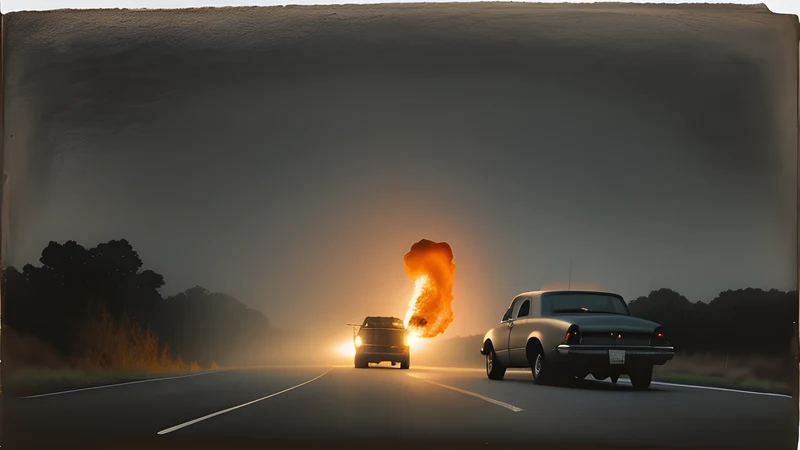
On the evening of 29 December 1980, three people were driving home along a quiet rural road near Huffman, Texas, north-east of Houston, when they met something over the road that would injure all three of them. Betty Cash was at the wheel; beside her sat Vickie Landrum and Vickie’s seven-year-old grandson, Colby. According to their account, a large, brilliant, diamond-shaped object hovered above the roadway ahead, throwing flame downward from its base and radiating heat so fierce that the car’s dashboard grew hot and the metal of the door handle nearly burned Betty Cash’s hand when she stepped out to look. After some minutes the object lifted away, and as it went the witnesses saw the sky fill with helicopters, a great many of them, large twin-rotor machines that seemed to escort or shepherd the thing away.
What makes this case unlike almost every other in the literature is what happened next. In the hours and days that followed, all three suffered a battery of symptoms — nausea, vomiting, diarrhoea, blistering of the skin, swollen and streaming eyes, and hair loss — of a kind associated with burns and radiation exposure. Betty Cash, who had spent the longest outside the car, was the worst affected and was eventually hospitalised. There are medical records. That is the rarest thing in this whole field: three human bodies that were hurt, and a paper trail of doctors treating them, where other cases offer only a photograph or a radar trace. The honest way to approach Cash-Landrum is to build the strongest case for its significance first, take the injuries and the witnesses with complete seriousness, and only then walk towards the questions the records cannot answer.
The best case, stated plainly
Begin with the witnesses, because they are unusually hard to dismiss. There were three of them, spanning three generations, including a young child, and their accounts of the central event were consistent and stable over years of retelling. They had no prior involvement in UFO circles and no obvious reason to invent an ordeal that left one of them seriously ill. Betty Cash in particular paid a heavy, visible price; a person seeking attention does not usually choose weeks of hospital treatment and lasting ill health as the vehicle for it.
Then the injuries, which are the heart of the case. The symptoms the three developed are consistent with exposure to intense heat and to ionising radiation, and they were documented by physicians who were treating real, suffering patients rather than chasing a story. This is physical evidence of a kind the field almost never produces. A light in the sky can be a star; a photograph can be foam; but burns and hair loss are events in the body, recorded in medical notes. The investigator John Schuessler, working with the civilian group MUFON, compiled the medical documentation into one of the most thorough case files in UFO history.
Finally the helicopters, which point the whole affair in a very earthly direction. The witnesses described a large fleet of military helicopters, which they took to be twin-rotor Chinooks, accompanying the object. If that is accurate, it implies the thing over the road was something the military knew about and was managing, an earthly craft rather than a visitor from elsewhere — an experimental craft, perhaps a catastrophic accident involving a machine the government would never admit to. The three later sued the United States government for their injuries. On this reading, Cash-Landrum becomes a story about ordinary citizens burned by a secret programme and then denied any acknowledgement, with aliens nowhere in it. That is the case at its strongest, and its strength is real.
The first seam: the crowd that saw nothing
Now follow it to the edges. The most immediate difficulty is corroboration, or the lack of it. The incident is said to have taken place near a populated area, not far from a major road, and to have culminated in a fleet of twenty or more large military helicopters filling the sky. A single helicopter over a suburb draws notice; a formation of twenty-three Chinooks, low and loud at night, is one of the most conspicuous things imaginable, felt in the chest as much as heard. Yet no independent flood of witnesses came forward to report that extraordinary aerial procession, and no one outside the car produced an account of the fiery diamond either.
That silence is a genuine problem for the strongest version of the case. The injuries are documented; the object and its enormous escort, the parts that would prove a government craft was involved, rest almost entirely on the testimony of the three people in the car. A physical craft trailing a squadron of heavy helicopters through populated Texas airspace ought to have been seen and reported by dozens of others, and it was not. The most checkable, most public element of the account is the one for which outside confirmation is thinnest.
The second seam: what the illnesses actually show
The injuries are the case’s foundation, so they deserve the most careful handling, with full respect for the fact that three people were really unwell. The symptoms were real. Whether they demonstrate what the case requires — exposure to a radiating craft — is where the ground softens. Acute radiation injury severe enough to produce the reported vomiting, skin damage and hair loss follows characteristic patterns, including specific changes in the blood that can be measured, and the surviving documentation does not cleanly establish that picture. Some physicians and reviewers who looked at the records suggested the illnesses might have had other origins, and Betty Cash’s general health was already fragile; she had other serious medical conditions in the years around the event.
The interpretation of the symptoms as radiation injury from a UFO was supplied largely by the investigators, working backwards from the witnesses’ story to a cause that fit it. That is a natural way to reason, and it may even be right, but it is not the same as an independent medical finding that the illnesses could only have come from an irradiating craft. The records prove that the three were hurt. They do not, on their own, prove what did the hurting, and the gap between those two statements is where the extraordinary interpretation has to be inserted by hand.
The third seam: a craft nobody could name
Then there is the lawsuit, which is revealing precisely because of how it failed. The witnesses sued the United States government for around twenty million dollars, on the theory that the object was a military craft and the government was responsible for their injuries. In 1986 the case was dismissed. The court’s difficulty was fundamental: the plaintiffs could not show that the object belonged to or was operated by the United States. The government stated that it owned no such craft, that no military unit in the area operated a fleet of helicopters as described, and that it had nothing matching the account. The suit collapsed because the craft could not be attached to anyone; the injuries themselves were never the point in dispute.
This leaves the case in a strange suspension. If the object was a secret American craft, no American programme has ever been identified that matches a nuclear-hot flying diamond escorted by Chinooks, and the incident never recurred. If it was something stranger, the physical evidence to establish that never materialised beyond the injuries, whose cause remains contested. Every attempt to pin the object to a known source — a military accident, an industrial fire, a misperceived aircraft — has failed to satisfy, and so has the extraordinary explanation. The case is genuinely unexplained, and its most important claims rest on three people’s memory of one night.
Why the seams do not settle it
Set the threads side by side and Cash-Landrum refuses to resolve cleanly in either direction, which is itself worth stating honestly rather than pretending to a verdict. Three credible witnesses reported a coherent event. One of them was seriously and lastingly ill. And yet the fleet of helicopters left no independent trace, the medical evidence does not by itself prove a radiating craft, and no object could ever be identified or attributed. The strongest case and its seams are both real, and they do not cancel out.
What is not in doubt is the human centre of it. Betty Cash’s decline was real; her health never fully recovered, and she died in 1998, on the anniversary of the encounter. Vickie Landrum lived the rest of her life insisting on what the three of them had seen. Whatever happened over that road, these were people telling the truth as they had experienced it, carrying an injury and a story that the authorities would neither explain nor own. The refusal of the government to engage — its flat denial of any craft or helicopters — did to Cash-Landrum what secrecy always does to such cases: it converted an unexplained event into a suspected cover-up, and gave the witnesses’ sense of abandonment the shape of a conspiracy.
The night in detail, and the years after
The encounter itself, as the three described it, lasted long enough to leave its mark. They had been driving home from an evening out when the light appeared over the pines ahead and settled above the road, close enough that they stopped the car rather than drive under it. By their account they were near the object for something like twenty minutes, Vickie Landrum and the boy staying mostly in the vehicle while Betty Cash spent longer outside, watching. Colby, frightened, is said to have cried and clung to his grandmother, a small human detail that investigators found hard to reconcile with invention. When the object finally rose, the helicopters converged, and the family drove on shaken, none of them yet aware that the worst of it was still coming in their own bodies over the following days.
The medical aftermath was prolonged and, for Betty Cash, severe. She spent time in hospital, reportedly lost patches of skin, suffered eye damage, and never regained her former health; friends and investigators described a woman diminished by whatever she had been exposed to. The case drew national attention, was documented at length by John Schuessler over many years, and became a fixture of the UFO literature precisely because it came with paperwork. It also drew the tabloids, and the involvement of outlets that paid for sensational stories has been used, fairly, to question how the case was shaped in the telling — although the core medical documentation predates the publicity and the lawsuit, which is part of why it resists easy dismissal.
The long arc of the witnesses’ lives is part of the case’s texture. Betty Cash’s health continued to decline through the 1980s and 1990s until her death in 1998. Vickie Landrum maintained her account to the end of her life in 2007. Neither profited meaningfully; the lawsuit failed, and what they were left with was ill health, a story no authority would confirm, and each other. That consistency across nearly three decades, through legal defeat and worsening health, is the single most persuasive feature of the whole affair, and it is why even sceptical observers tend to conclude that the three genuinely experienced something, whatever it was.
What the road really held
Cash-Landrum endures because it seems to supply the one thing the UFO field is always accused of lacking: bodies that were hurt, records that a doctor wrote, a wound you could photograph. That physical dimension gives the case a gravity that lights in the sky never have, and it is why believers return to it. It feels like the moment the phenomenon left evidence in flesh, and then watched the government walk away.
Underneath is a longing that runs deeper than aliens, the longing to be believed about a genuine injury. Three people were harmed on a Texas road, went to the authorities, and were told, in effect, that nothing had happened and nothing was owed. Whatever the true cause of their illness, that experience — of carrying a real wound that the powerful refuse to acknowledge — is one of the most human griefs there is, and it is the engine of the case’s staying power. People hold onto Cash-Landrum because it dramatises being hurt and disbelieved by those in charge, and understanding it means understanding that grievance, which was earned regardless of what hovered over the road that night.
For related cases where witnesses, injuries or official silence shaped the story, see the Belgian UFO wave, the Rendlesham Forest incident, the Betty and Barney Hill abduction, Roswell’s balloon that became a spaceship and Area 51.
Related Content