The Cardiff Giant: America's Favourite Fake Fossil
A ten-foot stone man, buried in a New York backyard to settle an argument about the Bible
Contents
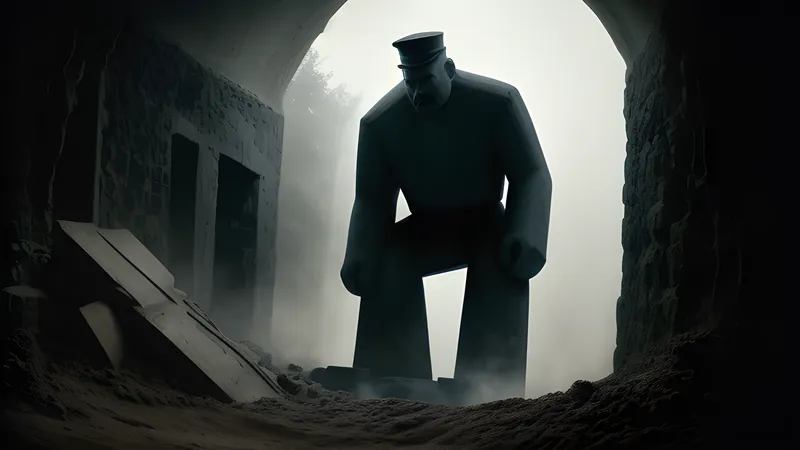
On 16 October 1869, two labourers digging a well behind William “Stub” Newell’s farmhouse in Cardiff, New York, struck stone at a depth of about three feet. They kept digging, thinking they had found a large flat rock worth clearing away, until a boot came free of the soil, attached to a foot, attached to ten feet and four and a half inches of grey-white figure lying on its back with its knees slightly bent, as if it had been dropped there rather than buried. Word reached the village within the hour. By that evening a tent had gone up over the pit, and Newell was charging fifty cents a head to look down into it. Within a week the fee was a dollar and the queue ran down the lane.
A farmer’s excuse for a stone man
The man behind the hole was not really Newell, though it was his land and his money on the fence around it. It was his cousin, a cigar manufacturer from Binghamton named George Hull, and Hull had not stumbled onto anything. A year earlier, in the summer of 1868, he had travelled to a gypsum quarry at Fort Dodge, Iowa, and bought a five-ton block of the blue-grey stone, telling the quarrymen it was destined for a monument to Abraham Lincoln. He shipped the block by rail to Chicago, where two marble cutters, Edward Burghardt and Henry Salle, spent months carving it into a naked recumbent man under oath of secrecy, working from a mould Hull had taken of his own body for proportion. The surface was scored with darning needles set in a board to fake pores, doused in sulphuric acid to age the stone, and the whole thing was crated and freighted east under the label “machinery” to avoid curious customs agents. In November 1868, under cover of night, Newell and Hull buried it behind the farmhouse and waited eleven months for it to be found by someone else, so that no suspicion would attach to the man who owned the spade.
Hull’s motive was not greed alone, though the money mattered enormously once it started arriving. It was an argument. He had spent an evening at a Methodist camp meeting in Ackley, Iowa, listening to a fundamentalist preacher named Mr Turk insist, from Genesis 6:4, that there really had been giants in the earth in those days — men of old, men of renown. Hull, an atheist by his own account, got into a heated dispute with Turk about biblical literalism that lasted long into the night and left him, he later said, wanting to make a fool of every man like Turk in the country. A stone giant, dug from the ground exactly where the Book of Genesis promised one should be, was his answer.
The quarrel this settled without settling anything
What makes the Cardiff Giant more interesting than an ordinary confidence trick is how precisely it was aimed. Mid-nineteenth-century America was arguing, loudly and everywhere, about the relationship between scripture and stone — Darwin’s On the Origin of Species was ten years old, geologists were unearthing enormous fossil skeletons that upended the young-earth chronology, and pulpit and lecture hall were fighting over the same rock strata. A discovery like the Giant did not need to prove anything scientifically; it only needed to exist in a moment when a large number of people badly wanted evidence for what they already believed, and a smaller number badly wanted evidence to needle them with.
It worked on both sides at once, and immediately. The Reverend Turk’s fellow travellers found in the Giant a literal answer to a literal reading. Meanwhile actual scientists, brought out to inspect it, were divided in ways that now look almost comic: the Yale palaeontologist Othniel Charles Marsh took one look and pronounced it “a most decided humbug,” pointing out fresh tool marks in the crevices, but a handful of others were cautiously willing to entertain a genuine petrified man, and the newspapers, delighted either way, printed both opinions with equal enthusiasm. Doubt did not slow the queue. If anything it lengthened it, because now there was something to argue about at the fairground rather than merely something to look at.
The journey from a farmyard to Barnum’s rival exhibit
Hull sold a three-quarter interest in the Giant to a syndicate of businessmen from Syracuse for $23,000, an enormous sum for 1869, and the Giant was hauled to that city for a grander exhibition, where the crowds only grew. It was here that the showman P. T. Barnum entered the story, in the manner that Barnum entered most good stories of his era: he offered $50,000 to lease it for three months and was refused, so he had his own sculptor carve a plaster copy and put that on display in New York instead, advertising it — with a straight face that has amused historians ever since — as the genuine Cardiff Giant, and dismissing the syndicate’s original as the fake. Two competing giants toured simultaneously, each denounced by its rival’s owners as a forgery, and audiences paid to see both and decide for themselves, which was really the whole business model laid bare: the argument was the attraction, and the artefact only its excuse.
The unravelling, when it came in December 1869, came from the quarrymen and stonecutters who had actually handled the thing and had no further reason to keep quiet once the money had moved on without them. Hull, facing exposure, gave a confession to the Chicago Tribune that laid out the Fort Dodge gypsum, the Chicago workshop, the acid bath and the burial, in enough mechanical detail that no honest defender of the Giant’s authenticity had anywhere left to stand.
The man who did most to force the confession was Othniel Charles Marsh, and his role is worth dwelling on, because it is a rare instance of the period’s science acting quickly and being proved right. Marsh, newly installed as America’s first professor of palaeontology at Yale, examined the Giant in Syracuse in November 1869 and wrote a short, withering report noting that the surface still bore glossy tool marks and that gypsum, being soluble, could not possibly have survived buried and wet in Onondaga clay for the millennia a genuine petrifaction would require. The state geologist of New York, John Boynton, had already reached a similar view, though he first guessed the figure was an old Jesuit statue rather than a recent fraud. The scholarly consensus that the thing was carved was in place within weeks; what it could not do was stop the public from paying, which is the detail that ought to trouble anyone who imagines that exposure and disbelief travel at the same speed.
Why the confession didn’t stop the ticket sales
What is genuinely strange about the Cardiff Giant is what happened after the hoax was proven: nothing slowed down. People kept paying to see it. Once it was openly a fake, being a famous fake became its own attraction, a piece of American theatre rather than a piece of American prehistory, and the crowds who came now came in on the joke rather than in spite of it. That shift — from believing the thing to enjoying having been fooled by it — is the part of this story that keeps recurring across a century and a half of American hoaxes, long after any given Genesis debate has cooled. A fake this good, revealed this publicly, becomes a kind of civic in-joke: everyone gets to have been briefly taken in together, and the shared embarrassment turns companionable rather than shameful, because an entire nation was fooled at once rather than any one person alone.
The Giant itself survives. It sits today in the Farmers’ Museum in Cooperstown, New York, not far from the Baseball Hall of Fame, where it is displayed with none of the original mystery and all of the original delight — a ten-foot stone man on his back, labelled honestly, still drawing visitors who want to stand over the same pit-shaped absence Newell’s well diggers found in 1869. Barnum’s rival plaster copy has its own afterlife too, on display for years at a museum in Michigan before ending up, fittingly, at yet another roadside attraction.
The hoaxer who could not stop
Hull was not finished. Nearly a decade later, in 1877, he tried the whole thing again — a second manufactured giant, this one dubbed the Solid Muldoon, planted near Beulah, Colorado, and “discovered” with the same theatrical care. It was a more sophisticated fake than the first, moulded from a mixture including ground bones, meat, clay and plaster rather than carved from gypsum, and for a while it drew crowds and even, briefly, the interest of Barnum, who is said to have offered to lease it. But the country had seen the trick before, a confederate talked, and the Solid Muldoon collapsed into exposure far faster than its predecessor. The second time, the audience was in on the structure from the start, and the magic that had sustained the Cardiff Giant for months lasted the Muldoon only weeks. A hoax, it turns out, is a thing you can perform convincingly only once; the second performance is merely a man repeating a trick everyone has already learnt to watch for.
The original Giant, meanwhile, had entered literature almost immediately. Mark Twain, delighted by the whole affair, published a short story in 1870 titled “A Ghost Story,” in which the restless spirit of the Cardiff Giant haunts a New York boarding house demanding a decent burial, only to be told, to its mortification, that it has been haunting the wrong exhibit — the ghost of a fake has attached itself to Barnum’s plaster copy of the fake. The joke is pure Twain and pure period: by 1870 the Giant was so thoroughly known to be false that its falseness had become the premise of comedy, a shared cultural fact the whole readership could be trusted to hold.
What the giant tells us about ourselves
The Cardiff Giant is often filed as an ancestor of crop circles, alien autopsy footage and every viral photograph that turns out to be staged, and the lineage is fair, but the more useful comparison is to the argument that produced it. Hull built a giant because he had sat through one evening of a dispute he could not win with words, and he understood something true about how disputes like that actually get settled in public: by whichever side manages to produce a more satisfying object. A carved gypsum man in a hole gave both a fundamentalist preacher and an atheist cigar maker exactly what each wanted to see, at the same time, for the price of a dollar at the fence. That is not really a story about credulous Victorians being easily fooled. It is a story about how badly people want a physical thing to point to when they are losing an argument about an idea, and how rarely anyone stops to ask who dug the hole.
Related reading on the desk: the Piltdown Man hoax, which used the same appetite for physical proof to fool the scientific establishment itself for forty years, and the Berners Street hoax, where the pleasure of watching a whole city fall for a stunt turned out to matter more than the stunt’s content ever did.
Related Content