The Bunny Man: A Virginia Bridge and a Century of Retelling
A hatchet-throwing man in a rabbit costume, two real police reports from 1970, and an asylum that never existed.
Contents
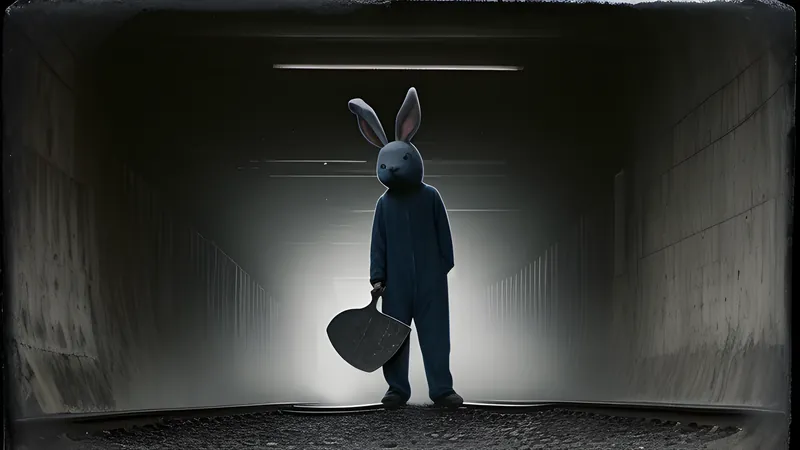
Colchester Road crosses a single-track railway a few miles south of Fairfax, Virginia, on a stone-and-steel overpass that Southern Railway built around 1906 to carry its line over the county road below. For most of the twentieth century it was just a trestle, unremarkable enough that the county never bothered to name it on a map. Teenagers now call it the Bunny Man Bridge, and on any October weekend a patrol car can usually be found parked at one end of it, there specifically to turn away the carloads of visitors who arrive after dark hoping to see a man in a rabbit costume standing in the tunnel with a hatchet. The story that draws them is decades old, and it splits cleanly into two halves: one half is sitting in a Fairfax County police file from October 1970, and the other half was invented, in pieces, by people who had never read that file at all.
What the file actually says
On the night of 19 October 1970, an Air Force Academy cadet named Robert Bennett was sitting in a parked car with his fiancée on a stretch of road near Guinea Road, not far from the Colchester overpass, when a man appeared at the driver’s side window. He was dressed in a white costume with what Bennett described as long rabbit-like ears, and he began shouting that the couple were trespassing on private property. Then he threw something through the car’s rear side window. It shattered, and inside the car the couple found a hatchet. Bennett reported the incident to Fairfax County police that night, and the report went into the county’s files as an assault with a deadly weapon by an unidentified subject in costume.
Three days later, on 22 October, a security guard named Paul Phillips was watching over a partially built house in the same neighbourhood when he saw a man in a bunny suit standing on the porch, chopping at one of the support posts with a hatchet. According to Phillips’s statement, the man told him, “All you people trespass around here, and if you don’t get out of here I’m going to bust you on top of the head.” The man then left on foot. Phillips, too, filed a police report, and for a few weeks afterward the local press ran short items about a costumed prowler with an axe menacing Fairfax County residents. No suspect was ever identified in either case, no one was charged, and after the autumn of 1970 the reports stop entirely. That is the entire documented record: two encounters, four days apart, in the same corner of the county, both filed with real names attached, and both unsolved.
The story nobody filed
What most people who visit the bridge actually believe happened is a different story, one with no paperwork behind it at all. In its most common form, sometime around 1904 a prison transport bus was carrying patients from an asylum for the criminally insane, being relocated after the facility was shut down, when it crashed near the overpass. The guards were killed in the crash, and most of the inmates were recaptured in the days that followed, but one was never found: a man remembered in some tellings as Marcus Wallster, or Douglas Grifon, depending on who is telling it. Farmers in the area began finding skinned rabbit carcasses, and eventually human bodies, hanging from the trestle in the months afterward, and the legend holds that the escaped inmate lived wild in the woods around the bridge for years, killing anyone who trespassed and stringing up rabbits as a kind of signature.
It is a good story, with a clean shape and a satisfying villain, and it is also, as far as anyone has ever been able to establish, completely fictional. There is no record in Fairfax County of a prison bus crash in 1904, no record of an asylum for the criminally insane being relocated through the area, and no contemporary newspaper account of rabbit carcasses appearing on the bridge before the 1970 police reports gave the location its name. The trestle itself was not even built until roughly 1906, two years after the crash is supposed to have happened. The asylum-bus story reads as a backstory grafted onto a bridge that had already become notorious for an unrelated reason, an explanation supplied long after the fact rather than an exaggeration of anything that happened around 1904.
Alice Ross and the paper trail
The person most responsible for untangling the two halves of the story was Alice Ross, a longtime local historian who worked with the Fairfax County Public Library’s Virginia Room and wrote a column on county history called Legends & Lore. In the 1980s, after the Bunny Man had become a fixture of local teenage folklore, Ross went looking for the historical record the asylum story claimed to rest on. She found the 1970 police reports, which were real and specific, complete with the names of the cadet and the security guard. She found no institutional record of any 1904 crash, no county asylum matching the description, and no newspaper coverage predating 1970 that mentioned a Bunny Man, a hanged rabbit, or a dangerous man living under the overpass. Her published research, later picked up by Washington-area newspapers whenever the story resurfaced around Halloween, is the closest thing the legend has to a debunking, and what it actually debunks is worth stating precisely. Her research leaves untouched the fact that something happened at that bridge in 1970; what it dismantles is the separate claim that the 1970 incident had seventy years of prior history behind it. The costumed man with the hatchet was real enough to end up in a police file. The 1904 backstory was invented afterward to explain him.
Why a bridge needed a bunny suit
Two teenagers get spooked by a man in a rabbit costume, and within a few years the county has a fully formed local monster with a name, a backstory, and a fixed address. That transformation is the more interesting story than either half of the file, and it follows a pattern folklorists recognise across hundreds of local legends: a real, unexplained, faintly absurd incident gets adopted by a community, and a community that adopts a scary story almost always wants to know why the monster is the way it is. A man throwing a hatchet while wearing a rabbit costume is frightening precisely because it is inexplicable. Explanations close that gap. An escaped mental patient with a grudge and a habit of skinning rabbits gives the absurd detail, the costume, a motive it never had in the original report, and it gives a specific, findable place, the bridge, an origin story that predates and outlasts the people who could actually remember 1970.
The bridge did real work here too. A trestle that runs underneath a road and swallows the headlights of any car that drives through it is exactly the kind of liminal, enclosed space that ghost stories gravitate towards, the same architecture of transition that shows up in stories about crossing bridges to reach a haunted stretch of road, as in the La Llorona legend’s rivers and crossings. Once the site had a name, Halloween pilgrimages did the rest, each carful of visitors arriving with an expectation and leaving with an embellishment, whether that meant claiming to have seen a shadow in the tunnel or simply repeating whichever version of the asylum story they had heard from an older cousin.
What the believer gets right
It would be easy to treat everyone who tells the asylum-bus version as simply misinformed, but that misses what the story is actually doing for them. Fairfax County in the 1970s was fast becoming the kind of anonymous, newly built suburb where a hatchet-wielding man in a rabbit suit could appear on a half-finished porch and then vanish into subdivisions that had not existed five years earlier. A legend that assigns the intruder a history, even an invented one, is a way of making an unsettling and genuinely unresolved local event feel bounded and explicable rather than random. The people telling the story around a bridge at night are not confused about the facts so much as they are doing what communities have always done with a frightening loose end: giving it a shape they can hold onto, the way the Hook Man gives a shape to more diffuse anxieties about parked cars and dark roads. The 1970 reports gave Fairfax County its Bunny Man. Everything that came after was the county deciding, collectively and without meaning to, what kind of story deserved to survive.
A bridge that still gets patrolled
More than fifty years after Robert Bennett filed his report, the overpass on Colchester Road is fenced, signed as private property along the adjoining tracks, and still visited often enough that county police maintain a routine presence there every autumn. Norfolk Southern, which now operates the line, has periodically asked the county to discourage trespassing on the tracks themselves, a considerably more mundane danger than anything in the legend. None of that paperwork mentions an escaped inmate. It mentions liability, trespassing, and a stretch of active rail line that a surprising number of people still want to stand on at midnight because of a story about a man in a bunny suit who was, as far as the record shows, real for about four days in October 1970, and has been getting more elaborate ever since.
How the legend learned to travel
The Bunny Man might have stayed a purely local story, the kind of thing older siblings used to frighten younger ones on the drive home, if it had not arrived at exactly the moment when American teenage folklore acquired new ways to move. Through the 1980s and 1990s the story circulated in the analogue manner such legends always had, passed mouth to mouth at high schools across northern Virginia, mutating a little with every telling. The location drifted, too. Some versions placed the killings at a different overpass entirely, and for years there was genuine confusion about which of the county’s several rail bridges was the true Bunny Man Bridge, a confusion that only sharpened the sense that the story belonged to a place older and vaguer than any single address.
Then the internet arrived, and a diffuse oral tradition froze into a canonical text. Early web pages devoted to haunted places gave the legend a fixed home at the Colchester Road overpass, a standard cast of characters, and a settled chronology beginning in 1904. The looseness that had let the story adapt to whoever was telling it hardened into something closer to scripture, repeated almost word for word across hundreds of sites because each new page copied the last. A 2001 academic paper by a University of Maryland student, Brian A. Conley, working with Fairfax County’s own historical records, laid out the documented 1970 incidents against the undocumented backstory in careful detail, and it is largely from that research, filtered through countless retellings, that the sceptical version now circulates alongside the scary one.
What the internet could not do was kill the story, because accuracy was never what kept it alive. If anything, the debunkings became part of the legend’s furniture, cited by the same visitors who then drive out to the bridge anyway, half-hoping the careful historians were wrong. The Bunny Man survives because he is useful: a name for the dark end of a tunnel, a reason to dare a friend to walk through it, a local monster in a landscape that keeps building subdivisions faster than it can grow its own ghosts. The 1970 file gave him a body for four October days. The century of retelling gave him everything else, and shows no sign of stopping.
Related Content