The Brown Lady of Raynham Hall: The Most Famous Ghost Photo
A magazine photographer aimed his camera down a Norfolk staircase in 1936 and came away with the image that still defines what a ghost is supposed to look like
Contents
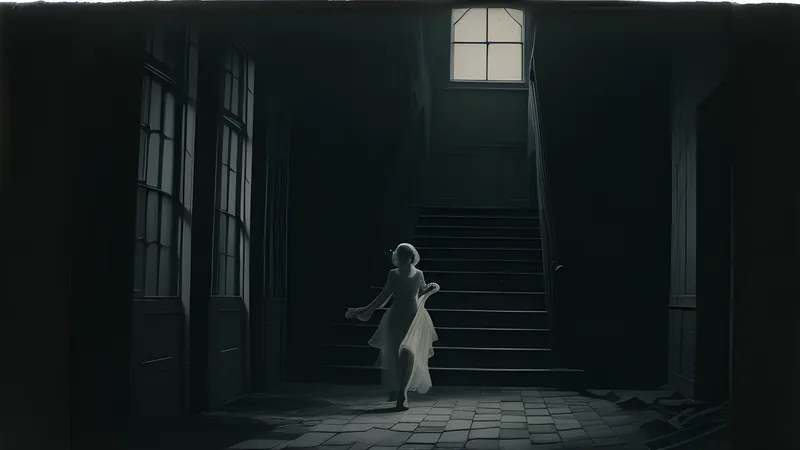
On 19 September 1936, a photographer named Captain Hubert Provand and his assistant, Indre Shira, were at Raynham Hall in Norfolk on a commission from Country Life magazine, photographing the great house’s interiors. They had set up on the oak staircase. Provand had his head under the focusing cloth, exposing a plate, when Shira called out that he could see a shape forming on the stairs — a filmy, veiled figure descending towards them. He told Provand to fire the shutter at once. Provand, who had seen nothing with his own eyes, did so, and when the plate was developed there it was: a translucent form in what reads as a bridal or hooded gown, gliding down the staircase of one of England’s older country houses.
Country Life published the photograph on 26 December 1936. Nearly ninety years on, it remains the single most reproduced, most argued-over ghost photograph in existence — the image that, more than any other, taught the modern world what a ghost is supposed to look like on film.
The house and the woman before the photograph
Raynham Hall did not need a photograph to be haunted. The seat of the Townshend family since the 1620s, it already carried a resident legend a full century before Provand set up his tripod: the Brown Lady, named for the brown brocade dress she was said to wear. Tradition identified her as Lady Dorothy Walpole (1686–1726), sister of Sir Robert Walpole, the man usually reckoned Britain’s first prime minister, and second wife of the second Viscount Townshend — “Turnip” Townshend, the agricultural improver.
The folklore attached to Dorothy is the kind that hardens around unhappy aristocratic marriages. One version holds that before her marriage she had been involved with Lord Wharton, a notorious rake, and that when Townshend came to believe his wife unfaithful — or simply tainted by that earlier connection — he confined her to her apartments at Raynham for the rest of her life. She died there, officially of smallpox in 1726, but, the legend insists, effectively a prisoner who never again left the house. Whether any of the confinement is historically true is genuinely unclear; the documented facts are a marriage, a death and a family that afterwards told stories about a brown-gowned woman on the stairs. That is the substrate the 1936 photograph landed on: a house already primed with a name, a dress and a grievance handed down through generations of Townshends and their guests.
The sightings that came first
The Brown Lady was a going concern throughout the nineteenth century, and two accounts in particular gave the later photograph its pedigree. Around 1835, a chronicler named Lucia C. Stone recorded that a guest at Raynham, a Colonel Loftus, saw the figure twice over the Christmas holidays. He described a woman in brown whose face, when he drew close enough to look, showed empty dark hollows where the eyes should have been. His account, told and retold at country-house dinners, fixed both the costume and the unsettling detail of the ruined face.
The more famous witness was the novelist and naval officer Captain Frederick Marryat, author of The Children of the New Forest. Marryat, a robust sceptic who reportedly asked to sleep in the haunted room precisely to expose the legend as nonsense, said he met the Brown Lady in a corridor one night, a lamp in her hand, and that she grinned at him in a way he found deliberately malicious. By the later telling of his daughter Florence, Marryat had a pistol on him and fired at the figure; the ball passed clean through her and lodged in a door behind. It is a marvellous detail, and like most marvellous ghost details it reaches us secondhand, through a daughter writing many years after her father’s death. But it did its work. By 1936 the Brown Lady was a specific, described, storied apparition with named upper-class witnesses, a costume and a face. The photograph corroborated an already-vivid figure; it had no need to invent her.
The age of spirit photography
To understand why the image landed as hard as it did, you have to place it at the tail end of a seventy-year industry. Spirit photography began in Boston in the early 1860s with William Mumler, who sold grieving clients portraits in which a translucent dead relative hovered at the sitter’s shoulder — “extras,” the trade called them, almost all produced by double exposure. The business boomed on the grief of the American Civil War and then the First World War, and it survived being repeatedly exposed as fraud, because the customers were not really buying evidence; they were buying reunion. In Britain the medium-photographer William Hope ran a thriving spirit-photo studio at Crewe until the researcher Harry Price caught him swapping plates in 1922. The very same years produced the Cottingley Fairies, whose paper cut-outs fooled even Sir Arthur Conan Doyle.
By 1936, in other words, the educated public had spent two generations learning both to crave and to distrust the ghostly photograph. That double conditioning is exactly why the Brown Lady image cut through. It came from a commercial firm shooting furniture for a respectable magazine — a source with nothing to gain from faking a ghost. It arrived pre-loaded with everything the public had been trained to look for, but with none of the usual marks of the con. The market had spent seventy years teaching people what a fake looked like, and this did not look like one.
The photograph itself, and the arguments about it
What makes the 1936 image so durable is that it is, by the standards of the genre, a genuinely good photograph of a ghost. The figure is centred on the staircase, semi-transparent, apparently in downward motion, with the veiled or hooded head that matches the folklore. Shira gave a signed statement swearing the exposure was honest, that both men had watched the plate develop, and that neither had tampered with it. Country Life, a serious title, stood behind its own commission. The photographers had, on the face of it, no obvious motive to defraud a routine interiors shoot.
Sceptical explanations have circulated ever since, and none has ever been proved to the exclusion of the others, which is precisely why the image survives. The most common is a double exposure: the figure being a faint prior image left on a reused or improperly advanced plate, or the ghostly form being the staircase itself bleeding through a second, misaligned frame. Others have suggested light leaking into the camera, or grease and moisture on the lens creating a diffuse vertical blur that the eye then organises into a human figure, or a skilful darkroom composite. Investigators who examined the case in later decades tended to favour some form of double exposure or camera fault, because a stray earlier exposure of a bright vertical object — a statue, a standing person, the banister itself — could plausibly produce exactly this shape and this transparency.
The honest position is that we cannot now interrogate the original plate under modern conditions, that both men are long dead, and that the technical explanations are plausible without being demonstrated. What is beyond argument is the effect: whatever produced it, the image looks precisely like what a culture steeped in spiritualism already expected a ghost to be.
Why This Image Broke Through
Almost every other spirit photograph from that seventy-year boom has been forgotten. The Brown Lady endures, and the reasons are worth naming. First, it arrived with a story already attached. A misty blob is only a misty blob; a misty blob descending the staircase of Raynham Hall, in the house of the Brown Lady, a century into her legend, is her. The photograph inherited a name, a costume, a class and a tragedy at no cost to itself. Second, its provenance was respectable in a way that spirit photographs almost never were — an assignment for an establishment magazine, published as a Christmas curiosity rather than sold as proof of survival, and that respectability functions as armour against the usual debunking. Third, the image is aesthetically restrained. There is no leering face, no ectoplasm, no beckoning crowd of the dead, only a single veiled downward-moving form, ambiguous enough that the eye keeps returning to resolve it and never quite manages. Ambiguity is the engine. A sharp photograph of a sharp ghost invites a sharp debunking; a soft grey shape invites you to keep looking.
What it’s really about
Strip the case to its mechanics and you have a great house that had told stories about a dead woman for two hundred years, a pair of photographers who caught a blur on a staircase, and a magazine that published it at Christmas, the traditional English season for a ghost story. The photograph works because every link in that chain was already in place before the shutter fired. Raynham had confinement and early death in its legend; the nineteenth century had supplied named witnesses; the twentieth century had a camera and a mass-circulation magazine to carry the result into every drawing room in Britain.
What people are really responding to when they look at the Brown Lady is continuity — the sense of a woman wronged in one century, seen in the next, and finally fixed on a glass plate in a third, as though the house had been patiently gathering evidence for its own sorrow. That is a deeply satisfying shape for a story to take, and it explains why sceptics have never dislodged the image and probably never will. You can demonstrate a double exposure. You cannot demonstrate away two hundred years of a family telling the same story about the same staircase, because the photograph was only ever the last and most photogenic witness in a very long line.
The Brown Lady is less a piece of evidence than a portrait of how a culture manufactures a ghost: an unhappy marriage, an early death, a name that survives in the family, a costume that survives in the telling, a face that curdles a little more with each retelling, and finally a technology arriving at exactly the right moment to give the accumulated story a body. Whatever Provand’s plate actually recorded, what it captured for certain was Raynham Hall looking at itself.
The image that taught us what a ghost looks like
The Brown Lady’s most lasting influence may be aesthetic rather than evidential. Before 1936, popular ideas of what a photographed ghost should look like were shaped by the crude “extras” of the séance trade — solid faces pasted at a sitter’s shoulder. The Raynham image offered something more sophisticated and, in the end, more persuasive: the translucent, veiled, downward-drifting form that has since become the visual shorthand for a ghost in film, television and a century of imitation photographs. When a modern horror film wants a staircase apparition, it is very often reaching, knowingly or not, for the grammar of the Brown Lady. That is a strange kind of afterlife for Dorothy Walpole, if it is her. A woman who may have been shut away and forgotten in her own lifetime became, two centuries later, the template for how an entire culture pictures its dead. Whatever the plate recorded, it fixed a look, and the look outlived every argument about the exposure. The photograph’s real subject, in the end, is less the presence on the stairs than our own enduring appetite to believe a camera can catch what the eye insists it saw.
For a case where a single disputed record became the anchor for a whole haunting, see Borley Rectory: England’s Most Haunted House and Its Faker, and for a modern British haunting that lived or died on the honesty of its recordings, The Enfield Poltergeist: A North London Haunting and a Girl’s Voice.
Related Content