The Bloop: The Sound That Wasn't a Monster
How a Cold War listening network recorded an iceberg and the internet heard Cthulhu
Contents
In the summer of 1997, sensors thousands of kilometres apart in the South Pacific picked up the same sound at the same time. It was extraordinarily loud, loud enough to register on hydrophones more than 5,000 kilometres from wherever it began. It lasted about a minute and rose sharply in pitch as it went, a rapid upward sweep that a human ear, if it could have slowed the recording down, might have called almost organic. Scientists at the American agency that recorded it gave it a working nickname that stuck: the Bloop.
For a sound with no confirmed source, the Bloop had everything a legend needs. It came from one of the emptiest patches of ocean on Earth. It was louder than any animal science could name. It rose and fell in a way that felt alive. And it had been captured by a listening system built for the Cold War, a detail that lent the whole thing a whisper of secrecy. Within a few years, a rectangle of spectrogram and a one-syllable nickname had become, in the folklore of the early internet, the recorded voice of a monster.
The ears in the deep
To understand the Bloop you have to understand what heard it, because the equipment is the least mysterious and most interesting part of the story. During the Cold War the United States Navy laid a network of underwater microphones across the ocean floor called SOSUS, the Sound Surveillance System, designed to track Soviet submarines by the sound of their propellers across whole ocean basins. Water carries low-frequency sound with astonishing efficiency, far better than air, and a deep-ocean channel can funnel it for thousands of kilometres. SOSUS could, in principle, hear a submarine on the other side of an ocean.
When the Cold War thawed, the National Oceanic and Atmospheric Administration’s Pacific Marine Environmental Laboratory gained access to some of this hardware for civilian science, chiefly to monitor undersea earthquakes and volcanic activity along the mid-ocean ridges. That is the crucial context. The hydrophones that recorded the Bloop were an oceanographic tool, run by seismologists, calibrated against thousands of hours of recordings of earthquakes, ship traffic, whale song, and the grinding of ice. The people who first heard the Bloop were among the most qualified on the planet to say what an ocean sound was, and they were honest enough to say, for a while, that they were not sure.
What was genuinely known
Here is the part of the story that is solid, sourced and worth conceding in full, because the temptation is to skip to the debunking and miss how real the mystery was. The Bloop was detected several times in the summer of 1997. Its source was triangulated to a remote point in the South Pacific, roughly 50 degrees south and 100 degrees west, off the far southern coast of Chile, in water far from shipping lanes and far from land. Its amplitude was genuinely remarkable: to be picked up clearly at such distances, the source had to be extremely powerful. And its acoustic signature, that quick rise in frequency, resembled the profile of a living thing more than it resembled a ship’s engine or an explosion, both of which have well-known and quite different shapes on a spectrogram.
That last point is the seed of everything. NOAA’s own scientists, chiefly the marine geophysicist Christopher Fox, noted early on that the sound’s variation in frequency was consistent, in general character, with a biological source, and that it did not match any recognised man-made noise. This was a careful, accurate statement about a spectrogram. It became, in the retelling, something else entirely: the claim that NOAA had declared the Bloop the call of an unknown animal. The agency had said the shape of the sound looked biological. The internet heard the agency say a monster was real.
The leap into the dark
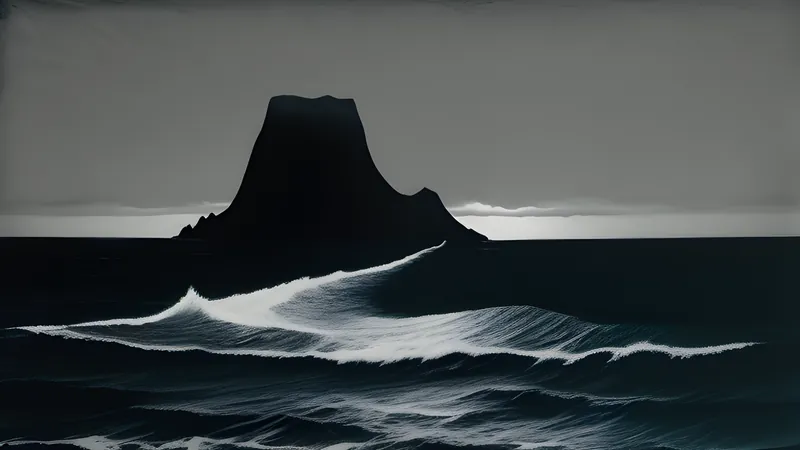
The fork in this story is a single number on a map. The Bloop was traced to a point in the South Pacific that lies within a few hundred kilometres of the fictional coordinates that the horror writer H.P. Lovecraft, in his 1928 story “The Call of Cthulhu,” gave for R’lyeh, the sunken city where a vast tentacled god-monster lies “dead but dreaming” beneath the waves. Lovecraft placed R’lyeh at 47 degrees south, 126 degrees west. The Bloop came from the same lonely quarter of the ocean. For a certain temperament, that coincidence was irresistible, and by the early 2000s the Bloop and Cthulhu were permanently welded together in the mythology of internet forums, creepypasta collections and late-night radio.
Set the fiction aside and a soberer version of the same leap remained popular: that the Bloop was the cry of a real but undiscovered sea creature, something larger than a blue whale, dwelling in the unmapped deep. This is where the documented record and the folklore part company. For the Bloop to be an animal, that animal would have to be vastly louder than any creature ever measured. A blue whale, the loudest confirmed animal on Earth, produces calls that are colossal by biological standards, and the Bloop was substantially louder still. An organism that outshouts a blue whale by that margin would have to be enormous, and an enormous unknown animal patrolling the South Pacific would leave other traces, carcasses, sightings, feeding signs. There were none. The sound was real. The creature required to explain it was not supported by anything else in the ocean.
Who carried the story, and why it travelled
The Bloop spread through exactly the channels that reward a good unexplained noise. It arrived at the turn of the millennium, when the internet was learning to circulate spooky media, and it had the perfect ingredients: an official-looking spectrogram, a government agency in the frame, a nickname a child could remember, and a link to a beloved monster. NOAA even released a sped-up audio clip so the public could hear the sound compressed into a few seconds, and that clip, detached from its scientific context, did more to build the legend than any theory. People shared the sound before they shared the explanation, because the sound was frightening and the explanation was technical.
This is the ordinary life cycle of a sound-based mystery. A phenomenon that arrives through the ear rather than the eye carries a particular kind of authority, because we trust our hearing to be direct and we struggle to reason about acoustics, as the residents of one American town discovered when a persistent low drone became the Taos Hum, an unexplained noise that some could hear and others could not. A sound that seems to come from nowhere feels like a message. And the deep ocean is the ideal stage for it, because almost everything about the deep is genuinely unknown, which means almost any claim about it is hard to disprove. The same darkness that let a real giant squid grow, over centuries, into the Kraken is the darkness the Bloop was dropped into.
The iceberg answer
The resolution came from the same laboratory that recorded the sound, and it arrived as a slow accumulation of evidence, one recording at a time. Through the early 2000s, NOAA’s hydrophone arrays recorded thousands more sounds from the ocean around Antarctica, and researchers led by Robert Dziak built up a library of the noises that ice makes: the groan of glaciers grinding on rock, the crack of icebergs splitting, the shudder of a berg scraping across the seabed. These “icequakes” or cryogenic signals turned out to share the Bloop’s key features precisely, including that distinctive rapid rise in frequency. By 2005 the working explanation was ice, and by around 2012 NOAA stated it plainly: the Bloop was the sound of a large iceberg cracking and fracturing as it broke up in the Southern Ocean, most likely near the Antarctic coast, the sound then carried thousands of kilometres north through the deep-ocean sound channel.
That is why the Bloop was so loud without being an animal. It was a geological event, the release of stress in a mass of ice the size of a small country, and ice on that scale can out-shout any living thing without difficulty. The sound was exactly as powerful and as real as the legend claimed. Its source was simply frozen water, and there was a great deal of it.
The Bloop had siblings
One detail rarely survives the retelling, and it deflates the legend more gently than any debunk: the Bloop was never alone. NOAA’s hydrophones picked up a whole family of unusual sounds in the late 1990s, and the scientists gave them all nicknames in the same offhand way, Julia, Slow Down, Train, Whistle, Upsweep. Each got a spectrogram and a working label while its origin was still open. Most were eventually traced to ice or to volcanic and tectonic activity along the sea floor: Slow Down and Train, like the Bloop, are now attributed to the movement and friction of Antarctic ice, while Upsweep was linked to an undersea volcano. Only the Bloop became a monster, and it did so for a reason that had nothing to do with the sound itself. It became a monster because someone noticed how close its coordinates fell to a line in a horror story. The other sounds were just as strange and just as loud, and no writer had left a map reference near them, so they stayed anonymous curiosities in a seismologist’s catalogue while the Bloop went on tour.
That contrast is the whole lesson in miniature. Its siblings shared its volume and its mystery; the ingredient that made the Bloop famous was a coincidence of geography with a piece of fiction, amplified by a nickname that begged to be spoken aloud. Legend is selective in exactly this way: of a dozen equally eligible mysteries, it adopts the one that already rhymes with a story we know.
What the monster was really about
Strip away Cthulhu and the giant squid and what the Bloop actually documents is a moment of honest scientific uncertainty that the culture around it could not tolerate. For a few years, careful people at a government laboratory had a loud sound and no confirmed source, and they said so. The gap between “we recorded something we can’t yet identify” and “there is a monster in the sea” is the gap the whole legend lived in, and it is a gap human beings rush to fill, because an unexplained thing feels like an unfinished story and we are built to finish stories.
The reach for a monster was a reasonable instinct pointed at an unreasonable target. The ocean genuinely is mostly unexplored; large creatures genuinely do turn up unannounced, as the long history of specimens washing ashore and being mistaken for sea serpents shows. A person who guessed “unknown animal” in 1997 was reasoning from a real and repeated pattern in the history of the sea. The reasoning was sound; the evidence, once it arrived, pointed at ice instead.
What lingers is the shape of the wanting. The Bloop offered a rare thing, a genuine mystery with an official stamp on it, recorded by real instruments in a real place, and for a few years no one could say what it was. That vacancy was intoxicating, and people filled it with the most magnificent thing they could imagine, a leviathan calling in the dark from the drowned city of a dead god. The truth, when it came, was an iceberg cracking apart in a cold sea where no one was watching. It is a smaller answer, and it explains the sound completely, and something in us still leans toward the god beneath the waves, because that is the sound we wanted the ocean to be making.
Related Content