The Black-Eyed Children: The Knock at the Door Folklore Built
A Texas reporter's late-night email in 1996, two children with all-black eyes asking to be let in, and a legend we watched form in real time
Contents
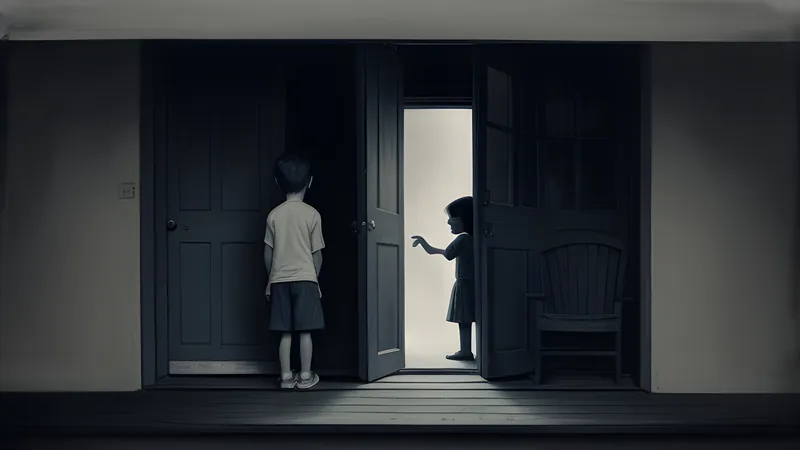
One night in 1996, a reporter in Abilene, Texas, named Brian Bethel stopped his car by a cinema to write a cheque, and two boys walked up to his window. They were, he guessed, somewhere between nine and twelve, and they wanted a lift — they needed to fetch some money to see the film, they said, or to get home to their mother, the pretext shifting slightly as Bethel remembered it. There was something wrong with the way they spoke, an odd, rehearsed insistence, a pressure to be let in that grew as he hesitated. And then he looked properly at their eyes and found them solid black: no iris, no white, no catch-light, just black from lid to lid. A wave of animal dread went through him. His hand was already moving to unlock the door, almost against his will, and he pulled it back, put the car in gear, and drove.
Bethel wrote that experience up and posted it to a paranormal email mailing list, and in doing so, without meaning to, he lit the fuse on one of the internet age’s most successful pieces of folklore. The black-eyed children — sometimes black-eyed kids, or BEKs — would spread from that message through forums, creepypasta sites, cable television and tabloid newspapers over the following two decades, gathering thousands of “me too” accounts along the way. It is one of the very few modern legends whose birth we can date almost to the night, and whose originator is a real, named, still-living person willing to talk about it. That combination makes the black-eyed children a rare gift: a chance to watch a myth assemble itself while the paint is still wet.
The email that started it
Brian Bethel is not an anonymous forum handle. He is a working journalist who spent years at the Abilene Reporter-News, and he has told and retold his 1996 encounter with a consistency and candour that put him at odds with the usual profile of a hoaxer. His account has stayed essentially stable for a quarter of a century; he has appeared on camera to describe it, most notably on the cable series Monsters and Mysteries in America; and he has been scrupulous about what he does and does not claim. He does not say he met demons. He does not offer a theory of what the children were. He says that something happened, that it frightened him more than anything before or since, and that he cannot fully explain the terror even to himself.
That posture is worth sitting with, because it is the opposite of the promoter’s certainty. Bethel presents a single, sincere, deeply unsettling experience and then declines to solve it, which is exactly how honest people describe the genuinely strange. It also happens to be the most fertile possible seed for a legend. A confident explanation would have closed the story; an ambiguous fright, told plainly by a credible narrator who withholds judgement, is an open door that thousands of readers walked straight through, each bringing their own late-night unease to fill the space Bethel left empty.
That sincerity is also what separates the black-eyed children from ordinary creepypasta. Most of the internet’s homemade monsters are openly fictional, written as fiction by authors who never pretended otherwise; the black-eyed children began with a working reporter insisting that something genuinely happened to him and declining to dress it up as anything grander than a fright he could not shake. The fiction accreted later, in the thousands of imitations, but the seed was a truth claim from a credible narrator. A story offered as real, by someone plausible who refuses to over-claim, travels on rails that a tale openly presented as invention never gets to ride, and it invites the reader to answer a different question — whether they believe him — rather than simply enjoy a scare.
An old rule wearing new clothes
The detail that gives the black-eyed children their peculiar grip is the one that sounds most modern and is in fact the oldest: they cannot simply take what they want. They knock, they linger, they ask — and, in almost every telling, they need you to invite them in. They press for permission to enter the car, the porch, the house, and the horror turns on the victim’s own hand reaching for the latch. This is a threshold rule, and it is among the deepest structures in the folklore of the uncanny. The vampire who cannot cross an uninvited doorway, the fairy who must be offered hospitality before it can work its mischief, the devil who requires a bargain freely struck: across centuries of European belief, the dangerous other is bound by consent, and the mortal’s peril is that they will grant it.
Bram Stoker fixed the rule most famously in Dracula in 1897, where the Count, for all his power, can enter a dwelling only once he has first been invited across the threshold, after which the welcome cannot be withdrawn — a literary crystallisation of a far older and widely recorded belief that the doorway is a protected boundary and that evil must be admitted before it can act. Folklorists have logged versions across Europe and beyond: fairies owed hospitality, spirits that must be asked in, the dangerous guest who is powerless at the gate and unstoppable once past it. The black-eyed children slot into that lineage precisely. Their whole menace is procedural — they cannot seize you; they must talk you into turning the handle — and the horror is the reader’s growing certainty that, under that strange insistent pressure, they might.
The black-eyed children inherited that rule wholesale and updated its furniture. The doorway became a car window; the traveller at the gate became a kid in a hoodie asking for a ride. The wrongness lives in the eyes, but the dread lives in the invitation — the sense that the threat cannot reach you unless you help it, and the sick suspicion that you are about to. Layered on top is a very modern anxiety about children themselves, the uncanny-valley horror of a child who behaves like something wearing a child, which the twentieth century had already rehearsed through changelings, sinister film infants and the long folk tradition of the not-quite-human young. Bethel’s story worked because every part of it was already loaded, waiting for a fresh trigger to pull.
How it travelled and mutated
From the 1996 mailing list, the legend followed the exact contours of the growing internet. It moved to web forums and ghost-story archives, then flourished in the creepypasta boom of the late 2000s, where anonymous authors could post first-person encounters that read like Bethel’s and be believed, shared and elaborated in turn. Each retelling firmed up the “rules”: the eyes are always fully black, the children always ask to be let in, refusing them is always the right move, and something bad — never quite specified — follows if you comply. This is folklore’s ordinary machinery of accretion, running at internet speed. A loose, singular experience hardened into a genre with conventions, and the conventions made new stories easy to produce.
Bethel himself gave the legend a second wind. In 2013 he wrote an anniversary retelling of the encounter for the Abilene Reporter-News, revisiting the 1996 night for a new audience, and the piece travelled far beyond Texas — reintroducing the story to a generation raised on creepypasta and handing them a named, verifiable originator to anchor it. A sincere first-person account from a working journalist behaves very differently online from an anonymous scary story: it gets treated as testimony, quoted as a source, and used to vouch for the hundreds of imitations around it. The 2013 retelling did exactly that, and the fresh wave of sightings and coverage that followed drew directly on its renewed authority.
The legend also crossed into old media and, tellingly, crossed the Atlantic. Around 2014 a flurry of British tabloid reports placed black-eyed children at Cannock Chase in Staffordshire, an area already thick with local folklore, complete with a paranormal researcher collecting fresh sightings. Whatever one makes of those accounts, they show the trope doing what durable legends do: detaching from its origin, finding a new landscape with its own ready superstitions, and putting down roots there. Low-budget horror films followed, as they always do, feeding the imagery back to audiences who then had the pictures ready the next time they were alone somewhere dark. The black-eyed children had become self-sustaining, no longer dependent on the man in Abilene at all.
What the knock is really about
The black-eyed children endure because they gather several real fears into one small, portable image. There is the primal wariness of the stranger at the threshold, older than any lock. There is the specifically modern dread that seeped into late-twentieth-century parenting — the stranger-danger decade, the milk-carton faces, the conviction that the world beyond the porch light is full of harm aimed at children and, sometimes, wearing their shape. And there is the quiet terror of the invitation rule, which puts the danger on the far side of your own free choice and whispers that you might, in a weak or hypnotised moment, open the door yourself. The legend hands all of that to you in the time it takes to describe a pair of eyes.
What makes it precious to a folklorist is the transparency of its making. We usually meet a legend already grown, its origins lost in generations of retelling, its first teller anonymous and long dead. Here the origin is a dated email, the first teller is a named reporter who will answer questions, and the spread is preserved in forum archives and broadcast tapes we can still read and watch. We can see the old threshold rule get bolted onto a 1996 car window, watch the “rules” crystallise post by post, and follow the trope to Staffordshire and into film. It is a legend caught in the act of becoming one.
That is why the black-eyed children belong on this desk beside the internet’s other homemade monsters, from Slender Man, born on a photo-manipulation forum, to the Fresno nightcrawlers, assembled from a single clip. Each shows a folklore forming in public, at speed, out of very old materials. And the oldest material of all is the one at the heart of Bethel’s story and of every haunted house before it, from the tapes of the Enfield poltergeist onward: the knock at the door in the dark, the pressure to open, and the whole weight of the tale resting on whether you do. The black-eyed children simply gave that ancient fear a fresh pair of eyes and let the internet do the rest. What we get to watch, uniquely, is the whole process in the open — a datable night, a named man, an archived email — a piece of folklore caught forming while we look on.
Related Content